


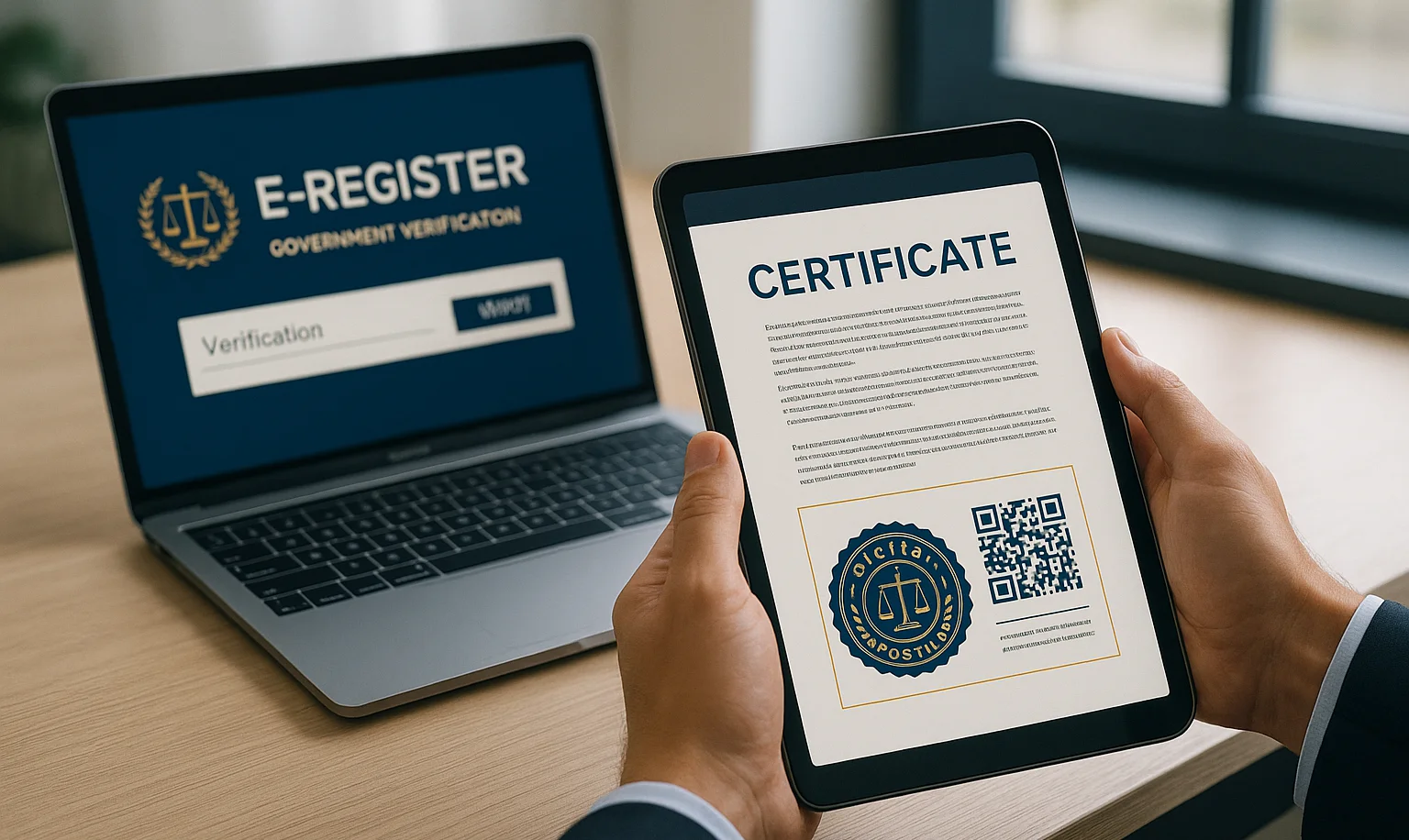
What Is an e-Apostille? Availability and Requirements in the USA
An e-Apostille is an official apostille issued and digitally signed by a designated competent authority. In the United States, availability depends on which authority is responsible for apostilling the document and whether it offers electronic issuance for that document type. This guide sets out how to check that availability and how to choose the route your paperwork takes.
What Is an e-Apostille?
An electronic apostille authenticates the signature on a public document, the capacity in which the signatory acted, and the identity of the seal or stamp, where applicable. It does not certify the document’s contents. In other words, it confirms the origin of the document, not whether the information it contains is true.
When asking what an e-Apostille is, it helps to distinguish three related terms:
- e-Apostille. The certificate itself, issued electronically and carrying the competent authority’s digital signature.
- e-Register. An online register for verifying an apostille, which an authority may maintain whether or not it issues e-Apostilles.
- Online application. A way of requesting an apostille. A request filed online can still produce a certificate on paper.
The e-Register and e-Apostille are separate components of the electronic Apostille Programme (e-APP) run by the Hague Conference on Private International Law, and a state can operate either one alone. A register also records apostilles issued on paper or digitally, so finding a certificate in one does not establish which form it took. An e-Register lets you check an apostille’s details, but it does not necessarily mean the issuing authority offers electronic certificates.
You should keep in mind two things. First, a scan is just a copy of a paper certificate. It is not an e-Apostille because it has not been issued and digitally signed by the competent authority.
Second, electronic issuance changes the format, not necessarily the processing time. The Convention’s ten numbered fields do not include a QR code, so a digital certificate does not guarantee instant turnaround or a scannable code.
e-Apostille vs. Paper Apostille: Practical Differences
Both formats authenticate public documents, but they differ in how you receive, store, and share the certificate:
| Feature | e-Apostille | Paper apostille |
| Certificate format | A signed electronic file, bound to the electronic document it certifies. | A printed certificate attached to the paper document by a staple, grommet or allonge. |
| Delivery and transmission | Sent by email or download, and forwarded abroad as a file. | Posted or couriered, with transit time in each direction. |
| Signature verification | The authority’s digital signature can be checked inside the file. | Verification may rely on a register entry or confirmation from the issuing office. |
| Storage and preservation | Held as a file, with copies carrying the same signature. | Held as a physical original that can deteriorate or be lost. |
| Physical handling | No original to surrender, so the file can be sent more than once. | The recipient usually keeps the original, so another recipient may require a separately issued certificate. |
Digital signatures are particularly relevant to verification. They let a recipient confirm which office issued the certificate and detect whether the file was altered after signing. This helps establish the certificate’s authenticity and integrity, although it does not make forgery impossible.
Which U.S. States Offer e-Apostilles?
Several U.S. states offer e-Apostilles, but eligibility and application requirements vary by state:
| State | Availability and document restrictions | Official source |
| Connecticut | Electronic issuance since 6 July 2026 for eligible documents, filed online. The certificate carries a secure electronic signature and is not valid if printed. e-Apostille and expedited orders are processed within 24 hours of receipt of a complete application. Birth, death, marriage, and adoption certificates require paper apostilles. | Connecticut Secretary of the State |
| Kentucky | Electronic issuance is available, with the certificate emailed to the applicant as a PDF. The submitted PDF must be electronically notarized by an authorized Kentucky online notary, certified by a county clerk, deputy county clerk, or a public university registrar. One document per request, and a separate request for each destination country. Vital records are excluded. | Kentucky Secretary of State |
| Utah | Electronic issuance and digital delivery since 9 July 2026. The state introduced online ordering in September 2026, allowing eligible applicants to submit requests online and receive digital apostilles when available. Birth and death records issued by the Utah Division of Vital Records and Statistics are excluded. | Utah Office of the Lieutenant Governor |
The table covers states whose published instructions confirm that they issue e-Apostilles; it is not a comprehensive list of all states that may offer the service. Some, like Montana, require a closer look. Montana is listed by the Hague Conference as implementing e-Apostilles, but its current published instructions do not clearly confirm that electronic issuance is available.
Minnesota, Rhode Island, and Washington previously ran e-Apostille pilot programs that ended on September 30, 2025. The official sources reviewed do not confirm that these states have resumed electronic issuance.
How to Apply for an e-Apostille in the USA
Applications go to the competent authority itself, since the United States has no single central portal for apostille requests. Choosing the correct route at the outset matters because an error can affect the subsequent stages of the process. Let’s take the stages in the order an application meets them.
Step 1: Identify the Correct Authority
The route follows the document rather than the applicant. What matters is which authority issued the record, or where the notarization took place, so a resident of one state may need to apply to another state’s authority if that is where the document was issued or notarized.
State records and notarized private papers go to the competent authority in the state concerned, usually the Secretary of State. Documents issued by federal agencies take a separate path.
An FBI background check is a federal record, and its certificate comes from the Office of Authentications at the U.S. Department of State. Those filings run through federal and FBI apostille services. Receiving the FBI report electronically does not change the authentication route.
Step 2: Prepare the Required Document Format
Preparation depends on the document type and the receiving authority’s requirements:
- Document status: does the authority require an official certified copy, or does the document in hand qualify as it stands?
- Preliminary steps: is notarization or another form of certification required first?
- Accepted format: will the authority accept an electronic original, a scan, or only the physical paper?
- Signature requirements: is the signature or certification the authority needs to verify present on the document?
Remote online notarization deserves a separate word. A document notarized remotely is not thereby eligible for electronic issuance, since eligibility is set by the authority and the document type. The state table above outlines those restrictions.
Step 3: Submit Through the Approved Application Process
Use the authority’s own application channel, listed on its official website. A complete submission specifies the destination country, identifies the applicant, includes the documents in the required format, and covers the applicable fee. Check the processing time and delivery method published for the route you have chosen, since both are set state by state.
Electronic issuance does not eliminate the need for physical delivery in every case. Where the process calls for the original document, it still has to reach the office.
How to Verify and Use an e-Apostille Abroad
Verification depends on the issuing authority and follows these steps:
- Open the official verification service that authority publishes.
- Enter the details it asks for, such as the certificate number and the date of issue.
- Verify the digital signature using the authority’s instructions, where applicable.
- Keep the original electronic file and forward it without converting it to another format.
A verification check and a status inquiry answer different questions. The first checks a certificate’s details against the authority’s records, while the second reports how far a pending request has progressed.
Printing is where an e-apostille service is most often undone. Do not print an e-Apostille unless you have checked the issuing authority’s instructions. Connecticut, for example, states that its e-Apostilles are not valid if printed.
Recognition abroad rests on the Convention rather than on the destination’s own technology. An e-Apostille issued under the Convention has the same legal status as a paper apostille and cannot be refused solely because it is electronic. A destination does not need to operate its own e-Apostille system to recognize an electronic apostille issued by another competent authority.
The underlying document is a separate matter. A receiving authority applies its own rules on translation, on how recently the record was issued, and on the documents it will accept, so recognition of the certificate falls short of approval of the application it supports.
Final Thoughts
The question “Can I get an apostille online?” covers two different things: whether a request can be filed online, which is widely possible, and whether the certificate will be electronic, which turns on the authority and the document.
Check the issuing office’s current requirements to confirm if your document qualifies for an e-Apostille or needs a paper certificate. You can also contact EZ Apostille for help identifying the correct route and managing the submission.
FAQ
Is there a time limit on an e-apostille?
No. The Convention sets no expiry date for an apostille in either format. However, the authority receiving the document may require the underlying record to have been issued within a specified period.
Can one electronic file serve two destinations?
Sometimes. A certificate names the country it was issued for, and Kentucky requires a separate request for each destination country. Before using the same e-Apostille for another destination, check the issuing authority’s requirements and confirm that the receiving authority will accept it.
What if the certificate shows the wrong details?
Go back to the issuing office with the certificate reference and the document it belongs to. Ask the authority how to correct the error or obtain a replacement.
Can I recover an e-apostille if I lose the original file?
If you lose your e-Apostille file, contact the issuing authority to ask whether it can provide another copy.
Can an issuing authority revoke an e-apostille?
If an e-Apostille was issued in error, contact the issuing authority to ask how the issue can be resolved.
Comments
Submit a Comment
Related Posts

U.S. Corporate Documents Needed to Open a Branch Abroad

Retiring in Spain from the U.S. and What It Takes to Make the Move

Hi! I have a M.A. degree from the University of Cincinnati (Ohio) and need to have it recognized in Greece. What is the due procedure? Can I submit a request online? Will I need to send my physical copy of the degree and wait until I receive it back. Finally, what is the cost of such a service?
Thank you very much in advance!
Thank you for your inquiry.
Please upload a copy of your M.A. degree through our online apostille webform (CLICK HERE). Submitting the form does not commit you to payment. We will first review your document to ensure that it is eligible for apostille processing.
Educational documents generally require notarization before they can be apostilled. During our review, we will determine:
Whether your document has already been properly notarized
Whether notarization is required
Whether we need the original document mailed to us or if we can work from a PDF copy
The appropriate next steps for processing
If you choose our Standard Service, the fees for an Ohio apostille are:
Apostille Service Fee: $175
Ohio State Fee: $5
Domestic Return Shipping: $35
The standard processing time is approximately 14 business days.
We also offer rush service options for Ohio documents. The available expedited service levels and pricing can be viewed on the webform.
Once the review is complete, we will contact you by email with the results and provide further instructions.
Best regards,
Apostille Service