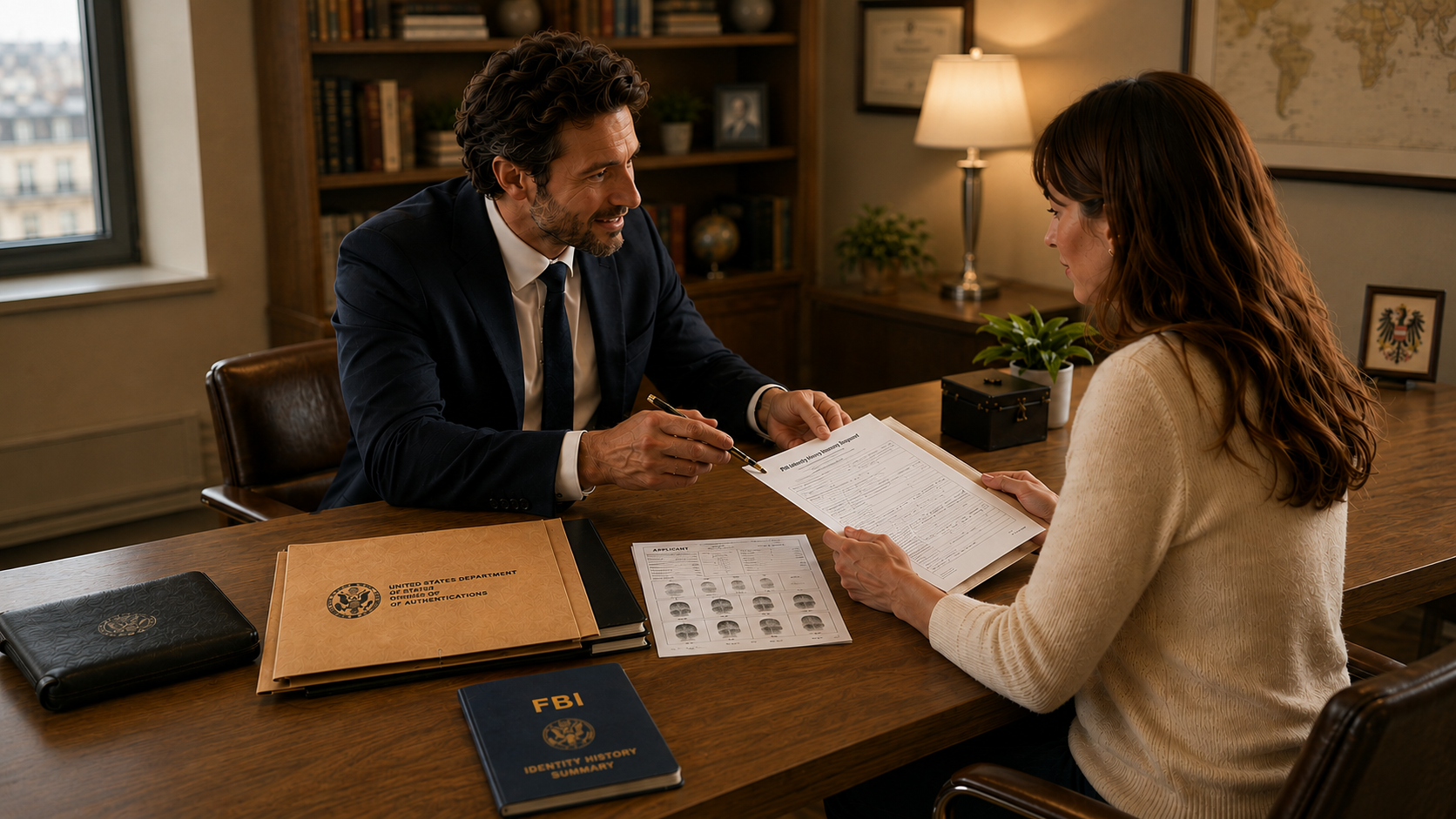
U.S. Documents for Dutch Residency: Apostille and Translation Guide
If you’ve found the perfect canal-side apartment in Amsterdam, don’t start decorating it yet. There’s a final paperwork chapter to secure residency before you can have your boxes sent across the pond. When you’re moving to the Netherlands from the U.S., foreign authorities don’t just take you at your word.
Instead, they ask for proof that your American documents are authentic for official use, from vital records to background checks. This comprehensive guide explains the typical Dutch residency documents and how to apostille and translate them in compliance with the IND and local municipality’s expectations.
U.S. Documents Required for Dutch Residency
To apply for a Netherlands residence permit, you’ll need to prepare a strict checklist of documents. Depending on the reason for your relocation, whether work, study, or family reunification, the exact items vary. That said, most applicants find themselves gathering the following civil, court, and federal records.
Civil Status Certificates
Vital documents that establish your identity, marital status, and family relationships are the backbone of your application. Regardless of visa categories, the Dutch government often builds your profile based on these documents:
- Birth certificate
- Marriage license
- Divorce certificate
- Death certificate (of a spouse or partner)
These must be issued by the relevant vital records office in the state where the event was recorded. For instance, if you were born in Texas and got married in Maryland, you’ll need to obtain a birth certificate from the Texas DSHS Vital Statistics and a marriage certificate from the Maryland Division of Vital Records.
Court and Federal Records
Depending on the procedure and your circumstances, Dutch authorities may also require additional documents to confirm your background and legal history in the U.S. This can come up in work, highly skilled migrant, or DAFT categories in the Netherlands, depending on the specific case. Examples of court and federal paperwork include:
- FBI Identity History Summary
- Court ruling and judgment
- Name change court order
- Affidavit of single status
- Guardianship and adoption decree
Local records often originate from probate or circuit courts, while federal agencies such as the FBI and federal court issue federal documents. For private papers that don’t contain an authorized public official’s signature and seal, notarization is required prior to apostille processing at the Secretary of State’s office.
Original and Certified Copy Standards
To obtain an apostille, only originals and certified copies qualify for processing. Submitting a scanned printout, photocopy, or uncertified version to state and federal authorities will result in immediate rejection. Check your document quality carefully in advance to avoid your submission being rendered unverifiable.
Apostille Routes in the United States
The Netherlands is a member of the Hague Apostille Convention, so it recognizes the apostille as a valid authentication for U.S.-issued documents. However, where you send your request depends on who issued the paperwork. Understanding these different routes is the first step to obtaining the right apostille for the Netherlands.
State-Issued Document Processing
Most personal records come from state-level authorities, including birth, marriage, divorce, and death certificates. These must be authenticated through the Secretary of State’s office or an equivalent authentication agency in the issuing state. Submission guidelines, processing times, and fees vary by state, and it’s important to check with the specific state authority before sending anything off.
Federal Document Processing
Records issued by a federal agency, typically the FBI background check, follow the federal authentication path. They should be routed to the U.S. Department of State in Washington, D.C. for processing. This is a common point of confusion, as applicants tend to submit them to the state where they live. In fact, you’ll need to submit federal documents to the State Department, not the local state office.
State-Specific County Certification Prerequisites
There’s a hidden hurdle that trips many applicants. Some states require additional county certification for documents issued by local registrars. This requirement, for example, applies to certain documents in New York before the Secretary of State’s office accepts your apostille submission. Knowing your state’s specific authentication chain is essential to avoid apostille rejection and costly delays.
Translation Rules for U.S. Documents
One surprising fact is that U.S. citizens applying for a Netherlands residence permit through the IND don’t need to have their documents translated into Dutch. The immigration service accepts paperwork originally issued in English as-is. That said, certain situations demand certified translations, so let’s explore them here.
English-Language Documents Accepted Without Translation
The Dutch government accepts documents issued in English, Dutch, French, or German — no translation is required if your document is in any of these languages. Hence, once your vital and federal records are apostilled, they’re recognized for use in the Netherlands without any additional Dutch certified translations.
Sworn Translation Standards for Exceptional Cases
Exceptions do exist in certain cases. If your documents contain any elements not in English or any acceptable language, such as handwritten notes or certifying stamps, you’ll often need to arrange a sworn translation. This also applies to circumstances where a municipality specifically orders a translation be attached. If the translation is done in the Netherlands, only a sworn translator registered with the Dutch court can produce it.
Document Preparation and Submission
Now that you’ve gathered your certificates, secured the apostilles, and sorted out the translation requirements, here comes the last step: submitting to Dutch authorities. While it’s straightforward, minor oversights might ruin weeks of effort. For a smooth Netherlands residence permit application, run through this checklist.
Validity Periods and Processing Times
Not all documents have an indefinite shelf life, even when an apostille is perfectly affixed. FBI background check freshness requirements can vary depending on the Dutch authority requesting the document, so check this in advance.
Additionally, apostille processing times at state offices range anywhere from a few days to a month, depending on the state’s workload. Federal authentication can take longer, with mail-in requests currently processed within 5 weeks of receipt. Thus, it’s necessary to time your request wisely to ensure the paperwork arrives fully valid.
Fees and Delivery Arrangements
Each state has its own cost structure and delivery methods. Most states charge around $5 to $20 per document for authentication, while federal apostille fees start at $20, excluding mailing costs. Submission and delivery options vary by state. Federal requests may be submitted by mail or, in qualifying circumstances, in person.
After processing, results are typically available for pickup or mailed to the provided address. The apostille will be physically attached to your document, verifying its authenticity for official use in the Netherlands. The package is now ready to travel with you to Amsterdam or The Hague for a residence permit.
IND and Municipality Submission Checks
Things may get a little nuanced here, as the IND and local municipality don’t have identical submission rules. The IND is generally more flexible about using English paperwork that’s accompanied by apostilles, whereas municipal BRP registration for a unique Citizen Service Number may in some cases require an additional Dutch translation. Thus, always confirm the specific requirements with your assigned municipality before the appointment to avoid missing a detail that can jeopardize your entire application.
Take the Stress Out of Dutch Document Preparation
Coordinating an apostille for the Netherlands shouldn’t feel like navigating a maze of government jargon. From document quality review to state or federal submission and certified translation, EZ Apostille can walk you through every stage with precision, reliability, and speed. Contact us today, and we’ll make sure the paperwork won’t hold you back from your Dutch adventure.
FAQ
Here are common answers about document preparation and apostille for a Netherlands residence permit for U.S. citizens.
Can a damaged apostille still be accepted?
No, a damaged apostille is generally unacceptable. If yours is torn, water-stained, or partially illegible, order a fresh copy and have it apostilled to ensure acceptance by the Dutch immigration authorities.
Are digitally issued U.S. certificates accepted?
Some states may accept digital copies and issue e-Apostilles. The Netherlands accepts foreign e-Apostilles, but you should still confirm that the document format meets the requesting authority’s requirements.
Will Dutch authorities return original documents?
It depends on the office and procedure. If originals are requested, confirm when and how they will be returned before submission.
Can a family member submit documents on the applicant’s behalf?
Yes, the IND accepts documents submitted by a family member with proper authorization. This is common when you have family in the Netherlands sponsoring you or authorized to be your legal representative.
Can name differences between U.S. documents affect acceptance?
Yes, name is a crucial piece of information that proves your identity, and a discrepancy may raise questions. If there’s a difference, additional documentation may be requested to resolve it, such as a name change order or a marriage license.
Does an apostille guarantee acceptance by Dutch authorities?
Not entirely. An apostille is only a starting point, along with other acceptance criteria. The IND and BRP offices have the final say on whether the document meets their validity timeframes, translation rules, formatting guidelines, and other substantive requirements.
Related Posts
FBI Background Check for Bulgarian Residency: What U.S. Applicants Need to Know

Getting Married Abroad: U.S. Documents Couples May Need