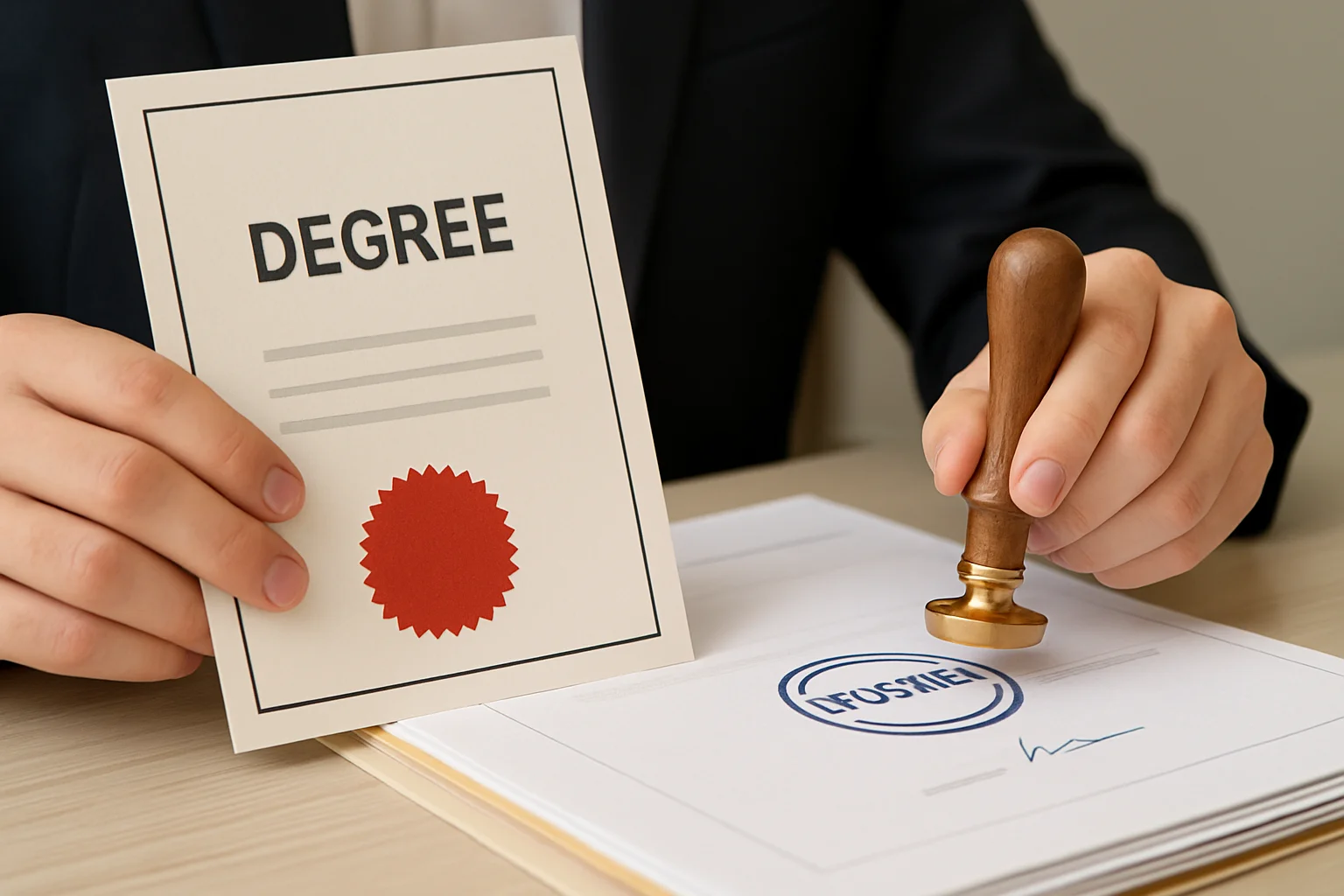
How to Apostille a U.S. Degree Certificate
If you’re heading abroad to work, study, or register in your profession with a degree from a U.S. college or university, the institution reviewing your application may ask for a degree certificate apostille. Below is a practical walkthrough of getting one, from document preparation and university certification to notarization requirements and state submission.
When Do You Need a Degree Certificate Apostille?
You need a degree apostille when the organization receiving your diploma requires formal authentication of the document. Requirements vary by country and institution, so the receiving authority’s instructions determine whether an apostille is necessary and what form of academic record it will accept.
The requested form of authentication depends on the destination. An apostille serves countries that are parties to the Hague Apostille Convention, while other destinations use degree legalization, a multi-step process that typically ends at the destination country’s embassy or consulate.
How to Get a Degree Certificate Apostille
Getting a diploma ready for use abroad involves several stages, from obtaining the correct academic record to completing the required authentication. The process of apostilling a degree follows a specific sequence, since each step builds on the documentation prepared earlier.
Step 1: Confirm the Receiving Institution’s Document Requirements
Start with the organization that will receive your documents to confirm its requirements before preparing the paperwork. Clarify the following points:
- Which educational document does it want: the diploma itself, transcripts, or both?
- Does it accept the original, or a particular type of certified copy?
- Does it require a translation, and who may prepare it?
- Does the document have to be issued within a set period, or submitted in a particular way?
Step 2: Obtain the Appropriate Document from Your University
Contact your university’s registrar’s office and request an original diploma, a duplicate, or an official certified copy, depending on the recipient’s requirements. If your original is lost, ask about a replacement.
Some registrar offices also prepare documents for apostille. Cornell University, for example, has an official authenticate the record, then arranges for that signature to be notarized in the same office.
An apostilled copy of a degree may be possible, though an ordinary photocopy is insufficient on its own because it does not establish the authenticity of the certification. A copy must first go through a certification procedure accepted by the relevant state authority. Two possible approaches include:
- University-certified copy. A university official certifies that the copy accurately reproduces an official academic record, and the official’s signature is notarized. The New York Department of State, for example, describes this procedure.
- Holder’s notarized statement. You sign a declaration concerning the copy before a notary. For instance, Texas accepts copies of school records accompanied by a “statement of ownership” signed by the student or a parent or guardian. Texas also accepts original school records when a school official provides a statement of issuance and signs it before notarization.
Step 3: Complete the Required Certification and Notarization
The state authority must be able to authenticate the signature on the document. Depending on the option selected in Step 2, this may be the university official’s signature or your own statement about the copy. The relevant signer must appear before a notary to complete the required act.
Check that the notarial certificate identifies the type of act performed and includes all required details. Texas, for example, requires the notary’s signature, seal, and date. The notary verifies the signer’s identity and completes the certificate but does not evaluate the academic record or qualifications.
Some states also require an additional certification of the notary’s signature before submitting the apostille. In New York, the County Clerk certifies the signature of the notary commissioned in that county before the document goes to the Department of State.
Step 4: Submit Your Degree Certificate to the Appropriate State Authority
The correct state authority for an apostille degree certificate depends on whose signature it must authenticate. In most cases, this is the Secretary of State in the state where the document was notarized or where the signing public official holds office. Your current address does not determine where the request should be submitted.
A complete request usually includes:
- the application form or cover sheet the office provides;
- the destination country;
- the required payment;
- the document itself;
- return delivery details, such as a prepaid shipping label.
Submission methods vary by state. Mail is common, while some offices also accept walk-in requests. Online submission is available where the relevant authority expressly permits it for this document type.
A representative can also submit the request on your behalf. California, for instance, accepts applications filed by another person. This option may be useful if you live abroad and cannot submit the documents in person.
Step 5: Check the Returned Document and Apostille
When your document is returned, review the complete set before submitting it to the recipient:
- Check that the apostille correctly identifies the official or notary whose signature or seal it authenticates.
- Make sure that all the pages and attachments you submitted have been returned.
- Check that the apostille remains attached to the document as issued by the competent authority.
Keep the apostille and the document together. Do not remove, separate, or alter the apostille or its attachments, as this may cause problems when the document is presented to the receiving authority.
Degree Certificate Apostille Costs and Processing Times
Both depend on the state and on the preparation your document needs, so plan each stage separately. Let’s start with the money, then the time.
Government Fees and Additional Expenses
State fees are charged per apostille or per document, and they differ from one state to the next:
- California: $20 per apostille, plus a $6 special handling fee for each different public official’s signature on in-person requests.
- New York: $10 per document at the Department of State, after County Clerk certification (Tompkins County, for example, charges $3 per document).
- Texas: $15 per apostille, with no separate handling fee on the state’s request form; school documents such as diploma copies need notarization first, so the notary’s charge is added to the total.
Additional expenses can include university charges for duplicates or certified copies, notarization, preliminary certification, service fees if you use an apostille provider, translation, and shipping in both directions.
Document Preparation, Processing, and Delivery Times
Your total timeline is the sum of several stages, and each is worth confirming with the office involved before you commit to a date:
- University preparation. This is often the longest step. Cornell’s registrar, for example, estimates 12 weeks for its part.
- Preliminary certification. If your document needs it, this step adds its own processing time.
- State processing. Timing depends on the office and method. New York offers same-day walk-in service at some locations, while drop-off requests in Albany and New York City are processed in the order received, not as priority requests.
- Delivery. Faster shipping shortens transit time, but it doesn’t move a request up the queue. California, for instance, processes mailed requests in the order they are received, even if you send them by overnight courier.
Final Thoughts
Your degree took years to earn, and the apostille is a small final step in putting it to use abroad. Most of what makes that step go well is decided early, when you learn what the receiving institution expects, and your university prepares the matching document. From there, notarization and state submission follow naturally, and if you’d like experienced support at any stage, EZ Apostille will help you.
FAQ
Do I Need Separate Apostilles for My Degree Certificate and Transcripts?
Usually, yes. Each separately issued document generally needs its own apostille, and states charge per apostille or per document.
Can I Use an Apostilled Degree Certificate in More Than One Country?
Yes. An apostille is generally recognized in any country where the Hague Apostille Convention is in force, not just the country named on the application. However, a recipient may keep the document you submit or require a separate original for each application, in which case you may need another apostilled copy.
Can a U.S. Embassy Apostille My Degree Certificate?
No. Apostilles for U.S. state documents come from the competent authority in the state concerned, usually the Secretary of State. If you live abroad, send the document to that office or use a representative.
Can I Get a U.S. Apostille for a Degree Issued Abroad?
No. The competent authority in the issuing country must authenticate the degree. A U.S. authority may be able to apostille a separate U.S. notarized document, such as a copy or translation, but that does not authenticate the foreign degree.
Does a Degree Certificate Apostille Expire?
The Convention sets no expiry date for an apostille. A recipient may still ask for a recently issued degree certificate or transcript, even if the apostille itself remains valid.
Related Posts

U.S. Corporate Documents Needed to Open a Branch Abroad

Retiring in Spain from the U.S. and What It Takes to Make the Move