


How Non-U.S. Citizens Can Get an FBI Background Check
Many assume that an FBI Identity History Summary Check is reserved only for citizens with an SSN or a government-issued ID. In fact, it isn’t strictly an American thing — anyone living in the U.S. can obtain a federal criminal report, regardless of citizenship. This article gives you all the essentials of getting an FBI background check for non-U.S. citizens, whether you’re holding a green card or an international student visa.
FBI Background Check Eligibility for Non-U.S. Citizens in the U.S.
An FBI background check for foreigners shares the same core principles as for U.S. citizens. In general, if you’re living in the country and willing to provide your fingerprints and a valid ID, requesting a rap sheet shouldn’t be an issue.
Permanent Residents
Holding a green card means you can order your own FBI report like an American citizen. It makes no difference whether the validity is 2 years or 10 years — lawful permanent residents are eligible to start the process with the FBI.
Visa Holders
Whether you’re on a work visa, including H1-B and L-1, or other non-immigrant status, you still qualify to submit a request. Your passport, along with a U.S. visa, may serve as acceptable proof of identity during the process.
International Students and Exchange Visitors
Students from foreign countries, as well as short-term exchange scholars, may apply for criminal background checks for transfers, internships, or post-graduation employment. A valid foreign passport and an I-20 are sufficient for identification.
Asylum Applicants, Refugees, and Other Non-Citizens
Other groups of residents, including asylees, refugees, and individuals holding a Temporary Protected status, may also request their federal records. Citizenship doesn’t matter in most cases, as officials will only ask for IDs and fingerprints.
Reasons Non-U.S. Citizens in the U.S. May Need an FBI Background Check
Beyond court proceedings, there are various cases in which an FBI report becomes necessary. From legal obligations to job applications, the most common life events that bring non-U.S. citizens into this process are listed below.
Immigration, Visa, or Foreign Government Requests
United States Citizenship and Immigration Services (USCIS), as well as foreign embassies and consulates, often require extensive criminal reports to verify your history in the U.S. They serve as supplemental materials for green card renewals, visa applications, or consular procedures.
Employment Screening
Certain employers, especially those in highly-regulated fields like education and healthcare, demand an FBI background check for employment to confirm a candidate’s criminal history. This requirement also applies to remote roles in the U.S. for international companies and non-profits.
Professional Licensing
If you’re a healthcare worker, a financial advisor, or a real estate agent, there’s a high chance that a rap sheet is required to meet state or federal licensures. By showing a clean record, you’ll be licensed more smoothly.
Education, Volunteering, or Personal Record Review
Graduate schools and volunteer organizations involving vulnerable populations frequently request FBI records to ensure safety and compliance. Sometimes, people also request their FBI Identity History Summary simply to review their own criminal history record and confirm that the information is accurate.
FBI Background Check Request Methods Available in the U.S.
Several different request methods allow non-citizens living in the U.S. to obtain their own criminal records. Some are universal but slow, while others return results faster and directly to the requesting institution. Here’s what to expect:
Direct FBI Submission
Submitting a request through the FBI’s official portal is the quickest way. Simply complete the online request form, pay the fee electronically, and provide a Live Scan or fingerprint card. Your rap sheet will be delivered digitally once it has been processed.
Paper Application by Mail
If you don’t have access to the online system, the good news is the FBI still accepts the traditional paper application. Enclose the signed form, your fingerprint card, and adequate payment. Expect a longer processing time due to postal delays.
FBI-Approved Channeler Limitations
Channelers are private agencies authorized to collect and forward data for faster processing. The catch is that their services are available only to citizens and permanent residents for personal review or authorized purposes. So, unless specifically instructed, foreign nationals should submit requests directly to the FBI.
NMLS or Fieldprint-Based Licensing Requests
For state licensing purposes, applicants may request the Nationwide Multistate Licensing System (NMLS) Criminal Background Check and use Live Scans or fingerprint cards provided by Fieldprint. The results will be transmitted to the specific licensing board — not to you.
Documents and Information Needed Before Applying
Before requesting an FBI background check for visa requirements or for any other purpose, gather the right documents, typically:
- A valid passport or government-issued ID
- Current U.S. address and contact information
- Payment of $18 for direct FBI submissions
- Your A-Number, visa, or immigration documentation, if applicable
Having these items ready helps you submit correctly and avoid unnecessary delays.
Fingerprint Requirements for Non-U.S. Citizens in the U.S.
Fingerprints must meet federal standards before they can be processed. Without a valid, readable set of impressions, an FBI background check for non-U.S. citizens might stall, disrupting visa schedules or employment start dates.
FBI-Accepted Fingerprint Card
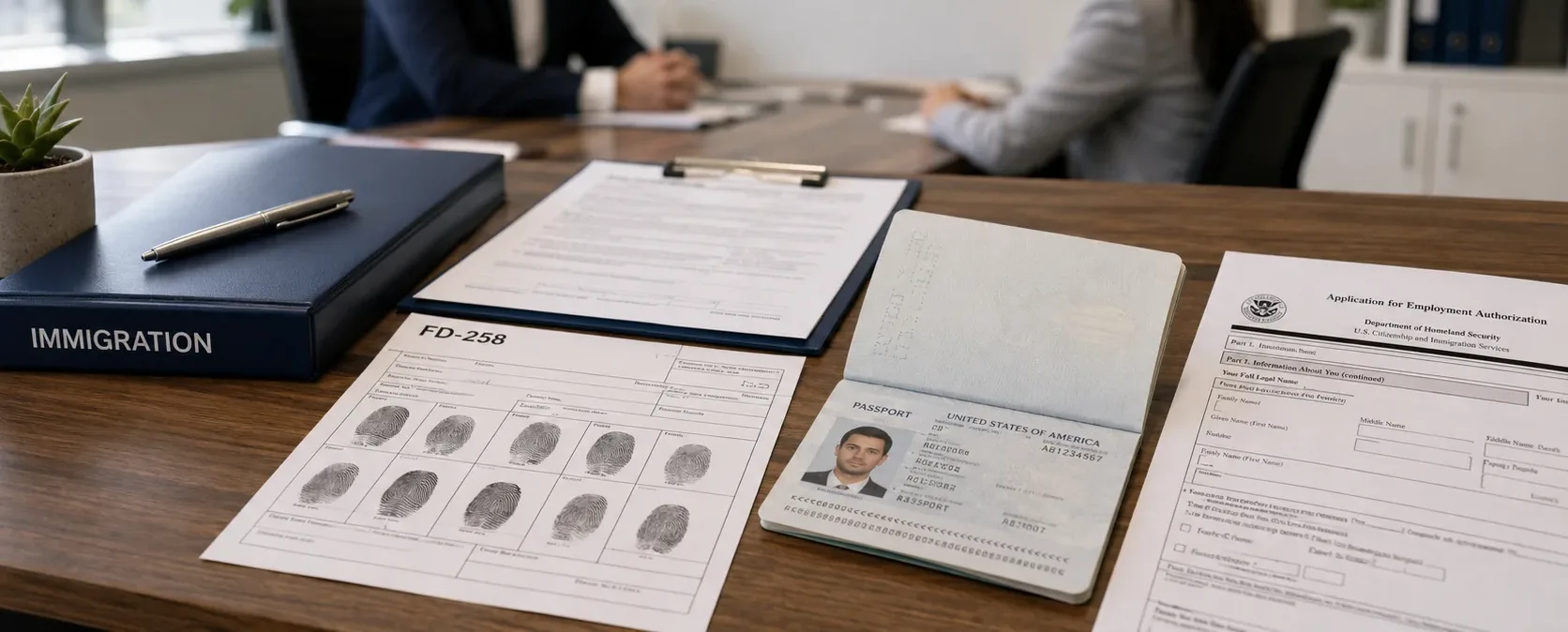
You must submit an FD-1164 or FD-258 fingerprint card with your complete personal details and ten prints. Make sure you use the official version from the FBI website and that all fields are filled out properly.
Ink or Electronic Fingerprint Capture
You have two options: the traditional ink-and-roll and the digital Live Scan. Electronic prints taken at participating post office locations are preferred. Note that if you’re currently outside the U.S., you’ll have to mail a physical fingerprint card.
Fingerprint Quality Standards
Federal officials expect clear ridge details and proper finger placement. If prints are too light, smeared, or cut off at the edges, be prepared to retake or resubmit them, since the FBI requires full impressions to run an accurate search.
Rejected Fingerprint Prevention
Keep your fingers moisturized in advance, but don’t overuse lotion. Technicians know how to capture prints with the right pressure and positioning, yet remember to double-check the quality and other personal details before you leave.
Step-by-Step FBI Background Check Process
The process of requesting an FBI background check for non-U.S. citizens is straightforward if you know the sequence of steps to take. Whether you need the report for immigration or work, follow these steps to facilitate processing:
Step 1 — Confirm the Request Purpose
Ask yourself why you need the rap sheet, since different purposes might require a specific submission method, additional materials, or an apostille later.
Step 2 — Select the Correct Submission Method
Choose between the FBI online portal, a mail-in application, or, in certain cases, a licensing system. The fastest method for both citizens and non-citizens is always direct FBI submission.
Step 3 — Complete the Identity History Summary Request
Complete the online application form with your accurate information. Remember to include your full legal name exactly as it appears on your photo ID. A discrepancy can derail the entire search.
Step 4 — Get Fingerprinted
Drop by a fingerprinting service, preferably a participating U.S. post office or a local police department, to complete the fingerprinting process. Bring your valid ID and verify the prints are legible and properly rolled on the spot.
Step 5 — Submit Fingerprints and Payment
Electronic prints at participating locations will be automatically forwarded to the FBI. Otherwise, you may mail the physical card to the Criminal Justice Information Services (CJIS) Division in West Virginia. Pay the required fee online at the time of submitting your application.
Step 6 — Track the Request Status
You’ll receive an email confirmation after sending an online request. Paper submissions by mail are harder to track, and you usually need to contact the Division by phone for inquiries.
Step 7 — Receive the FBI Background Check Results
Once processed, you’ll receive the results electronically or by mail, depending on your submission method. Check the report for errors and make copies for your personal filing if necessary. Finally, forward it to the requesting institution.
Processing Time and Result Delivery
Online requests often return results within 48 hours of providing electronic fingerprints at a participating post office. If you submit the request online but mail a physical fingerprint card, results may take around 15 days after the FBI receives it. Full mail-in requests usually take longer, and applicants should also allow extra time for postal delivery. Results will be delivered either electronically or by mail based on your submission method.
Need an Apostille for Your FBI Background Check?
More than a clean record, an FBI background check apostille is usually the final authentication before your document can be accepted by authorities overseas. Our team at EZ Apostille is here to handle that requirement promptly and accurately. Get in touch today for personalized consultations!
FAQ
Here are some quick answers about FBI background checks for non-U.S. citizens.
Does an FBI background check show immigration status?
No, it doesn’t display your immigration status. The report strictly contains criminal arrest and conviction data drawn from national databases.
Will the FBI background check include arrests without convictions?
Potentially, yes. Arrests may be reported even if no charges or convictions were found. The only situation where arrests without convictions don’t appear is when the record has been expunged or sealed.
Is an ITIN acceptable instead of a Social Security number?
Yes, you may use an ITIN or leave the field blank, and this won’t affect processing.
Does the name on the ID have to match the application exactly?
Absolutely! Your name must be consistent across documents. Differences between your ID, application, and fingerprint card may cause substantial delays.
Can a non-U.S. citizen request a background check without a U.S. driver’s license?
Of course. You don’t need a driver’s license — a valid passport or government-issued ID is enough.
Does the FBI background check expire?
There’s no expiration date on the report, but agencies often require reports issued within the last 3 or 6 months.
Can errors on an FBI background check be corrected?
Yes, you can submit a formal challenge to the FBI, along with supporting documentation, for correction. Note that amending information may take up to 45 days.
Comments
Submit a Comment
Related Posts
FBI Background Check for Bulgarian Residency: What U.S. Applicants Need to Know

Getting Married Abroad: U.S. Documents Couples May Need

Good morning,
I’m an Italian citizen, with non-immigrant Visa L1-b, and I live in the USA from August 2024.
I need to do the work Brazilian Visa but for the reason I live more than 12 months in the USA, they required the FBI Background Check, with apostille, translate in Portuguese.
I would like to know step by step how and in what part you can you help me to get this document, and time line.
Because I need it as soon as possible.
Thanks in advance, for your availability in answer.
Christian Pellino
Hello Christian,
Thank you for your inquiry. We can assist you with the Apostille service and translation services and shipping back your documents to your mailing address. The processing time to complete the apostille for a federal document such as an FBI background check will be 1-2 business weeks.
After the apostille is completed, translation services will follow with can take another 3-4 business days.
To obtain an official FBI report or background check, you must submit your request directly through the FBI or an FBI-approved channeler. Submitting your request directly through the FBI will take about 12-14 weeks. An FBI-approved channeler will email you a PDF of your FBI report within 24 to 48 hours.
You can see the official list of approved channelers here.
Directions on how to submit a request to the FBI directly can be found here.
Once you have ordered your report, you can send us your apostille request by filling out an Apostille Job Request. Once we receive your request, we will email you your confirmation and quote.
Regards,
Allan Capistrano