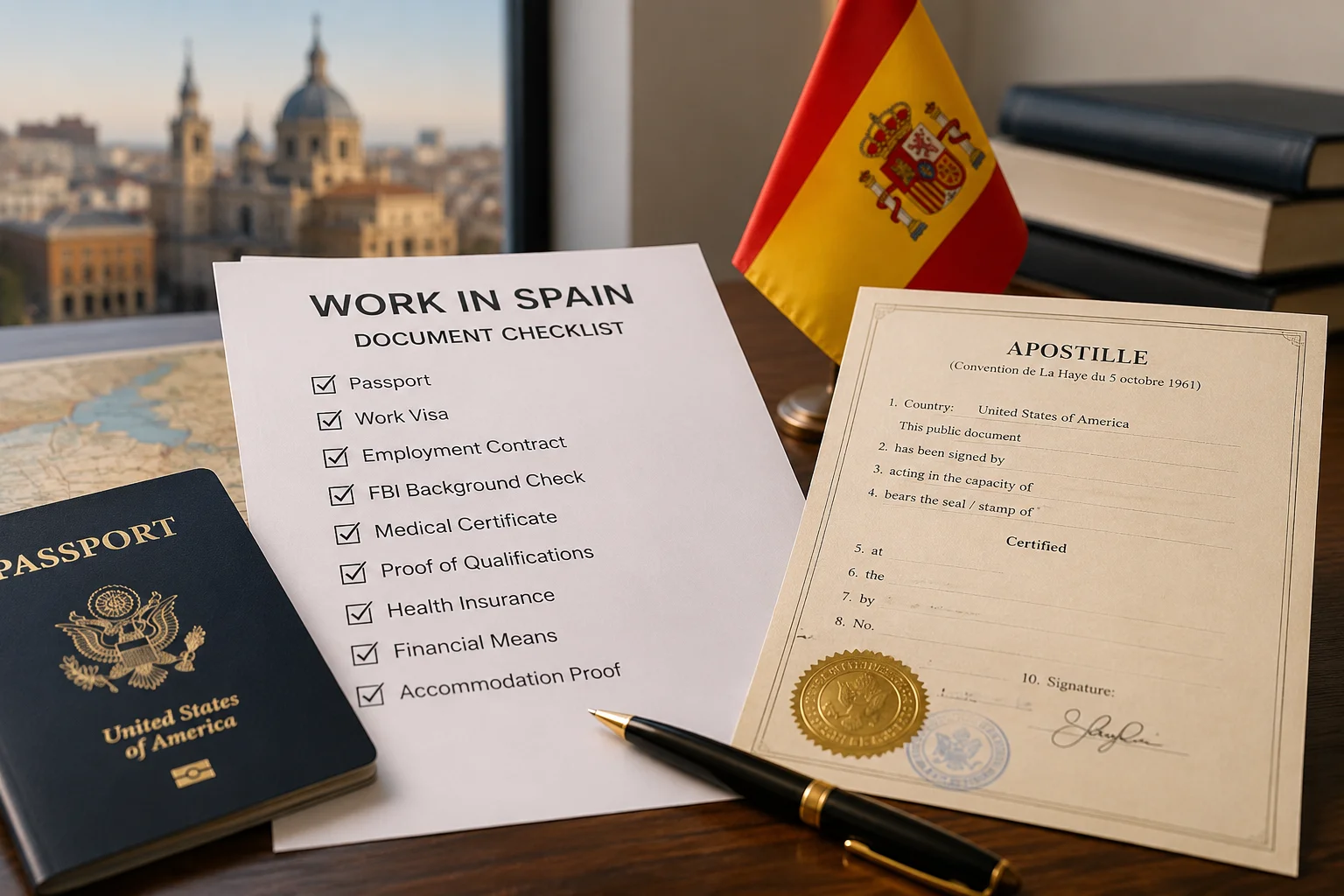
Working in Spain: Document Checklist, Apostilles, and Local Acceptance Rules
Your dream career in Madrid or Barcelona isn’t far-fetched anymore, but there’s a bit of paperwork to tackle before departure. To work in Spain, U.S. citizens often have to present a set of documents along with international authentication for acceptance abroad. Today’s post provides all the essentials of the apostille for Spain, so you know which records qualify and what the process looks like.
How to Work in Spain as a U.S. Citizen
If you’ve wondered, “Can Americans work in Spain?” the answer is yes, but only after meeting requirements. In other words, you must follow a precise procedure to secure the paperwork, and it isn’t as simple as booking a one-way flight to Spain.
Work Visa Requirement Before Employment
Foreign nationals must obtain a valid visa to work in Spain prior to starting a job or performing any paid work. Working on a tourist visa exposes you to penalties and deportation risks. It’s crucial to attain authorization from the Spanish government.
Employer Sponsorship and Spanish Authorization
Visa approval depends on sponsorship from a Spanish employer. The hiring company must initiate the work permit process with the Provincial Labor Department and, if required, prove that no local candidate can fill the position. You may only apply for a visa after the employer receives official authorization.
Consulate Review Before Travel
You’ll submit a visa application to the Spanish embassy or consulate in the U.S. with the approved work authorization and properly apostilled U.S. documents. Immigration officers then review it and stamp the visa into your passport.
Documents Needed to Work in Spain as a U.S. Citizen
Now, let’s move on to the actual paperwork often required to live and work in Spain. Below is a checklist of the most typical items for a Spanish visa application, though not every one of them may apply, depending on your job type.
- Valid U.S. passport
- Spain work visa application form
- Employment contract or work authorization approval
- FBI background check
- Medical certificate
- Proof of qualifications or professional credentials
- Health insurance or Social Security coverage evidence, if required
- Proof of financial means or employer support, if required
- Accommodation proof
- Family records for dependents, if applicable
Preparing these documents early helps you prevent last-minute complications, especially if the contract has a starting date. More importantly, some papers need an apostille before Spain can accept them, which we’ll discuss in the next section.
U.S. Documents That Usually Need an Apostille for Spain
Visa agents rely on the apostille to confirm the origins of your U.S. documents for official use. This makes it important to pursue the apostille process for Spanish visa approval, and here are the categories that nearly always require authentication.
FBI Background Check for Visa Review
Spain mandates that you present proof of a clean criminal history in the U.S. to work there. An FBI Identity History Summary is the gold standard, and you may order it via the FBI official portal before requesting a federal apostille for Spain.
Civil Records for Dependents or Family Status
Birth certificates, marriage licenses, divorce decrees, and child custody orders are critical documents that demonstrate marital status and family relationships. Civil records must be certified by a competent agency and apostilled at the state level.
Educational and Professional Credentials
Authorities often require university diplomas, transcripts, or professional licenses to verify your qualifications for employment. To be eligible for a state apostille, they should feature an institution registrar’s signature and notarization.
Medical Certificate for Long-Stay Visa Review
A Medical Certificate of Good Health confirming that you’re free from illness that could affect the local population is non-negotiable. It must come from a registered physician, properly notarized and apostilled, to be accepted at the consular office.
How to Apostille Documents for Working in Spain
You might be aware by now that the apostille process isn’t one-size-fits-all for your records. So, how do we ensure Spain will accept them for official use? Follow this streamlined roadmap to apostille documents correctly for Spain.
Document Issuing Authority Check
Where your documents come from tells you exactly where to submit an authentication request. Confirm whether a county office, state authority, or federal agency issued them.
Certified Copy or Original Record Preparation
Authentication offices don’t take basic photocopies or unofficial versions. They must be either certified public records or notarized private documents with original signatures to qualify for apostilles and visa purposes.
Federal Apostille for FBI Background Checks
For those issued by a federal entity, such as FBI background checks, submit to the U.S. Department of State in D.C. for federal authentication.
State Apostille for Vital, Court, and Academic Records
Local documents, including vital records, court-issued papers, and academic credentials, fall into the jurisdiction of the Secretary of State’s office or a similar designated agency in the issuing state.
Sworn Spanish Translation After Apostille
Finally, have the apostilled paperwork translated into Spanish by a sworn translator (traductor jurado) who is registered with the Spanish Ministry of Foreign Affairs. Translations conducted by an unrecognized linguist won’t pass consular review.
Spain Visa Acceptance Rules for Apostilled U.S. Documents
When organizing apostilled documents for Spain, it’s also important to understand how officials evaluate them. Specifically, they follow a few key rules to decide whether they accept or reject the documents you’ve submitted.
Correct Apostille Attached to the Correct Record
Each document must come with an individual apostille. You can’t request one apostille for a stack of papers. Attaching the wrong apostille to a record? That’s a guaranteed rejection from the embassy or consulate.
Original, Certified Copy, and Notarized Copy Limits
Keep in mind that Spain only considers three types valid: originals, certified copies issued by the record-keeper, and notarized private papers. Other versions that don’t bear an official signature or stamp will be denied.
Matching Names, Dates, and Personal Details
Information such as names, dates, and places must be consistent across all documents in your submission. Discrepancies, even a minor typo or abbreviation, can prompt questions or requests for supplementary materials.
Consulate-Specific Review Standards
Consulate expectations vary — for example, the LA and Boston offices may have different standards. Always consult the specific instructions from the consulate where you’re applying to ensure you meet their exact documentation requirements.
Validity Periods for Time-Sensitive Records
Most criminal background checks and medical certificates expire really quickly, often within 3 to 6 months. Submitting an expired or nearly expired document, even with a flawless apostille, will lead to resubmission and delay.
Common Mistakes with Apostilled Documents for Spain
Many applicants, even the most well-prepared, may face visa rejection due to common paperwork errors. Before gathering your records, take a glance at the six most frequent mistakes in the apostille process for Spain.
Apostilling the Wrong Document Version
Submitting an uncertified copy disqualifies your request. Additionally, using an insufficient format, such as a short-form birth certificate instead of a comprehensive one, will result in rejection for immigration purposes.
Using the Wrong Apostille Authority
The rule of thumb is that local state records go to the Secretary of State’s office, while the Department of State handles federal documents. Submission to your state of residence rather than the document’s issuing state is also a common misstep.
Translating Before Apostille Completion
Spain requires translations by sworn translators after the apostille. Missing this specific requirement and having the document translated before apostille processing will definitely lead you to start from scratch.
Submitting Non-Sworn Translations
Using a casual machine translation or a bilingual friend for translations will be deemed unfit. Only professional sworn translators accredited by the Spanish Ministry of Foreign Affairs are allowed to take this task.
Detaching the Apostille from the Document
An apostille must be permanently attached to the document it verifies. Removing the certification will automatically break its validity, so keep everything bound together when forwarding the final package to the end recipient.
Preparing Expiring Documents Too Early
Medical certificates and background checks have a limited validity window. Obtain these reports too early, and they may expire even before you can schedule a consular appointment. Plan on ordering them in time, not prematurely.
Ready to Work in Spain Without Document Delays?
We hope this article has clarified how to work in Spain as a U.S. citizen — and shown that the process doesn’t have to feel like a second job for you. Besides understanding the standard document checklist and authentication rules, being aware of constant challenges also saves you time and effort. If you prefer a professional touch, contact our team at EZ Apostille today — we provide steadfast apostille services for Spain.
FAQ
Here are the most common concerns about working in Spain from our clients.
Can a U.S. citizen start the Spanish work visa process without the apostille already completed?
To a certain point. You can gather documents and fill out forms, but the consular office won’t process your visa without authenticated documents.
Is one apostille enough for both the U.S. document and its Spanish translation?
Yes, one apostille is enough. Note that Spain requires the apostille to be completed before translation, so it certifies the original U.S. document only.
Can an apostilled U.S. document be reused for a future Spain application?
Sometimes, yes. It can be reused if the underlying document remains valid and the requesting authority doesn’t require a recently issued one.
Does Spain accept apostilles issued several months before the visa appointment?
In general, yes. Apostilles don’t expire, but they don’t work if the record they validate becomes outdated, such as an FBI background check that’s older than a year.
Can a document be apostilled in one U.S. state and used at any Spanish consulate?
Yes, state-level apostilles are accepted throughout the U.S., and it doesn’t matter which state your apostille comes from as long as it was properly issued.
Are online notarized documents accepted for apostille before submission to Spain?
Only if the state recognizes online notarization. It’s best to confirm with the state office as well as the Spanish consulate where you’re sending your visa application first.
Does the apostille need to be removed or scanned separately for translation?
No, you must keep the apostille firmly attached. Removing the certification will break the chain of authenticity, making it useless. Translators will work with the complete file that includes the apostille.
Related Posts
FBI Background Check for Bulgarian Residency: What U.S. Applicants Need to Know

Getting Married Abroad: U.S. Documents Couples May Need