


How to Check if An Apostille is Valid?
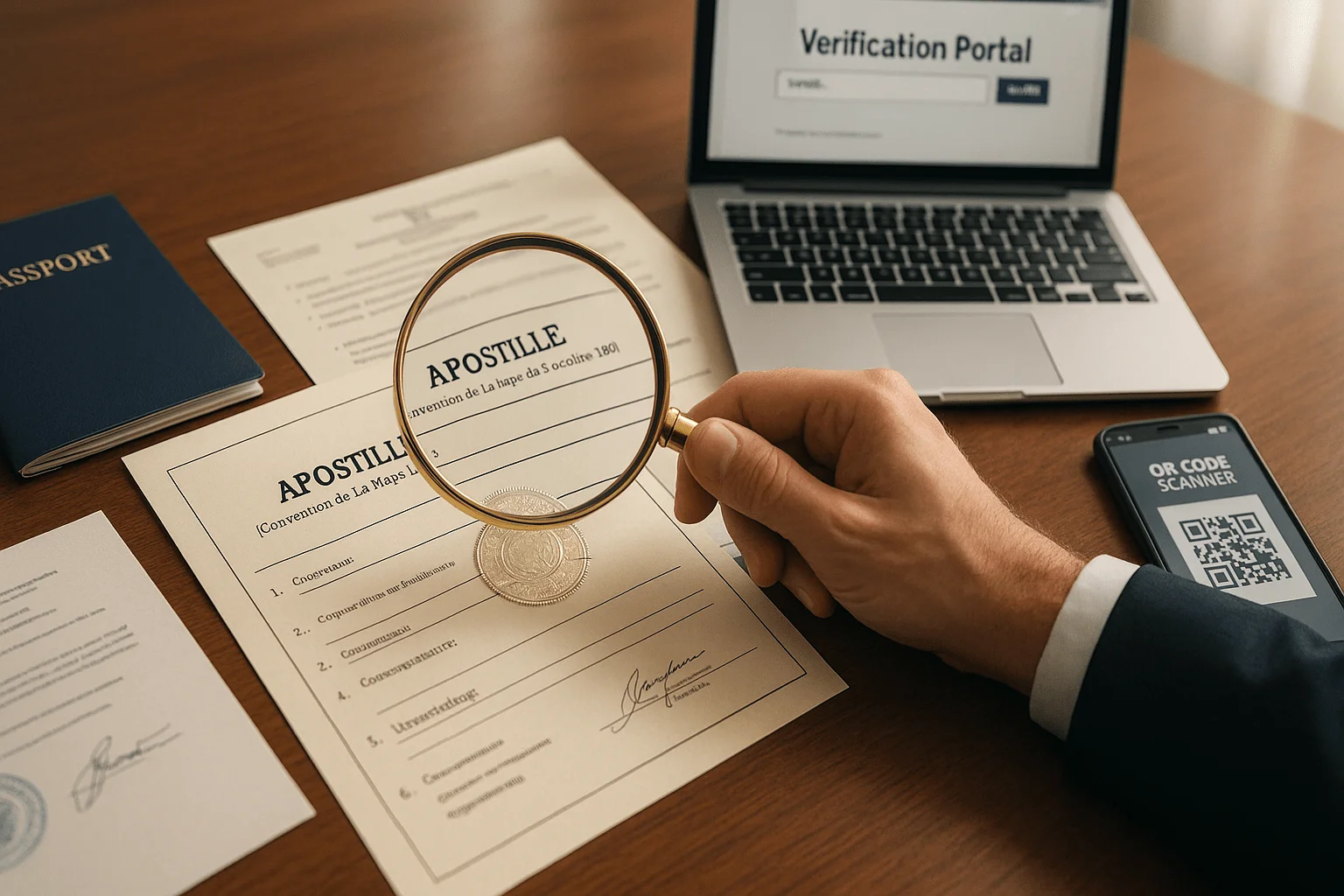
An apostille can look official, but to prove its validity, you need to verify the certificate with the authority that issued it.
This is different from checking whether an older apostilled document is still acceptable. An apostille does not generally have an expiration date, but the receiving state may have its own requirements for the paperwork. See our guide to how long an apostille lasts for more on this distinction.
Countries designate specific authorities to apostillize records, such as foreign ministries, courts, or Secretaries of State. They may provide an online verification system or register, or handle requests through their official contact channels. The key question is whether the apostille appears in the issuing authority’s records.
What Does Apostille Verification Confirm?
An apostille certifies three things:
- the authenticity of the signature on the underlying document;
- the capacity in which the person signing acted;
- the identity of the seal or stamp, where the document bears one.
Verification establishes a fourth thing — that the certificate matches the issuing authority’s register. Other matters fall outside apostille verification:
- the accuracy of what the document says;
- whether that information is still current;
- how recently the document was issued;
- whether the receiving authority will accept it.
A transcript with a verified apostille remains a transcript whose contents the apostille did not examine. An older birth certificate with a valid apostille is an older record, and a consulate that wants a recent one will say so.
The check earns its place where paperwork carries legal or financial weight. Visa files, company registrations, court proceedings, and property transfers turn on records the receiving office can trace. A certificate that cannot be matched to the issuer’s record can put the file on hold, and checking first can catch the problem before submission.
How to Verify an Apostille
Each step narrows the question before the next begins, and together they run from the certificate in hand to a confirmed record. Let’s take them one at a time.
Step 1 – Read the Certificate and Identify the Issuing Authority
The apostille includes everything the search needs. Field 1 gives the country. Field 5 gives the place of issue, field 6 the date, field 7 the issuing authority, and field 8 the reference number.
The authority that issued the apostille is often not the authority that issued the document beneath it. A county office may have issued a birth certificate while the state Secretary of State issued the apostille. Field 7 names the second, and you should approach it.
Step 2 – Confirm the Body Is a Designated Competent Authority
An apostille is valid only if a designated competent authority issued it. Each Contracting State notifies the depositary of its designated Competent Authorities, and the HCCH publishes the list.
Check the name in field 7 against the HCCH list of Competent Authorities. An organization absent from that list for that country calls the rest of the certificate into question.
Ministries merge, and departments are restructured, so an older certificate may name a body that has since changed title. The HCCH entry generally identifies the successor, but it does not issue or register apostilles and cannot verify individual certificates. Its list identifies only the relevant competent authority; that authority can confirm whether it issued an apostille.
Step 3 – Find the Verification Channel That Authority Operates
Learning how to verify apostille documents starts with how the issuer answers inquiries. The available channels may include:
- a public e-Register, holding the apostilles that the authority has issued;
- an official verification page on the authority’s own site;
- a QR code printed on the certificate, leading to an official website;
- direct contact with the competent authority through its published contact channels.
Where an authority runs one, a verification page usually sits alongside its request forms. Few authorities operate the full set, and some answer by contact alone.
Availability also depends on when the certificate was issued, since a register covers the period it was built for. There is no universal answer, because the real question is always narrower: this apostille, from this authority, in that year.
Step 4 – Search the Register
Checking apostille documents against a register comes down to entering the right identifiers. Systems differ in what they ask for:
- the apostille number from field 8;
- the issue date from field 6;
- an access or security code printed on the certificate;
- a separate reference or verification code, where the authority’s system requires one;
- a QR code, scanned rather than typed.
Registers vary in how many of these they require. Enter them exactly as printed, including leading zeros and prefix letters, since most failed searches are typing errors rather than missing records.
Step 5 – Compare the Certificate With the Result
The apostille carries ten numbered fields, fixed by the Convention. Compare each against what the register returns:
| Field | Information shown | What to compare |
| 1. Country | The state whose authority issued the apostille | That it matches the country in the register entry |
| 2. Has been signed by | Name of the person who signed the underlying document | The spelling, against both the document and the record |
| 3. Acting in the capacity of | The office or role that person held | That the role is identical in the record and on the document |
| 4. Bears the seal/stamp of | The body whose seal appears on the document | That the named body matches the seal on the page |
| 5. At | Place of issue of the apostille | That the city matches the issuing authority’s location |
| 6. The | Date the apostille was issued | The date in the record, digit for digit |
| 7. By | The competent authority that issued the apostille | That it is the authority queried, and appears on the HCCH list |
| 8. No | The apostille’s reference number | The number in the record, character for character |
| 9. Seal/stamp | The issuing authority’s own seal | That a seal is present and belongs to the authority in field 7 |
| 10. Signature | Signature of the issuing officer | That the officer is named where the register shows one |
Fields 5 to 8 appear on the certificate under the single word “Certified,” which is why the place, date, authority and number read as one block rather than four separate lines.
Differences in the transliteration of a personal name are common and rarely significant. A different number, date, or issuing authority needs clarification before you use the document.
Step 6 – Contact the Issuing Authority Where the Search Cannot Settle It
Direct contact may be necessary when:
- the authority operates no public register;
- the apostille was issued before the authority’s online records began;
- the site is unavailable, or the search returns an error;
- the search returns nothing, or returns a record that does not match;
- the certificate came from a different competent authority within the same country.
An unsuccessful online search does not, by itself, establish that an apostille is invalid. The records may be incomplete, unavailable online, or held by another competent authority. If verification remains unclear, contact the authority identified on the apostille and ask it to confirm whether it issued the certificate and whether its details match the official record.
How to Verify a U.S. Apostille
In the United States, the apostille verification route depends on which authority signed field 7. State-issued and federally issued certificates part company at that point, and each has its own channel.
State-Issued Apostilles
Documents issued or notarized within a state are apostilled by that state, in most cases through the Secretary of State. Birth and marriage certificates, court records, notarized private papers and corporate filings follow that route. Verification goes back to the office named on the certificate, using the contact details it publishes.
Apostille verification online varies by state. Some provide a searchable lookup tool, while others handle requests by email or phone. Check the issuing state’s official website to see which option is available.
Federal Apostilles
Documents issued by federal bodies are apostilled by the U.S. Department of State, Office of Authentications. FBI Identity History Summaries, federal court records, and papers signed by federal officials follow that route, and other federal authorities handle specific document types.
The Office of Authentications publishes no searchable lookup for certificates it has already issued, so confirmation of a federal apostille comes through direct approach to that office.
Paper Apostilles and e-Apostilles
Format changes which channels are open, not what verification proves. What differs from one to the next is the method available, the information it needs, and the limits that come with it:
| Apostille format | Possible verification method | Information required | Important limitations |
| Paper apostille | Direct contact with the issuing authority | Number, issue date, signatory name | No instant answer; response time depends on the office |
| Paper apostille recorded in an e-Register | Register search, or direct contact | Number and issue date, sometimes an access code | The register covers the period it was built for |
| e-Apostille | Register search, plus the digital signature inside the PDF | The original PDF, and register details where published | A printed copy cannot carry the digital signature; verify the original file |
| Apostille with a QR code | Scan the code, then confirm where it leads | The code and a device that reads it | A code can be printed on anything; the destination is what counts |
| Apostille with no public online record | Direct contact with the issuing authority | Number, issue date, and the document it is attached to | Absence of an online record says nothing about authenticity |
An e-Register is not confined to electronic certificates. The HCCH describes it as a way for an authority to register the apostilles it issues independently of whether they have been issued in paper or in electronic form, so a paper certificate may appear in one.
A QR code is not required by the Convention. The model certificate carries ten fields, and none of them is a QR code, so its absence proves nothing about a certificate. Where a QR code is present, the destination is what matters. It should open a page on the issuing authority’s own domain, and a code leading elsewhere is a reason to stop and ask.
Digital signatures differ by issuer. An e-Apostille signed with a certificate a PDF reader does not recognize is not thereby invalid, since it may use a national certificate authority the software has not been told to trust. Checking an e-Apostille therefore means opening the signature panel inside the file as well as searching the register.
Warning Signs That Require Further Verification
Whether an apostille is genuine turns on the register entry, not on the look of the page. None of the following proves a forgery by itself, and each is a reason to return to the issuing authority before the document is relied on:
- the register entry and the certificate disagree on a material detail;
- the organization in field 7 is not a designated competent authority for that country;
- the number or date shows signs of alteration, such as overtyping, correction fluid, mismatched ink or a change of font within a line;
- a QR code opens a site unconnected with the issuing authority;
- the apostille appears to have been moved from one document to another, leaving staple holes that do not align or an allonge whose fold does not match;
- names, dates, seals or document references do not correspond to the document underneath;
- the issuing authority states that no such record exists.
The last of these settles the question — but only when the statement comes from the authority itself, in writing.
What to Do if an Apostille Cannot Be Verified
Work through this in order, since the earlier steps resolve most cases.
- Re-enter the number and date, watching for transposed digits and dropped prefix characters.
- Check the register’s coverage period against the issue date on the certificate.
- Confirm the right authority was queried, as a country may have several, each covering different document types or regions.
- Contact the authority named in field 7 and request written confirmation of the record.
- Ask the receiving institution what it will accept, since some take a letter from the issuing authority and others want a fresh certificate.
- Order a replacement document and a new apostille once the earlier steps are exhausted.
Reissuance costs time and money, and a search that returns nothing more often reflects a coverage gap or a typing error than a problem with the certificate.
How EZ Apostille Can Help
A certificate can stall because you don’t know which office to contact, or which of that office’s channels answers. At EZ Apostille, we review the certificate, identify the issuing authority, and locate the channel that authority uses.
Our team double-checks any inconsistency between the certificate, the document, and the register entry, and we approach the issuing authority for written confirmation. Where a replacement proves necessary, we say so and arrange a new apostille or embassy legalization for a destination outside the Apostille Convention.
Conclusion
An apostille is verified by its issuer, not by its appearance. Seals, paper stock, and layout carry little weight, while the register entry and the authority’s own confirmation are what count.
Start with field 7, find the channel that the authority operates, and compare the result against the fields printed on the certificate. Where nothing comes back, treat it as a question for the issuer rather than a verdict on the document. Contact EZ Apostille for a document review, or when a certificate needs replacing.
FAQ
Is checking apostille status the same as verifying an apostille?
No. A status check reports how far a request still in progress has moved, while verification confirms that a certificate already issued appears in the issuing authority’s record. Different systems usually answer them.
Does apostille verification confirm the contents of the underlying document?
No. The certificate covers the signature, the signer’s capacity, and the seal. What the document says falls outside its scope, so a verified apostille on an inaccurate document does not make the document accurate.
Can an apostille be genuine but still be rejected?
Yes. Acceptance rests with the receiving authority, and a document may fall outside its recency rules, need a certified translation, or be the wrong document type. None of that reflects on the apostille.
Can a private company officially verify an apostille?
No. The issuing competent authority confirms its own record. A service provider can identify that authority, reach it, and obtain written confirmation, though the confirmation itself comes from the authority.
Is an e-Apostille accepted in all countries?
In principle, yes. Under the Apostille Convention, an e-Apostille should not be rejected simply because it was issued electronically. It has the same legal effect as a paper apostille and should be accepted by Contracting Parties. In practice, some receiving offices may still ask for a paper version.
What should I do if my apostille was rejected abroad?
Ask the receiving authority to explain the reason for the rejection in writing. The next step depends on the reason: you may need a new document or translation, while a problem with the apostille itself should be referred to the issuing authority.
Comments
Submit a Comment
Related Posts
FBI Background Check for Bulgarian Residency: What U.S. Applicants Need to Know

Getting Married Abroad: U.S. Documents Couples May Need

Good am sir/maam july pako nag request ng Birth Certificate at CENOMAR of my sister in-law until now wala pa po, ito po ang special order #NZY5E7 & #NDKB8.
Good day,
Thank you for reaching out. Unfortunately, we are unable to access or check the status of orders NZY5E7 and NDKB8, as these appear to be transactions for Philippine-issued documents or with another company.
For an update regarding the Birth Certificate and CENOMAR request, please contact the Philippine agency or service provider where the request was originally submitted or the correct agency. They will be able to access the transaction and provide you with the appropriate status or assistance.
We apologize that we are unable to access or provide an update on these requests.
Thank you for your understanding.