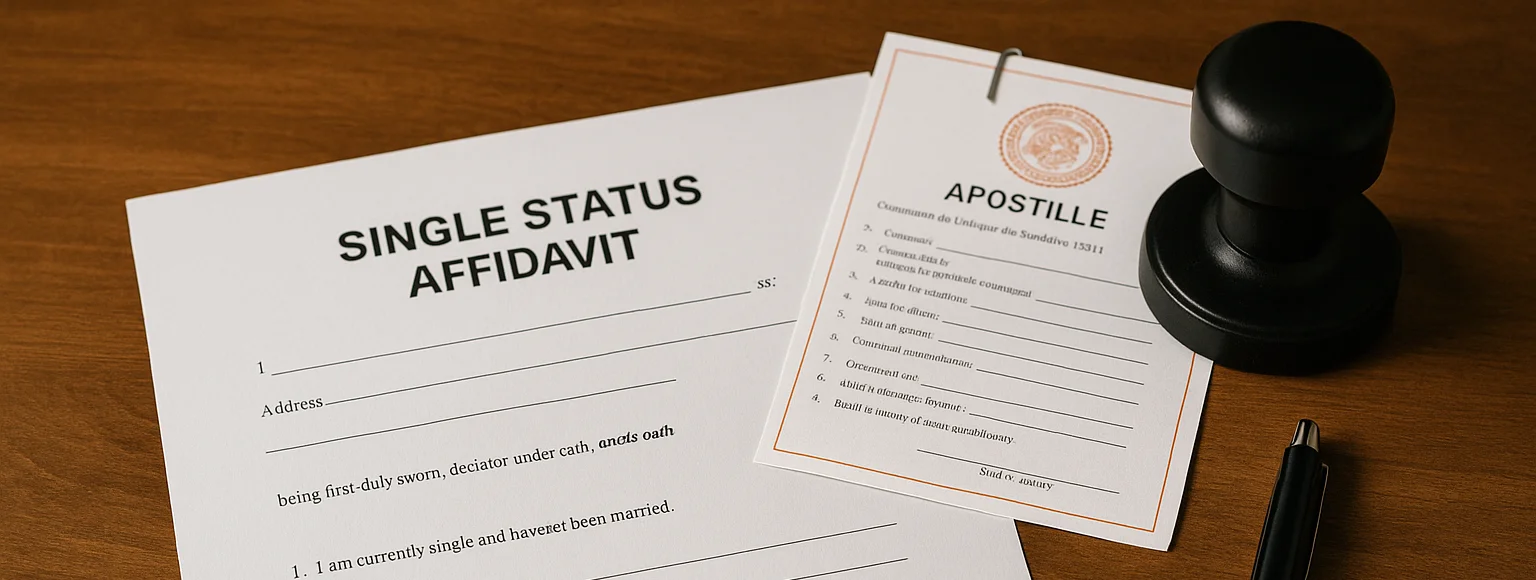
Single Status Affidavit Apostille
Being asked to prove that you’re single may sound simple — until you start looking at the paperwork. Depending on where you’re getting married, applying for residency, adopting, or handling another legal matter, you may need a single status affidavit, a no-marriage-record letter, or another form of proof.
And if that document is going abroad, an apostille may be part of the process. The exact requirements depend on the country, the receiving authority, and the U.S. state where your form is issued or notarized. Below, we explain which records may be accepted, how to prepare them, and how the apostille process works.
What Is a Single Status Affidavit?
A single status affidavit is a sworn statement confirming that you are unmarried or otherwise legally free to marry under the laws that apply to your situation.
When the affidavit is intended for use abroad, it may also need an apostille. The apostille does not verify your marital status itself. Instead, it authenticates the notary’s signature and seal so the receiving authority in another country can recognize the document.
When Is a Single Status Affidavit Required?
You may need to provide proof of single status in a range of situations abroad, including:
- marriage;
- residency or long-stay visa applications;
- adoption procedures;
- inheritance or property matters;
- other legal or civil processes that depend on marital status.
The receiving authority — such as a foreign civil registry, court, or government office — decides whether proof of single status is required and what type of document it will accept. Always confirm the requirements with that authority before you begin.
Types of Documents Used as Proof of Single Status
Several types of documents may be used as proof of single status in the United States, but they do not all serve the same purpose. The table below compares the most common options:
| Document | Who Prepares or Issues It | What It Shows |
| Single Status Affidavit | The applicant, signed before a notary | A sworn statement that the applicant is unmarried and free to marry |
| No-Marriage-Record Letter | A state or local vital-records office | That no marriage record was found in that office’s files for the place and period searched; it does not confirm you have never married elsewhere |
| Single Status Certificate | A state or local office, where available | An official statement of single status; availability and terminology vary by jurisdiction |
| Certificate of No Impediment (CNI) | A competent authority — state, local, consular, or other, depending on the jurisdiction | That no known legal obstacle to the marriage exists |
| Affidavit of Eligibility to Marry | The applicant, often before a notary or consular officer | A sworn statement that the applicant is legally eligible to marry |
Document names, issuing authorities, and the scope of any records search vary by jurisdiction. Because these documents are not automatically interchangeable, the receiving authority decides which type of proof it will accept.
How to Get Proof of Single Status in the U.S.
The United States does not issue one standard federal single status certificate. Instead, you generally have three ways to obtain or prepare the document you need.
Request a Single Status Certificate or No-Record Letter
Some state or local offices can search their own marriage records and issue a certificate or a no-record letter based on what they find. Availability, wording, and the scope of the search vary by jurisdiction, so check what your state or county office can provide.
Prepare a Notarized Single Status Affidavit
If the receiving authority accepts a sworn statement, you may prepare your own single status affidavit and sign it before a notary. This is often the route used when no official certificate is available or required.
Sign an Affidavit at a U.S. Embassy or Consulate
If you are already abroad, you may be able to sign an affidavit of eligibility to marry before a U.S. consular officer. Availability and requirements vary by post, so contact the specific embassy or consulate before relying on this option. You should also confirm with the receiving authority whether a consularly notarized affidavit is acceptable and whether any further authentication is required.
What Should a Single Status Affidavit Include?
Wording varies, but a single status affidavit commonly includes:
- full legal name;
- date and place of birth;
- current address;
- citizenship;
- current marital status;
- a statement that the applicant is legally free to marry;
- previous marriage details, if applicable;
- the intended spouse’s name, if required;
- the destination country and purpose;
- the applicant’s signature;
- a completed notarial certificate with the notary’s signature and seal.
The receiving authority may require additional information or specific wording, so confirm its expectations before the affidavit is signed.
How to Get a Single Status Affidavit Apostilled
Once you know which document you need, the apostille process generally follows a similar sequence. The exact steps depend on the state and destination country.
Step 1 – Confirm the Destination Requirements
Start with the authority that will receive the document. Confirm the accepted document type, any required wording, how recent the document must be, whether an apostille or full legalization is needed, and whether a certified translation is required.
Step 2 – Check Whether the Document Is Ready for an Apostille
Make sure the document has the elements the state authority needs to authenticate it, such as an original signature, official seal, certification, or proper notarization, depending on the document type.
Step 3 – Notarize the Affidavit If Required
A personal affidavit usually must be signed in front of a notary public. Government-issued records that already carry an official signature and seal generally do not need to be notarized separately before apostille processing.
Step 4 – Obtain County Certification If Required
Some states require an additional county-level certification before a notarized single status affidavit can be apostilled. Check the requirements of the relevant Secretary of State’s office before submitting your document.
Step 5 – Submit the Document to the Correct State Authority
The document is generally submitted to the competent authority in the state where it was issued or notarized. Check whether the state accepts requests by mail, in person, or both. A typical submission may include:
- the document to be apostilled;
- the required request form or cover sheet;
- the government fee and accepted payment method;
- prepaid return shipping for mailed requests.
Step 6 – Translate the Completed Document If Required
Some receiving authorities ask for a certified translation of both the affidavit and the apostille into the local language. Before arranging the translation, confirm whether it is required and whether it should be completed before or after the apostille is issued.
What If the Destination Country Does Not Accept Apostilles?
If the country where you plan to use your single status affidavit is outside the Hague Apostille Convention, an apostille will not be the final form of authentication you need. Instead, the document may have to go through a longer legalization process before the receiving authority will accept it.
For a notarized affidavit, that can involve state authentication followed by additional federal and consular steps, depending on the destination. Since the exact route varies, confirm the requirements with the foreign authority or consulate before submitting the document.
Do Single Status Affidavit Requirements Vary by State?
The general apostille process is broadly similar across the U.S., but the details can change considerably from one state to another. Notarization rules, county-level certification, submission methods, fees, and processing times are all determined at the state level.
Here is how the process can differ:
- New York: notarized documents generally require county clerk authentication before they are submitted to the Department of State for an apostille.
- California: an original properly notarized document can generally be submitted directly to the Secretary of State without a separate county certification step.
- Texas: the affidavit must be an original document properly notarized by a Texas notary to qualify for state apostille processing.
- Florida: a notarized affidavit must include a complete notarial statement and the original notary’s signature, stamp, and seal before it can be submitted to the Division of Corporations.
- Illinois: an original document notarized by an Illinois notary can be submitted to the Secretary of State according to the state’s current apostille procedures.
- Washington: a personal affidavit must be properly notarized before it is submitted with the state’s apostille request.
- Pennsylvania: original-document and notarial requirements apply, so the document should be checked against the state’s current instructions before submission.
As you can see, requirements differ significantly, so always check the current rules of the state where your affidavit was notarized, or simply contact EZ Apostille to confirm what applies to your document.
Processing Times, Validity, and Costs
Timelines, validity, and costs vary by state, document, and destination country, so no single estimate applies to every case.
Estimated Processing Timeline
Processing time depends on the issuing state, the office’s current workload, the submission method, and whether any county clerk certification, translation, or embassy legalization is also required. Expedited handling may be available in some states or through professional services when a deadline is tight.
Document Validity and Recency Requirements
There is no universal validity period for a single status affidavit. However, some receiving authorities require the document to have been issued or signed recently, often within three to six months. For that reason, it is usually best to prepare it close to the date of submission.
Apostille Fees and Additional Costs
Government apostille fees vary by state, while the total cost may also include notarization, county clerk certification, certified translation, return shipping, and embassy legalization for non-Hague destinations.
Common Mistakes That Delay the Apostille Process
Even a small mistake in the affidavit or submission can slow the process down or lead to rejection. Before sending your document, check for these common problems:
- Choosing the wrong proof-of-status document: A single status affidavit, no-record letter, or other document may not be interchangeable, so confirm which form of proof the receiving authority expects.
- Signing an affidavit too early: Signing before the notarial act is completed can invalidate the notarization or require you to sign the document again.
- Using unacceptable affidavit wording: Missing or incorrect language can mean preparing a new affidavit before the process can continue.
- Skipping a required county clerk certification: If county-level authentication is required, omitting this step can cause the apostille request to be returned.
- Sending the document to the wrong authority: A state document generally needs to go to the competent authority in the state where it was issued or notarized.
- Requesting an apostille for a non-Hague country: Documents for countries outside the Hague Apostille Convention generally follow a legalization route instead.
- Using an outdated document: If the receiving authority sets a recency limit, you may need a newly issued or newly signed document.
- Overlooking translation requirements: Even after authentication is complete, the paperwork may still need a certified translation before it can be used abroad.
How EZ Apostille Can Help
A single status affidavit can take different paths depending on how it was prepared, where it was notarized, and where it will be used. EZ Apostille helps you identify the correct route before anything is submitted, reducing the risk of delays caused by the wrong authority, missing certification, or an unsuitable document.
We review your paperwork, confirm the required state or federal authentication steps, arrange apostille or legalization processing, and coordinate return shipping. Instead of working out each requirement on your own, you can hand over the process and know your document is moving through the appropriate channels for its destination.
Single Status Affidavit Apostille Checklist
Before sending your document for apostille, run through this checklist:
- the correct document type has been confirmed;
- the destination country’s requirements have been reviewed;
- the affidavit is properly signed and notarized;
- сounty сlerk certification is completed, if required;
- the appropriate apostille or authentication authority has been identified;
- the request form, payment, and return shipping are ready;
- any translation requirements have been confirmed.
Apostille Your Single Status Affidavit with EZ Apostille
By this point, one thing should be clear: the correct apostille path depends on the document you have, the state where it was prepared or notarized, the country where it will be used, and the authority receiving it. Getting those details right at the beginning can save a lot of backtracking later.
If you would rather not navigate these variables yourself, contact EZ Apostille or submit your document for review. We’ll check what applies and take care of the authentication steps for you.
FAQ
Can I draft the affidavit myself, or do I need a lawyer?
In most cases, you can prepare a single status affidavit yourself and sign it before a notary; a lawyer is not usually required. If the receiving authority abroad asks for specific legal wording, confirm that wording before you sign.
What if I was previously married?
You can still provide a single status affidavit, but you may also need to show how the earlier marriage ended, typically with a divorce decree or death certificate. Those supporting records may require their own apostille.
Do I need separate affidavits for multiple countries?
Possibly. Different authorities may require different wording, recency, or separate originals, so one affidavit will not necessarily work for every destination. Confirm the requirements for each country before reusing the same document.
Can I get it apostilled while I am outside the U.S.?
Yes, in many cases. A U.S. state document can still be submitted to the appropriate U.S. authority by mail or through an apostille service. If you need a new affidavit while abroad, you may also be able to sign it at a U.S. embassy or consulate, depending on local requirements.
Can someone submit my single status affidavit for an apostille on my behalf?
Yes. A third party or an apostille service can generally submit the request for you, as long as the document meets the relevant apostille requirements.
Can a remotely notarized single status affidavit be apostilled?
It depends on the state. Some allow apostilles for remotely notarized documents, but the rules vary, and the receiving authority may have its own requirements. Check both before relying on remote notarization.
Can the same affidavit be used for marriage, residency, or another legal purpose?
Not always. The required wording, recency, or supporting documents may differ by purpose, so an affidavit prepared for one application may not be accepted for another.
What should I do if a foreign authority rejects my single status affidavit?
Ask the authority why the affidavit was rejected. Once the issue is clear, you can correct the document or authentication path and resubmit it. EZ Apostille can review the rejection and help you get the document back on track.
Related Posts
FBI Background Check for Bulgarian Residency: What U.S. Applicants Need to Know

Getting Married Abroad: U.S. Documents Couples May Need