
FBI Background Check for Canadian Immigration: Complete Guide
You’re running through the Immigration, Refugees and Citizenship Canada (IRCC) checklist and come across “police certificate.” For U.S. residents, this often means a specific document: the FBI Identity History Summary Check. It sounds like a bureaucratic journey ahead, but with the right roadmap, any applicant can obtain theirs hassle-free. Our comprehensive guide breaks down everything you need to know about the FBI background check for Canadian immigration, helping you check this off with confidence.
When Canadian Immigration Requires an FBI Background Check
First things first, it’s fundamental to understand who needs to obtain an FBI rap sheet when moving to Canada. The truth is that not all applicants do — it depends on your circumstances. Here’s how IRCC generally approaches this requirement.
Permanent Residence and Some Temporary Residence Applications
The need for U.S. police clearance is mostly associated with citizenship and permanent residence applications. Certain temporary categories, including work, study, and visitor visas, may also require criminal reports. Since requirements vary by program, check the current IRCC rules and specific application instructions.
Applicants Who Lived in the United States
If you’ve lived in the U.S., IRCC likely asks for proof of good conduct during that time. It should be pointed out that the request for police certificates is based on residency history rather than citizenship. Therefore, foreign nationals, such as permanent residents or temporary visa holders, may be asked to present one.
When IRCC May Request a U.S. Police Certificate
You typically have to submit a report if you’ve spent more than 6 consecutive months in the States in the last 10 years. There’s no need to account for your time in Canada or before you turned 18. However, each immigration case is different, and the safest bet is to refer to the IRCC guidance for your application.
What FBI Background Check Document Do You Need?
You might be aware that there are several types of criminal reports in the U.S. That’s why the top priority here is to identify which one IRCC actually means when requesting a police certificate. Below is a breakdown:
FBI Identity History Summary Check
The document commonly called an FBI background check is officially known as the FBI Identity History Summary Check. It’s a record of charges, convictions, and arrests drawn from a nationwide database built directly from your fingerprints.
Why IRCC Treats the FBI Summary as a U.S. Police Certificate
IRCC considers the FBI rap sheet as equivalent to a U.S. police certificate because it covers all states and territories. The report provides a comprehensive criminal history, allowing Canadian officials to assess the applicant’s admissibility.
Difference Between FBI and State Police Certificates
Unlike FBI checks, state-level certificates only show records held by a specific state or jurisdiction. For instance, a California police clearance reflects activities reported to the state’s law enforcement system, not elsewhere. Hence, the federal version is required for immigration purposes, rather than a local police certificate.
How to Request an FBI Background Check for Canadian Immigration
Securing an FBI background check to meet Canada’s immigration requirements centers on a few sequential steps. Let’s go through how things work from start to finish in this part.
Prepare Personal Details and Identification
Make sure you have all the basics before submitting: full name, former names or aliases, date of birth, SSN (if applicable), and mailing address. You’ll also need your government-issued photo ID, such as a passport or driver’s license.
Submit Fingerprints on the Required Card
Fingerprints play a central role in background checks, as the FBI relies on print-based searches. These must be taken at a local police station, a selected USPS location, or a private service and submitted together with an official request form.
Choose an FBI Submission Method
You have multiple options to request: electronically, by mail, or through an FBI-approved third-party channeler. Each comes with different turnarounds and fees, so it’s worth comparing them carefully before making a decision.
Receive the FBI Identity History Summary
Once your request is processed, you’ll receive a digital PDF via email or online portal or a physical report delivered to your address, depending on the chosen submission method. Verify that all details match your other paperwork. The FBI summary is now ready to be uploaded to your IRCC application.
Fingerprint Requirements for an FBI Background Check
The fingerprint standards are strict, so you should always verify the current form requirements on the official FBI source before submitting your print card. That said, understanding the overall expectation can save you from a frustrating cycle.
Accepted Fingerprint Methods
Impressions are usually captured by ink-and-card or digitally. You basically apply ink to your fingers and roll them on an approved physical card (FD-258 or FD-1164), or have your prints taken via Live Scan and transmitted to the FBI.
Fingerprinting Inside or Outside the United States
If you’re in the U.S., congratulations — you have plenty of options for giving your prints: local sheriff’s departments, participating post offices, and private fingerprinting services. Outside the U.S., it becomes a little bit more complicated, and you may need to contact local authorities or U.S. consular offices for guidance.
Common Fingerprint Rejection Issues
Smudged or faded ridge patterns are among the most common reasons for rejection. Other issues include sending incomplete information or an unapproved card type. To minimize risk, have your prints taken by a professional and double-check print quality before submitting.
Apostille or Authentication for FBI Background Checks Used in Canada
Once you’ve obtained your FBI background check for Canada immigration, a typical question arises: Does it need an apostille? The answer is that it depends on the requesting authority and the purpose of use, so confirm the current rules instead of assuming an apostille is necessary.
When an FBI Background Check May Need an Apostille for Canada
The IRCC itself doesn’t require FBI background checks to be apostilled. However, other institutions, such as provincial governments and local agencies, may demand authenticated documents for their own verification. Thus, if you use your report elsewhere, check with the specific recipient about authentication requirements.
Why FBI Reports Use a Federal Apostille When an Apostille Is Required
Because the FBI rap sheet is a federal document, it must be authenticated by the federal government rather than an individual state. You’ll need to request a federal apostille before sending the document to Canada.
U.S. Department of State Apostille for FBI Reports
The U.S. Department of State (DOS) handles authentication for federal paperwork. The destination country’s status under the Hague Convention determines whether you’ll receive an apostille or an authentication certificate. Since Canada is a Hague member, an apostille is a valid form of authentication.
When Translation or Additional Review May Be Needed
In some cases, Canadian authorities may ask for a translation into French. Always engage professional translators who are certified or registered in Canada to carry out the work. Also, further review or certification may be called for, and checking these additional requirements in advance can help you avoid unwanted delays.
Processing Time, Validity, and Delivery Considerations
Timing is by far the part that people worry about most when requesting an FBI background check for immigration to Canada. We’ll walk through processing timelines, validity expectations, and delivery methods so you can plan accordingly, but keep in mind that they might shift over time due to backlogs.
FBI Processing, Channeler, and Mail Delivery Timelines
Submitting your digital Live Scan, whether directly to the FBI or through a channeler, takes from 1 to 3 business days. Using the mail-in method is a different story, as it often spans 6 to 12 weeks after your fingerprint card is received. You should also factor in transit time both ways for realistic planning.
IRCC Timing and Document Freshness Expectations
The Canadian immigration authority generally requires that FBI background checks be no more than 6 months old before the date your application is sent. If your rap sheet was issued more than 6 months ago, there’s a high chance it will be rejected. That said, the exact freshness window varies by program, so following your application instructions is the most reliable way to meet IRCC’s expectations.
Electronic vs. Mailed FBI Results
IRCC accepts both PDFs and physical copies of the FBI summary. Electronic delivery is often much faster, and that’s why most applicants request their reports digitally by providing a Live Scan. However, if you currently live outside the U.S., submitting by mail is the only option, since the technology isn’t available abroad.
Common Mistakes That Can Delay a Canadian Immigration Application
A small error can derail your entire immigration application, so it’s essential to know what potentially causes delays and avoid those pitfalls. Be alert to the following common setbacks:
Requesting the Wrong Police Certificate
Sending a local police clearance instead of a federal one? IRCC won’t accept it and likely will request that you resubmit an FBI summary. To avoid wasting weeks, always double-check the specific instructions of your application first.
Submitting Poor-Quality Fingerprints
Illegible prints lead to significant delays, as you’ll need to resubmit from scratch, especially when it already took weeks for a physical result by mail. To sidestep this, use a professional fingerprinting service and clarify quality on the spot.
Ignoring Apostille or Authentication Requirements
While IRCC doesn’t require an apostille, failing to check the authentication requirements of other intended recipients may also put your immigration plan on hold. Confirm rules early and factor in the DOS processing time to speed up.
Waiting Until the Immigration Deadline Is Too Close
Procrastination can silently kill your application. If you choose to mail a request, FBI processing alone takes several weeks. And suppose your fingerprint card has been rejected due to low quality, it would be months before the result reaches IRCC. Starting your FBI summary request as soon as IRCC notifies you is imperative to give yourself breathing room in case something goes wrong.
When Professional Help May Be Useful
Certain situations make professional assistance worthwhile, so consider reaching out for help if any of these scenarios apply to you:
- Applying from abroad: Navigating foreign fingerprinting services is challenging, especially if they’re unfamiliar with FBI protocols.
- Facing an urgent immigration deadline: You can speed up the process by having an expert interpret document checklists and handle the legwork.
- Your fingerprints were rejected: Rolling a correct second set of prints is particularly crucial when your application deadline is looming.
- Unsure whether an apostille or authentication is required: Specialists research requirements and give you a definitive answer for your situation.
- Tricky rules for an IRCC program: If you’re stressed over confusing guidelines, rely on someone who deciphers instructions as a profession.
Handling your application independently is possible, but if you’re already overtaxed or facing complications, expert guidance makes the difference between a smooth process and a stressful one.
Keep Your Canada Plans on Track
The FBI background check is a critical part of your Canadian immigration application. From fingerprints to apostilles, knowing the precise steps is key to your successful move to Canada. And if you’re uncertain about authentication, contact our team at EZ Apostille — we’re here to guide you.
FAQ
Stuck on your Canada immigration application’s FBI background check? Here are answers to the most common concerns:
Do I need a state police certificate in addition to the FBI report?
Most cases solely require the FBI summary. However, IRCC may request additional state police certificates if the federal report appears incomplete.
Is the FBI Identity History Summary the same as a police certificate?
Yes, it’s the equivalent of a national police certificate, since it compiles criminal records across the country.
Can I get an FBI background check from outside the United States?
Yes, you can obtain it when abroad, but the process may take longer due to international mailing.
Do FBI background checks for Canada need an apostille?
No, not for IRCC submissions. Meanwhile, if you’re submitting your report to a Canadian employer, school, or municipal government, you may need to secure an apostille first. Check with the end recipient about authentication in advance.
How long can an FBI background check take for Canadian immigration?
It depends entirely on your submission method. Electronic submissions often return results much faster than mailing. In short, turnaround may range anywhere from 1 day to 12 weeks, excluding transit time.
What happens if my fingerprints are rejected?
You’ll need to resubmit a new card or Live Scan if the FBI rejects your fingerprints. That means starting over by dropping by a local law enforcement office or a fingerprinting service one more time.
Related Posts
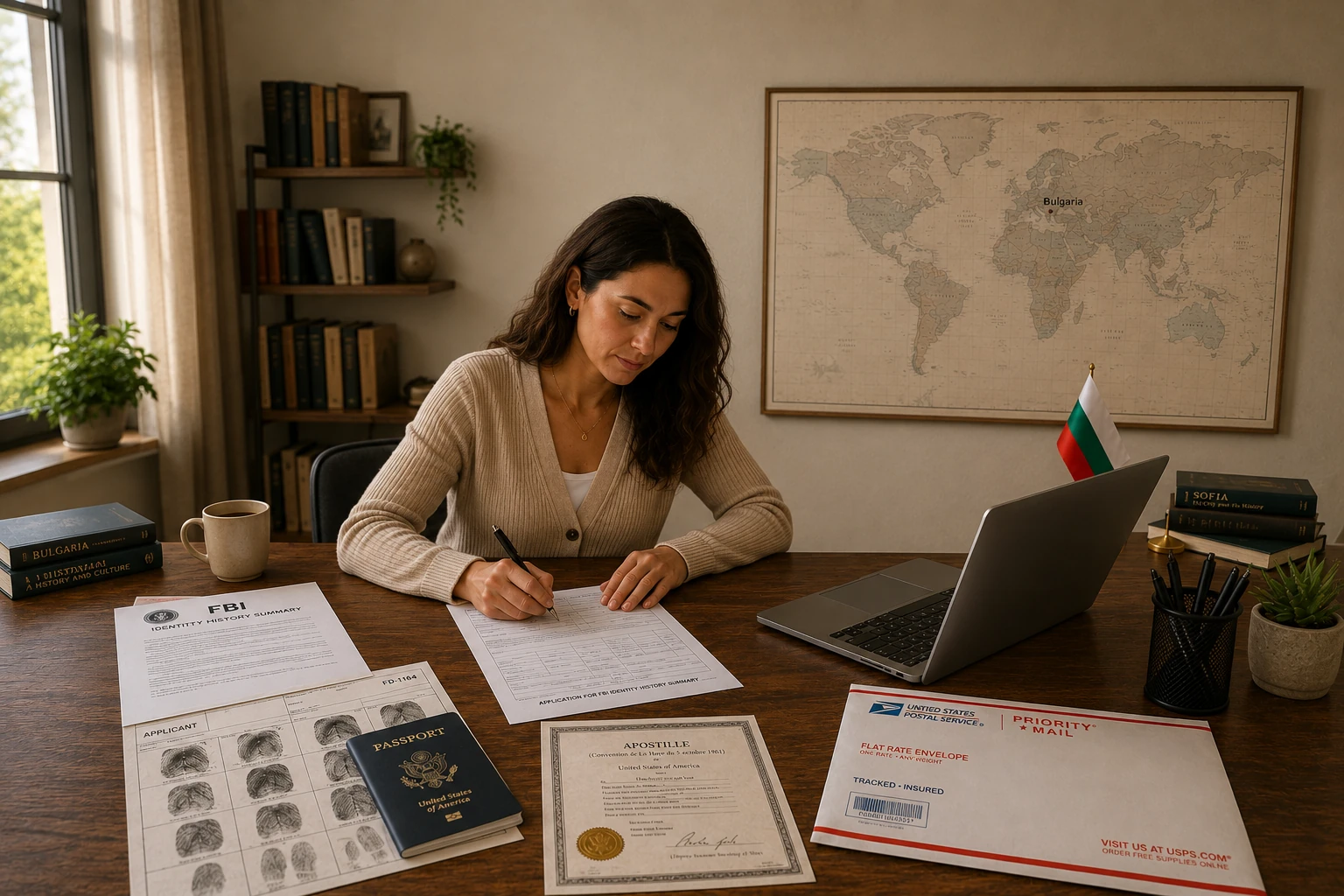
FBI Background Check for Bulgarian Residency: What U.S. Applicants Need to Know

Getting Married Abroad: U.S. Documents Couples May Need