Michigan Apostille: Where to Apply, What Gets Rejected, and How to Avoid Delays
You may have heard of apostilles, but how do they work when your Michigan documents need global recognition? Whether you’re holding individual records, business filings, or court judgments, getting them apostilled by the Michigan authority isn’t as cumbersome as it seems. This guide is here to simplify every step, call out recurring snags, and share insider advice — so you can confidently get your documents recognized without stressing out.
Apostille Processing in Michigan: Authorities and Submission Rules
Before sending off your request, it’s crucial to understand who holds the power over that international approval and the factors affecting its issuance. The Michigan Secretary of State apostille process follows specific rules, and your choice of submission can change the timeline.
Michigan Department of State (Office of the Great Seal)
The primary authority responsible for issuing Michigan apostilles is the Michigan Department of State (DOS), Office of the Great Seal in Lansing. This state office verifies signatures and seals of public officials and attaches apostille certificates to documents for use in foreign countries. If your paperwork is certified or notarized within Michigan’s borders, you’ll submit it for authentication here.
When County Clerk Certification Is Required First
Civil papers, including birth, death, marriage, and divorce certificates, must first be certified by the appropriate county clerk to be eligible for apostille processing, unless issued by the Division for Vital Records & Health Statistics. Failing to meet the county certification requirement would result in delays or rejections.
Submission Methods and Their Impact on Processing
Michigan accepts apostille requests by mail or in person. While mailing is convenient for those living on the other side of the state from the apostille office, it adds significant time because of mail transit. Drop-off often accelerates things, but it requires making an appointment and visiting the physical office in Lansing. Hence, select the best method depending on your timeline and urgency.
What Documents Are Accepted for Apostille
Knowing which of your records qualify for an apostille in Michigan can save you from pointless back-and-forth. Generally, the apostille authority authenticates documents signed by a competent state official or notary public. Below are the five main categories regularly submitted for authentication.
Vital Records
This group contains birth certificates, marriage licenses, and divorce decrees, which must be certified copies obtained from the state or local county where the events were registered. Uncertified versions, such as hospital souvenir certificates, can’t be processed. Apostilled vital records are fundamental during immigration, marriage, and many other legal proceedings in foreign countries.
Notarized Documents
Powers of attorney, business contracts, parental consent letters, and affidavits that need foreign recognition fall into this category of eligible documents. The rule of thumb is that the notarization must be complete and verifiable under Michigan’s law. A missing signature, seal, or notarial statement can stall the apostille process.
Court Records
Adoption papers, probate orders, name change certificates, and other court-issued documents can be processed as long as they bear the official signature and seal of the Michigan clerk of court. These documents are often needed to finalize an adoption, settle an estate, and update your personal information abroad.
Business Documents
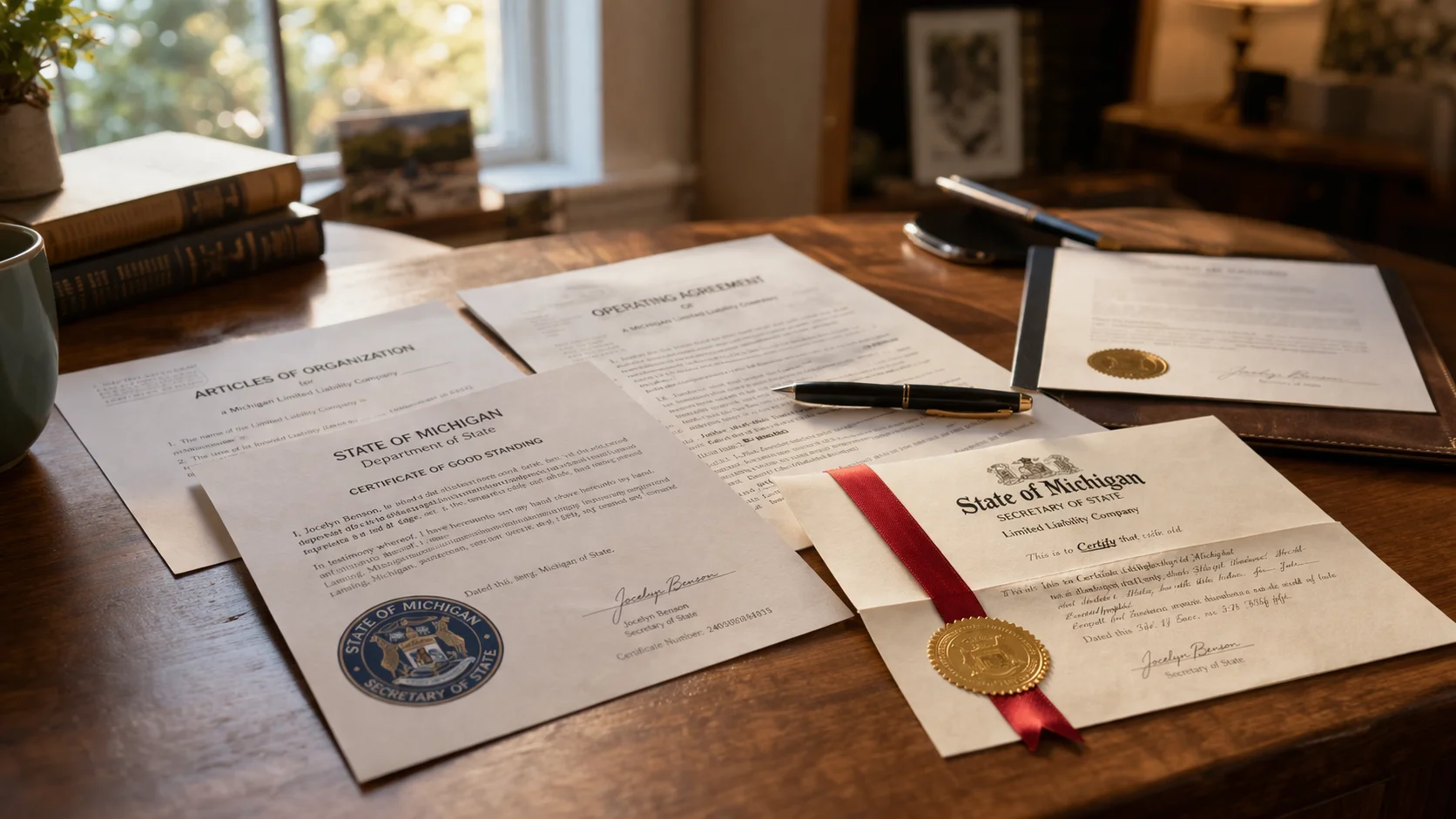
Corporate filings, articles of incorporation/organization, certificates of good standing, and trademark registrations are commonly apostilled paperwork for international use. Authentication is a critical step for Michigan companies expanding business into global markets, particularly launching branch offices, opening bank accounts, and registering operations there.
Academic Records
Diplomas, transcripts, and credentials are eligible for an apostille, but they must have a school registrar’s signature and proper notarization before processing. Check with your registrar’s office to order a copy of your record for apostille purposes. Past achievements usually need to be recognized outside the U.S. when applying to college, seeking employment, or securing residency overseas.
How to Apply for an Apostille in Michigan: Step-by-Step
The apostille process follows a straightforward five-stage workflow outlined by the state authority, where each step matters. Neglecting a small detail may trigger an outright decline, so here’s a clear guideline to submit your document correctly.
Step 1 – Make Sure You Have the Correct Document
The state of Michigan only issues apostilles for certified copies or notarized originals. That’s why it’s essential to confirm whether you have the acceptable version. Email printouts, photocopies, and any other unofficial records can’t be verified with an apostille.
Step 2 – Notarize the Document or Get a Certified Copy
If your paper isn’t already certified or notarized, make sure you request a certified copy from the issuing agency or a notarization at the time your private document is signed. For instance, birth certificates must come from the county clerk or state registrar, while commercial contracts must be signed before a notary.
Step 3 – Prepare Your Apostille Request
Once you have the document ready, complete the Apostille Request Form provided by Michigan. This form basically asks for your contact details and the country where the record is destined for use. Double-check that every field has been filled out to avoid your final package being returned to the wrong address.
Step 4 – Submit the Request to the Michigan Office of the Great Seal
You can submit your request either by mail or by dropping it off at the Office of the Great Seal in Lansing for review. For in-person submissions, remember to schedule an appointment before you arrive. Bring your request form, document that needs authentication, and accurate payment covering the state’s processing fee.
Step 5 – Receive the Apostilled Document
Once verified, your document will be returned to you with the apostille physically affixed. It serves as proof of authenticity to the underlying record, so don’t separate them. Processing time by mail typically ranges from 4 to 6 weeks, while in-person requests are often processed the same day, depending on workload and availability. Either way, plan early if you need the paper for a cross-border deadline.
Common Reasons Apostille Requests Are Rejected in Michigan
Nothing is more frustrating than waiting weeks for an unprocessed request because of an avoidable error. The good news is that you can learn from others’ mistakes, and most rejections for an apostille in Michigan fall into the following types.
Notary Errors and Incorrect Certificate Wording
Many applicants face refusal due to improper notarization. If the notary fails to include the precise wording or uses poor formatting according to Michigan’s standards, the office won’t accept the document. Always confirm that the notarization is complete with a sharp jurat.
Wrong Document Format
Submitting unofficial copies of your personal records, court documents, or corporate papers is also a common mistake. Be mindful that only certified copies or notarized originals are acceptable. Don’t expect an apostille when you send laminated certificates or scanned printouts — you’ll receive a rejection note instead.
Missing Required County Certification
Certain documents, including birth and death certificates, must be accompanied by a county clerk certification before they can be apostilled. This applies to vital records that don’t come directly from the state registrar. Missing the required certification means the state office can’t validate the signature, leading to rejection.
Signature or Seal Cannot Be Verified
Again, the entire Michigan apostille process relies on confirming that the official signature and seal match the state database, so make sure they’re verifiable. Rejection often happens when documents have a smudged, faded, or illegible signature or seal, making it impossible for apostille officers to verify them.
Submission to the Wrong Authority
Finally, directing apostille requests to an incorrect authentication office is a surprisingly common pitfall. Keep in mind that only the Office of the Great Seal is authorized to issue apostilles for Michigan-issued paperwork. Submitting to another state authority or the federal government will definitely result in rejection.
Special Cases That Affect the Apostille Processing in Michigan
Although most requests follow a similar path, some situations call for special attention when applying for an apostille in the state of Michigan. They may involve additional certification, different authorities, or a totally divergent authentication method. Here’s what to consider:
Documents Issued Outside Michigan
If your paperwork was issued or executed in other jurisdictions, Michigan can’t authenticate it. Each state handles its own apostille process, so you’ll need to contact the issuing authority — the office won’t touch your document if it’s from Texas or Florida.
Educational and Corporate Documents
Diplomas and transcripts typically need notarized registrar statements, meaning they must be signed by a school administrator in the presence of a notary public. Additionally, corporate filings, such as certificates of good standing, are often valid in a limited timeframe, so check their issue dates before submission.
Use in Non-Hague Countries
An apostille is only recognized in countries that are parties to the Hague Convention. If you plan to use your record in a non-participating nation, you’ll need to follow the authentication path instead. This entails Michigan’s authentication, followed by further approval at the DOS and the foreign consular office.
Submit Your Michigan Apostille with Confidence
Understanding the requirements governing approval is your key to obtaining an apostille from the Michigan authentication office. Follow the required steps, evade setbacks, and your document will be accepted overseas without issue. For expert guidance and faster processing, contact our team at EZ Apostille — we’re here to make it quick, simple, and hassle-free!
FAQ
More questions? Here are some quick answers to clear up your confusion about the apostille process in Michigan.
Do I need to send the original document, or can I submit a copy?
It depends on the type of document. The state office accepts certified copies for publicly issued records and notarized originals for privately created documents.
Can I include multiple documents in one apostille request?
Absolutely! You can mail or physically deliver your documents in one request at a time. However, each will be processed individually with its own apostille.
Is the submission of documents on my behalf by someone else possible?
Yes. Many applicants choose to partner with a third-party professional service, like EZ Apostille, to submit the paperwork on their behalf. You can also ask a friend or family member to handle submissions for you if possible.
Will I be notified if there is a problem with my documents?
Usually, no. The Office of the Great Seal typically returns the documents unprocessed with an explanation of the issue. Then, you’ll need to fix it and resubmit your request.
Is it possible to track the progress of my apostille request?
Michigan currently doesn’t provide tracking, so you either have to wait until the package is returned or contact the office directly.
Is an in-person submission faster than mailing the documents?
Yes, definitely. Hand-delivering your request to the Lansing office is the fastest way to get an apostille. In comparison, mail-in processing takes significantly longer, especially during peak seasons, plus transit time. The trade-off is that you have to make it to Lansing during business hours.
Do I need an appointment to submit documents in person?
Yes. You must make an appointment beforehand to drop off your documents. Visit the official website of the Michigan Department of State to schedule one before visiting.
Related Posts
FBI Background Check for Bulgarian Residency: What U.S. Applicants Need to Know

Getting Married Abroad: U.S. Documents Couples May Need