Relocating to another country or starting a business abroad soon? Yet your Wyoming documents must undergo a final procedure before they can be accepted on foreign soil: an apostille. Recognizing that the process can be unfamiliar, EZ Apostille specializes in navigating Wyoming’s apostille requirements while minimizing the stress of document authentication. Let’s uncover how our Wyoming apostille service can help with your global move!
Wyoming Apostille Services
End-to-end apostille and document authentication services across Wyoming
Federal
$175
-
1-2 weeks
Not including shipping and fees charged by the State Department, Secretary of State, or embassies. For non-Hague Convention countries there is no expedited service available when obtaining a federal apostille from the State Department. Some states do not offer expedited processing.
Standard
$175
-
4-14 business days
Not including shipping and fees charged by the State Department, Secretary of State, or embassies. For non-Hague Convention countries there is no expedited service available when obtaining a federal apostille from the State Department. Some states do not offer expedited processing.
Rush
$225
-
1-3 business days
Not including shipping and fees charged by the State Department, Secretary of State, or embassies. For non-Hague Convention countries there is no expedited service available when obtaining a federal apostille from the State Department. Some states do not offer expedited processing.
Same Day
$275
-
24 hours
Not including shipping and fees charged by the State Department, Secretary of State, or embassies. For non-Hague Convention countries there is no expedited service available when obtaining a federal apostille from the State Department. Some states do not offer expedited processing.
*Not including shipping and fees charged by the State Department, Secretary of State, or embassies.
*For non-Hague Convention countries there is no expedited service available when obtaining a federal apostille from the State Department.
*Some states do not offer expedited processing.
Apostille Services in Wyoming


1. Apply online
Send us your request online and receive a quote from a specialist the same day. We will also review a scan of your documents for any errors and let you know ASAP if additional steps are required.

2. Send us your documents
No need to make an appointment or go to a physical location. Just mail us your documents through a secure tracked shipping service (FedEx, DHL, or UPS). In some cases we may not even need the physical copy!

3. Receive Your Apostille
Once completed, your Apostilled documents will be mailed to you via FedEx or DHL and will arrive at your doorstep. Ask about our shipping options! Whether in the US or Worldwide, we’ll get them to you wherever you may be.
Documents We Apostille in the USA
Corporate Documents
- Certificates of good standing
- Certificates of incorporation
- Certificates of origin
- Power of attorney
- Hiring documents
- Company invoices
- Other business documents
Personal or Family Documents
- Marriage certificates
- Death certificates
- Birth certificates
- Divorce decrees
- Single status affidavits
- Power of attorney
- Wills
- Car titles
- Adoption dossier
- FBI records
- Criminal history reports
- Any notarized document
Academic Documents
- High school
- GED
- College diplomas
- Report cards
- Other various school records
Place an order to calculate your cost or talk to our experts
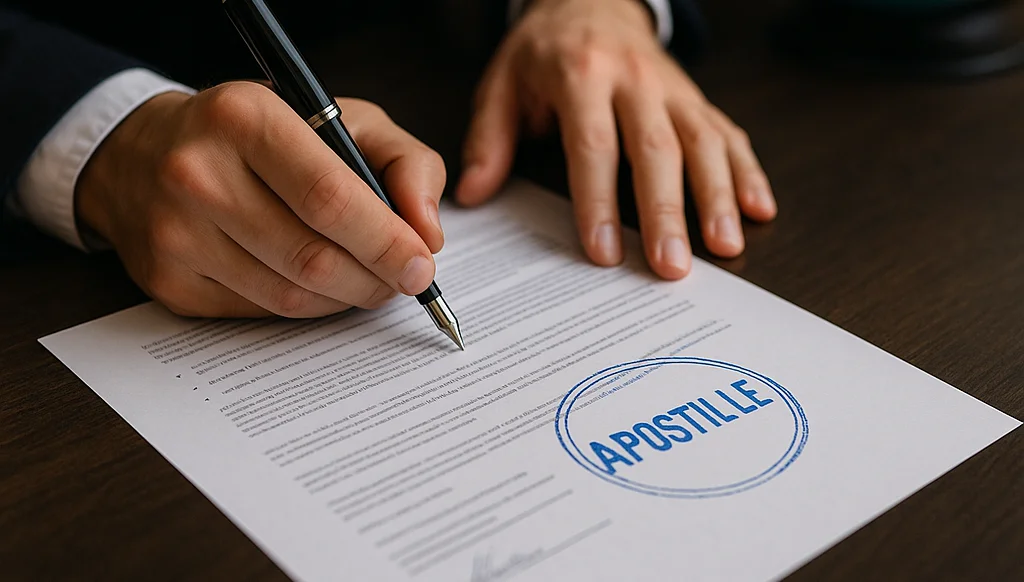
How Apostille Services Work in Wyoming
At EZ Apostille, we focus on a simple principle — accuracy and speed. We streamline the path of your local paperwork from the folder to international recognition by dividing it into smaller stages. This ensures no details are left to chance and that your apostilled Wyoming documents are fully recognized abroad.
Document Review and Eligibility Check
The initial stage is to confirm that your papers qualify for the state apostille process. Our professional assessment identifies their origins and current condition, as well as determines exactly what’s needed for successful authentication. This crucial review also catches issues that may potentially derail the process, like missing notarization or submitting uncertified versions.
Notarization Requirements Under Wyoming Law
Documents without the official seals and signatures of competent Wyoming authorities must be notarized under the state law. Notarization is an essential link in the verification chain, enabling the state office to proceed with an apostille. This often involves signing the document — an affidavit or agreement, for example — in front of a Wyoming notary public before requesting an apostille.
Certification by the Wyoming Secretary of State
Once the apostille package is correctly prepared, it will be submitted to the Wyoming Secretary of State’s office in Cheyenne. This is the exclusive authority that issues apostilles and authentications in the state. The officials confirm the signature and seal on your paperwork, rather than the content, and affix an apostille certificate upon satisfaction. Our work lies in handling the submission protocols to secure this certification quickly and efficiently.
Apostille or Embassy Legalization for International Use
The Wyoming apostille makes your documents instantly valid in Hague Convention countries. If the receiving country isn’t part of this treaty, you’ll receive an authentication certificate from the state office instead. Our team then manages the subsequent chain of authentication by forwarding the apostilled paperwork to the U.S. Department of State and the destination country’s embassy or consulate for verification, respectively.
Submit Your Documents Today
Documents Eligible for Apostille in Wyoming
It’s crucial to know which records are eligible for an apostille in Wyoming, but partnering with EZ Apostille means we’ll check them for you as soon as you reach out to us. The state office accepts a range of documents, from personal records to corporate filings. The unifying factor is that they must originate from Wyoming.
Business and LLC Documents
Wyoming-based corporations and businesses often require their records to be validated for foreign use. Most requests that we receive involve:
- Incorporation papers
- Corporate powers of attorney
- Commercial contracts
- LLC operating agreements
Securing a corporate apostille supports trade, investment, and expansion abroad by providing the certified credentials that global partners and authorities expect.
Personal and Vital Records
Authenticated personal documents are the cornerstone for many life events abroad. Qualified documents include, but are not limited to:
- Birth certificates
- Marriage certificates and divorce decrees
- Police clearances
- Single status affidavits
These are often part of the application for visas, long-term residency permits, and international adoption.
Academic and Educational Records
To pursue advanced degrees or highly regulated career fields, students and professionals need to present their verified academic achievements to foreign authorities. Some examples include:
- High school and college diplomas
- Official academic transcripts and school records
- Professional certificates and licenses
With a proper apostille certification, your hard-earned qualifications will be recognized by foreign institutions and employers, opening doors to various interesting opportunities worldwide.
Legal and Court-Issued Documents
Wyoming-issued legal paperwork must be authenticated before being presented as proof in a foreign court system. Our team typically handles:
- Settlement agreements
- Guardianship orders
- Wills and probate records
Our precise handling guarantees your sensitive legal filings maintain their integrity throughout the apostille process and meet strict international standards for recognition.
Submit Your Documents Today
Processing Options Tailored to Your Needs
EZ Apostille gives you full control of your apostille request. A one-size-fits-all schedule doesn’t always align with international plans, so we’ve designed multiple processing options that cater to various needs and budgets. Here’s how you can customize the Wyoming apostille experience, whether your deadline is weeks or months away.
Standard Service Timeframes
Most clients select the standard processing speed for its quality-cost efficiency, perfect for well-planned endeavors. We leverage the state’s regular mail-in processing timelines, which often return results within 5 business days, excluding transit time. This option is highly recommended if you don’t need the paperwork urgently, such as when you’re planning ahead for marriage or business expansion.
Expedited Requests and Rush Handling
If you need to meet a tight submission deadline for university enrollment or an unexpected legal requirement overseas, rush handling can significantly shorten the turnaround. This often entails additional costs for prioritizing your submission with the apostille office. While more expensive, selecting these options allows you to receive an apostille in as little as 1 to 3 business days.
Pricing Packages
EZ Apostille offers transparent pricing packages with no hidden fees. Once you contact us, we’ll openly discuss your expectations and preferred processing speed to help you select a suitable package. Each covers the mandatory state fee of $20 per document, our expert handling, and secure delivery. Whichever service tier you choose, an all-inclusive quote will be provided beforehand, so you can make informed decisions and manage your authentication budget wisely.
Get Started
Apostille Services in Major Wyoming Cities
Our Wyoming apostille service team serves both individual and business clients across the state. From Cheyenne’s corporate filings to Laramie’s educational credentials, we help verify local signatures for foreign acceptance, no matter where you’re located.
Cheyenne Apostille Services
Wyoming’s capital and most populous city often generates a huge volume of apostille requests for government-related and corporate documents. Our business clients routinely submit their LLC records and contracts for authentication to secure international investment or to be involved in business ventures abroad.
Casper Apostille Services
Casper communities often need apostilled documents for personal purposes, such as settling an inheritance, registering a marriage, or adopting a new family member overseas. Birth certificates, death certificates, and marriage licenses are among the most frequently requested types of records.
Laramie Apostille Services
Home to the University of Wyoming, this vibrant college town usually demands authentication for academic records. We’ve assisted many students and alumni in securing apostilles for their diplomas, transcripts, and enrollment letters to pursue graduate studies and employment in foreign countries.
Start Your Apostille Process Today
Why Clients Choose EZ Apostille in Wyoming
More than a one-off service provider, Wyoming clients choose EZ Apostille to be their strategic partner in document authentication for many advantages. By combining local expertise with concierge-level quality, we proudly offer:
- Wyoming expertise, worldwide coverage: We know the ins and outs of Wyoming and maintain a borderless coverage through our mail-in system.
- Built-in translation service: Certain countries require certified translations to assess document content, and we can connect you with top-tier linguists without the need for a separate search.
- Clear updates at every step: We keep you informed with our timely status updates at each milestone, from our initial review to the moment your final apostille is being shipped back to you.
Our local knowledge and commitment to transparency ensure your important paperwork is prepared with utmost care, empowering your international goals with reliability and confidence.
Request a Free QuoteApostille Services in Wyoming: What Clients Ask
Do Wyoming business documents need notarization before apostille?

Can documents issued outside Wyoming be apostilled in the state?
Are digital or electronic documents accepted for a Wyoming apostille?
What if my destination country is not part of the Hague Convention?
Should translations be done before or after obtaining a Wyoming apostille?
Ask us anything!