Out-of-State Apostille: Can You File in a Different State?
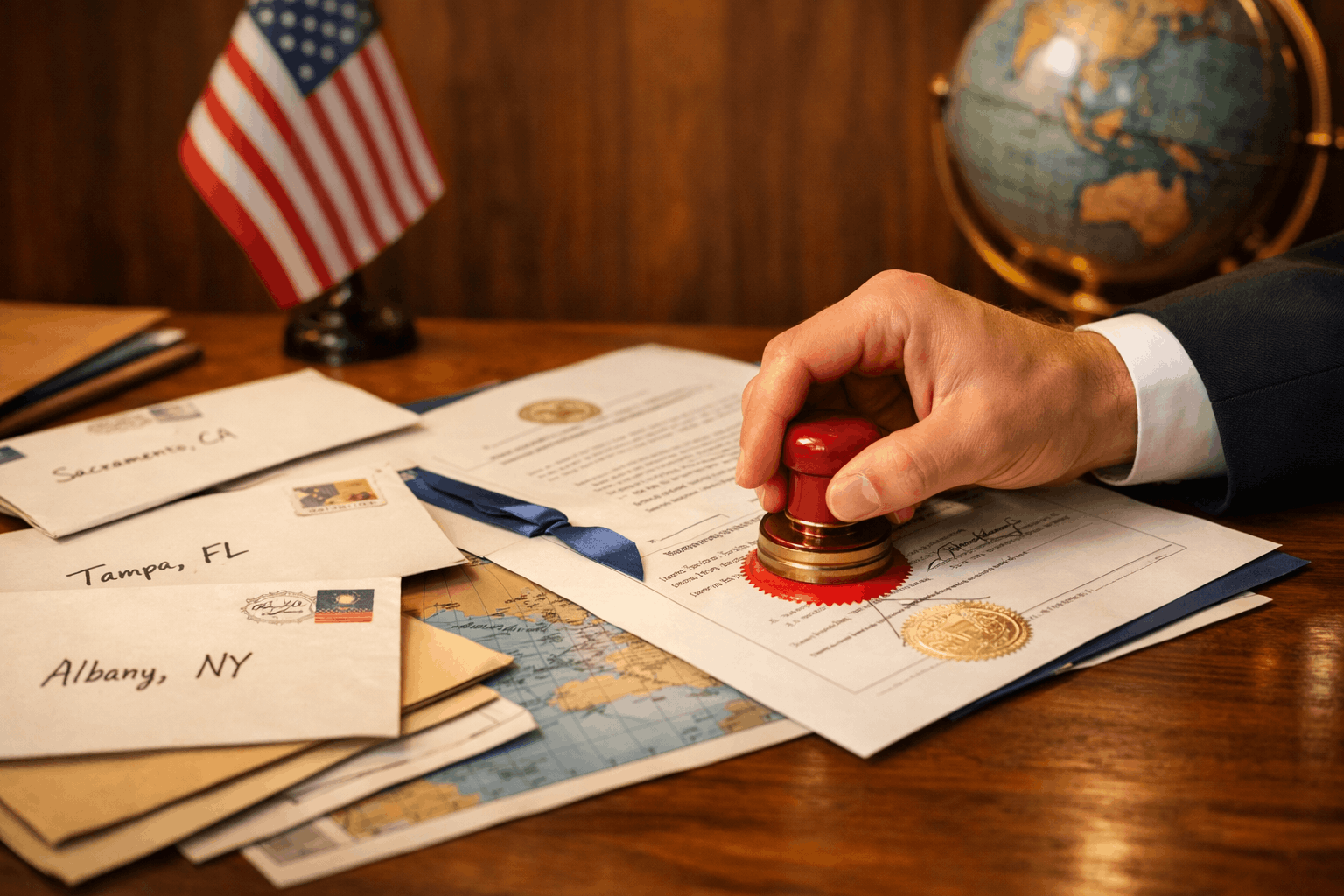
Your document needs to go global, but there’s one final hiccup: it originates in California, and you now reside in New York. Each state has its own jurisdiction; you can’t just drop paperwork at the nearest state office. The truth is, obtaining an out-of-state apostille is simpler than you think, and this guide explains the process clearly, so you’ll know how to handle apostille requests from across the country.
Can I Get an Apostille in a Different State?
The most confusing point for those authenticating documents for international use is requesting an apostille in another state. While you may hope your local Secretary of State’s office can accept the request, the process doesn’t work that way. Let’s pull back the curtain on the rules before you send it off.
Jurisdiction of the Secretary of State
The authority to issue apostilles is reserved for the Secretary of State in the state where the document was created or notarized. For instance, if California issued your marriage license, only the California Secretary of State can authenticate it. Filing a request in New York would result in immediate rejection.
Signature Verification Requirements
The apostille process hinges on signature verification. The state authority confirms that the signature of the county clerk or notary public on your document is genuine and valid before attaching an apostille. One state simply can’t verify a signature from another state because they don’t have access to that verification system.
State-Specific Authentication Databases
Each state maintains its own authentication database of notaries, county clerks, and public officials within the state to cross-check signatures and seals. States generally don’t share these databases. That’s why an apostille must come from the document’s state of origin, as others don’t have a built-in system to validate it.
Common Situations That Require an Out-of-State Apostille
The need for an apostille in a different state occurs more frequently than people expect. Humans are mobile, and documents follow us to every part of the globe. Here are some scenarios where you might request cross-state apostilles.
You Moved to Another State
Relocation is the top reason for an out-of-state apostille. You were born in California, attended school in Texas, got married in Florida, and moved to New York for your career. If a foreign authority asks for an authenticated school transcript, you can’t file for an apostille in your current state of residence.
Corporate Documents Registered Elsewhere
Businesses with operations spanning multiple states often require apostilles from the state where they were formed. Particularly, formation documents like articles of incorporation, bylaws, and resolutions must be verified by the state where a company was legally registered, rather than where its headquarters are located.
Notarized Documents Signed During Travel
Sometimes, you may find yourself notarizing a document while visiting another state. Let’s say it’s a power of attorney, and later you need to authenticate it as part of documentation to be sent overseas. Since notarization is handled by the state where it was signed, the apostille must be obtained from that state.
Options If You’re Located in a Different State
If your document was issued elsewhere, don’t book a flight just yet. Instead, read on. Fortunately, there are several ways to request an apostille in a different state from where you’re based without having to travel back.
Mailing Documents Directly to the Issuing State
Submitting your request by mail to the Secretary of State’s office in the state where the records originated is the most direct option. Include all required forms, payment, and a prepaid return envelope to minimize the risk of delays. The downside? Standard processing times may stretch for weeks during peak periods.
Using a Registered Apostille Service Provider
Professional assistance is adept at handling complex paperwork under time constraints. You simply hire a service specializing in the documents that require an apostille in the issuing state. The experts will handle the logistics on your behalf, managing physical submission at the state office for expedited processing.
Coordinating With a Local Notary Before Submission
For privately created documents, you can arrange for notarization to happen in the state where you currently live. Think of powers of attorney and affidavits. Simply draft new versions and have a local notary witness the signatures on them. This effectively establishes locally notarized papers that can be apostilled in-state.
Authorizing a Representative to File on Your Behalf
This option is especially useful if you already have a personal connection in the state where your documents were recorded. You can authorize a family member, friend, or acquaintance to file an apostille request in the issuing state. This helps you receive approval faster than mailing without being physically present.
Special Considerations for Federally Issued Documents
When you ask, “Can I get an apostille in a different state?” the answer totally changes when federal documents are involved. Unlike state-issued records, they don’t belong to any state and must follow the national authentication path.
FBI Background Checks
FBI background checks can’t be processed at the state level. Issued by the FBI, these reports must be authenticated by the U.S. Department of State (DOS). Note that they’re already certified, so you can send them directly to Washington, D.C., without having to obtain any prior certification.
Certificates of Naturalization
Proof of your U.S. citizenship issued by the U.S. Citizenship and Immigration Services (USCIS) is also considered a federal record. Similar to FBI checks, certificates of naturalization require an apostille from the federal government to become valid overseas. Sending them to your state capital will result in your package being outright rejected.
Federal Documents Apostilled by the U.S. Department of State
Other documents originating from a federal agency, including immigration papers, tax letters, social security verifications, and federal court records, must go through the DOS. Knocking on the wrong door causes you to go back to square one.
Processing Times and Turnaround Factors
The time it takes to receive final approval for an out-of-state apostille is between 5 and 15 days, plus mailing transit. Some states offer expedited and rush options for shorter turnaround. Federal apostilles are longer, with most cases reaching more than 5 weeks to complete. Main factors affecting speed? Mailing delays, office backlogs, the accuracy of your submission, and additional county certification.
State-to-State Variations You Should Know
While the process adheres to the Hague Convention standards, each state may have its own procedures. It’s essential to understand these variations before you send that important package.
Original vs. Certified Copies
Some states accept certified copies, whereas others strictly require the originals. Most of the time, public records, such as birth certificates, must be certified copies from the state Department of Health, and private documents, such as commercial agreements, are notarized originals.
Notary Commission Validity
Notary rules may differ from state to state. However, the notary’s commission has to be active at the time of apostille processing in general. Additionally, you should also pay attention to notarial wording, as certain states require it to be exact as outlined, or the authentication will stall.
County-Level Certification Requirements
In states like New York, notarized documents must be certified by the county clerk in the county where the notarization took place before they’re eligible for the apostille. Missing this step results in resubmission, so pay close attention to your state requirements on the county clerk’s certification.
Payment Methods and Filing Forms
Mandatory filing fees and payment methods vary by state, with some accepting checks or money orders only for mail-in requests. Request forms are also different, which means completing an incorrect form can defer processing. Always download the current apostille request form from the relevant state website.
Mistakes That Delay Out-of-State Apostille Requests
The most organized people may trip over a small yet obvious mistake over and over again. Keeping an eye out for these most common pitfalls when requesting an apostille in a different state saves you from idleness and frustration.
Submitting to the Wrong State Authority
The biggest error of all time is sending paperwork to the wrong authority. Bear in mind that only the state where the document was issued has jurisdiction over it. Also, distinguish between state and federal records to select the correct authentication path.
Sending Improperly Notarized Documents
If a notarized power of attorney or agreement lacks a notarial signature, has incorrect wording, or contains an expired stamp, the apostille office can’t process it. Always double-check notarization before submission, as a notary error can freeze the whole process.
Using Digital Copies When Originals Are Required
Most states have not yet accepted scans or digital reproductions for apostille purposes. That’s why physical originals and wet-signed certified copies are conventional. In the meantime, only a few selected states, such as Montana and Kentucky, authenticate digital PDFs and issue e-Apostilles.
Missing Prepaid Return Instructions
If you choose to mail your documents, apostille offices often require a return shipping label. Forgetting to include a prepaid envelope may add weeks to your timeline. Some states hold your package in the office until you provide further instructions, while others mail it back using time-consuming ground shipping.
Ready to Request Your Apostille?
Navigating out-of-state apostilles doesn’t mean you need to fly across state lines for paperwork. At EZ Apostille, we guide you through every stage of the apostille process, from document preparation to state filing, while you observe from afar. Reach out to us today so that you can skip the research and shipping anxiety!
FAQ
Explore answers to the most common queries about apostilles in another state.
Can I notarize a document in one state and apostille it in another?
No. Apostilles must come from the same state where the document was notarized, as other states can’t verify the notary’s commission.
Do I need to appear in person in the issuing state?
No. Most states offer mail-in options or allow you to authorize a trusted representative who handles the submission on your behalf. You can absolutely manage everything without physically being there yourself.
Can an apostille service handle documents from multiple states at once?
Of course. Professional services are well-versed in requirements across states and can coordinate apostille requests across different jurisdictions simultaneously.
Are apostille fees the same in every state?
No. State processing fees vary significantly, ranging from as low as $5 per document to over $20 in some states. Always check the latest fee schedule of the specific state to plan your budget accordingly.
How do I track my out-of-state apostille request?
Certain state offices provide online tracking tools, while most still operate without any updates at all until your apostille ships back. If you use a traceable delivery service, you can track where the package is while it’s in transit.
Does the destination country affect which state issues the apostille?
No. The state where the document was created has sole authority to issue an apostille for it, not the country where it will be used. Subsequently, the destination country has the power to accept or reject the apostilled document.
Related Posts
Bill of Sale Apostille: The Easy Guide for International Transactions
How to Legalize U.S. Documents for The Bahamas