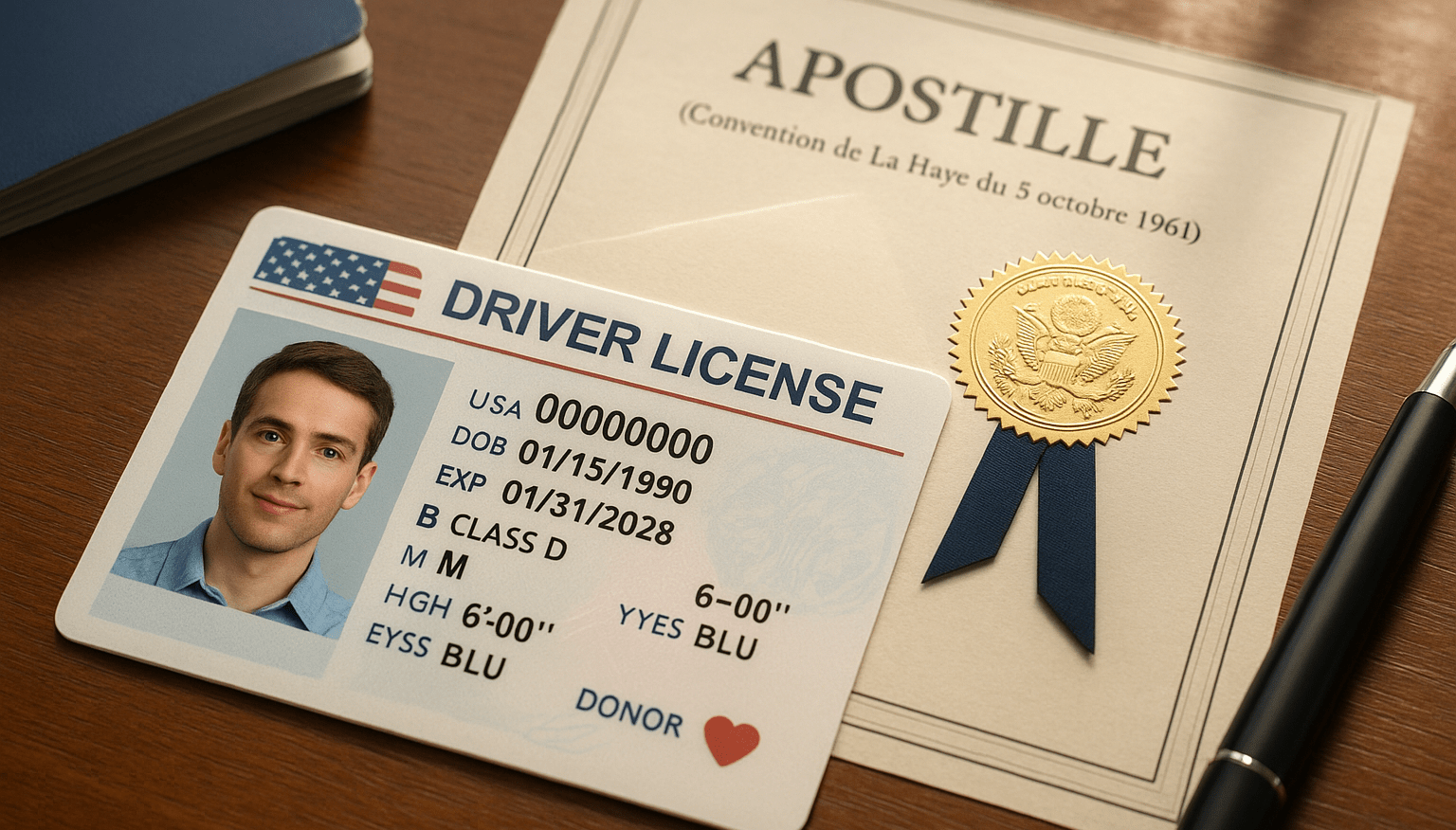
Driver’s License Apostille
A driver’s license is one of the most commonly used forms of identification when at home. However, its validity doesn’t automatically transfer when used abroad. In some situations, foreign authorities may ask for a driver’s license apostille to confirm that it is a genuine government-issued document.
In this article, we’ll provide a 360-degree view of how everything works and how using an industry pro can streamline the process so nothing stands in the way of you and your international ambitions.
When a Driver’s License Is Needed for International Use
For certain processes abroad, a driver’s license may be requested as supplemental identification, depending on the country and the agency involved. However, given that you’re dealing with foreign agencies, pulling out your license as if it were in the U.S. won’t be enough to satisfy the requirements. That’s when a driver’s license apostille comes into play, authenticating your pocket ID so international agencies will accept it for its intended purpose across global borders.
Here are some of the main situations in which a driver’s license is often needed overseas:
- Situations involving driving, including renting, leasing, and registering a vehicle, converting your license, or applying for a local permit.
- Permanent or temporary residency.
- Supporting identification, such as for education, work, immigration, insurance, and bank accounts.
- Administrative procedures, such as court and legal matters, and insurance claims.
Country Rules for Accepting the U.S. Driver’s License
No universal rules govern U.S. driver’s license acceptance, but the Hague Apostille Convention provides a standardized process for many nations. Outside the convention, the process is usually slower, costlier, and more complex. Let’s look at the details below.
Requirements in Hague Convention Countries
For countries within the Convention’s jurisdiction, obtaining an apostille for a driver’s license is usually sufficient for authentication, but acceptance still depends on each country’s regulations. For administrative and other purposes outside of actual driving, an apostille is sufficient to verify your license abroad. Whereas driving rules vary by country, and whether it’s short-term or long-term driving.
Requirements in Non-Hague Countries That Require Legalisation
On the other hand, for non-Hague countries, authentication typically involves a multi-stage process that includes state certification, U.S. Department of State authentication, and consular legalization. However, as with Hague nations, local rules often differ when it comes to driving, depending on the destination, how long you intend to drive, and whether or not you are a resident.
How Country Requirements Differ for Using or Exchanging a License
When using the license for its titular purpose, driving, the requirements are less clear-cut. Apostilles are generally not required for driving abroad. Most countries rely instead on an International Driving Permit (IDP) and the physical U.S. license. Only certain administrative licensing processes might require authentication. To be sure, it’s a good move to check the specific country’s regulations before proceeding.
Using an Apostilled Driver’s License Abroad
In Hague Convention countries, an apostille authenticates notarized copies, but acceptance varies by agency and purpose. After landing, how do authorities verify it, and does it expire? Here’s a quick rundown to ensure your apostille suffices.
How Foreign Offices Recognise an Apostilled License
At its core, the Hague Convention standardizes the apostille process between nations, and this extends to the driver’s license apostille documentation. This means that the apostille format is the same no matter which country it is, making it easy and simple for officials to identify when presented.
How Authorities Verify Apostille Authenticity
When an apostilled copy is specifically requested by officials for inspection, all that’s required is a visual check, where it’s reviewed to make sure that it contains all the relevant elements. However, in rare cases, when further verification is required, officials use either direct confirmation with the issuing authority or cross-checking online via government databases.
Validity Period and When a New Apostille May Be Required
An apostille has no expiration date, but that doesn’t necessarily mean that it will work forever, as the license itself does have one. Renewing, replacing, or updating your driver’s license in a way that alters the ID’s key details, like the license number, will result in the apostille no longer being valid for the new license. What’s more, some countries occasionally have time-related rules that limit how old the actual license can be to ensure the information is current.
How to Apostille a Driver’s License
Now it’s time to dive into the ins and outs of how to apostille a driver’s license so your ID will not only travel with you across international borders but also be able to serve its intended purpose upon arrival.
Here’s an overview of how to get an apostille for your license:
Preparing a Certified or Notarised Copy
The first step for getting the process moving is to make a color copy of the driver’s license, then carefully review it to make sure all relevant details are clear and visible, such as the license number and name. Once done, the copy can be taken to a licensed notary, after which you will receive a notarized copy.
Submitting the Document to the Correct State Office
Once the notarized copy is in your hands, it can then be submitted to the relevant authority alongside the apostille application. For driver’s licenses, the apostille is issued by the Secretary of State’s office in the same state where the license was issued.
Receiving the Apostilled Document and Checking Details
After the driver’s license apostille has been processed, it’s essential to double-check the details, such as ensuring the license information and name are correct and match the license. It’s also important to review the apostille itself to verify that there are no mistakes that could be costly down the road. Below are some of the key elements to check that are present on the apostille:
- Issuing authority
- Reference number
- Official seal
- Date
Adding Translation if Required by the Destination
Always check to see if a translation into the local language is required, and if so, have the documents accurately translated and attached to the apostilled document. Some countries may require a translation of the notarized copy of the license or the apostille, depending on how the document will be used. If a translation is required but not provided, the driver’s license apostille may be rejected by the receiving authority.
Common Mistakes and How to Avoid Them
When making overseas plans, it’s important to make sure that every step is carried out in line with the strict requirements. Failure to follow the correct procedures at any stage can lead to costly delays or rejections that could derail your plans. Thankfully, using a trusted apostille service can mitigate these potential pitfalls and ensure smooth sailing from start to finish.
Below are some of the common mistakes to look out for and how to best avoid them:
Incorrect or Incomplete Notarial Certification
A notarial certificate that does not meet the requirements is a common error that can cause serious problems, as it’s a crucial piece for obtaining your driver’s license apostille. To avoid mistakes, be sure to:
- Verify the copy is accurate once notarization is received.
- Check that all required elements, such as dates and signatures, are present and clear.
Using the Wrong Type of Copy for Apostille
Submitting the wrong type of copy for the apostille is another common pitfall. A copy that doesn’t meet requirements will not be accepted by the state for processing. Here’s how to avoid that outcome:
- Ensure the copy is notarized.
- Confirm the type of copy required by the state.
Choosing the Wrong Authority for Submission
In the U.S., driver’s licenses are issued by the state government, not the federal government, so apostille documentation must be submitted to the appropriate state authority. Here are some tips:
- Submit to the Secretary of State’s office in the state where the license was issued.
- Check with the authority for exact requirements about accompanying documents, fees, and submission options.
Problems Caused by Damaged or Expired Licenses
If the license is expired, damaged, or its details are not clearly visible, this is a major red flag. That’s because even if the apostille is valid, a license that does not meet the standards will make it difficult, or, in the case of expiration, impossible, for officials to verify. Keep in mind:
- The license must be in good condition with all information legible.
- License must be current and valid.
Professional Assistance and Remote Processing
Coordinating international documents can be challenging, especially when different countries have their own authentication rules. Working with an experienced service like EZ Apostille helps you avoid paperwork errors, missed requirements, and delays. Let’s review our benefits.
When Professional Apostille Services Are Beneficial
Driver’s licenses and other legal documents must meet strict technical standards before they can be apostilled or legalized. Even small mistakes — an incorrect notarial certificate, an outdated copy, or missing details — can lead to rejections. We help prevent these issues by reviewing documents beforehand, preparing them for submission, and managing every step with precision and consistency.
Rush and Time-Sensitive Processing Options
If you’re facing tight deadlines, such as job start dates, residency appointments, or urgent travel plans, a fast turnaround becomes essential. Our experts offer expedited handling, tracking state processing times daily, and using priority shipping options to help move your documents through the system as efficiently as possible.
Completing the Apostille Process While Outside the United States
When you’re already overseas, arranging an apostille from afar can be complicated — many states require physical submissions, original notarizations, or U.S.-based mailing addresses. EZ Apostille acts as your representative back home, managing the entire process locally and ensuring your completed documents reach you securely, regardless of where you are.
Ready to Secure Your Driver’s License Apostille?
When a country requires an authenticated copy of your U.S. driving credentials, a driver’s license apostille is the simplest way to meet that requirement. Preparing the documents correctly keeps your international plans running smoothly, and services like EZ Apostille can manage the process for you from start to finish. Contact us today to get your documents processed quickly and correctly.
FAQ
Can a temporary or digital driver’s license be apostilled?
Sometimes, depending on state rules, many states do not allow notarization of temporary or digital licenses.
Does the apostille affect the legal status of the license inside the United States?
No. It will have zero effect on the legal status of the license in the U.S.
How long can I store an apostilled license before using it abroad?
The apostille itself doesn’t expire. However, the license does, and some countries require recent documents.
Can an apostille be issued if the physical license was recently renewed?
Yes, as long as the notarized copy reflects the current, valid license information.
Will foreign authorities ever ask for additional verification beyond the apostille?
Only in rare cases, when the apostille or license appears suspicious.
Related Posts

Apostille for a Distributorship Agreement: Requirements, Process, and Costs
How to Get an Apostille for a Birth Certificate in New York