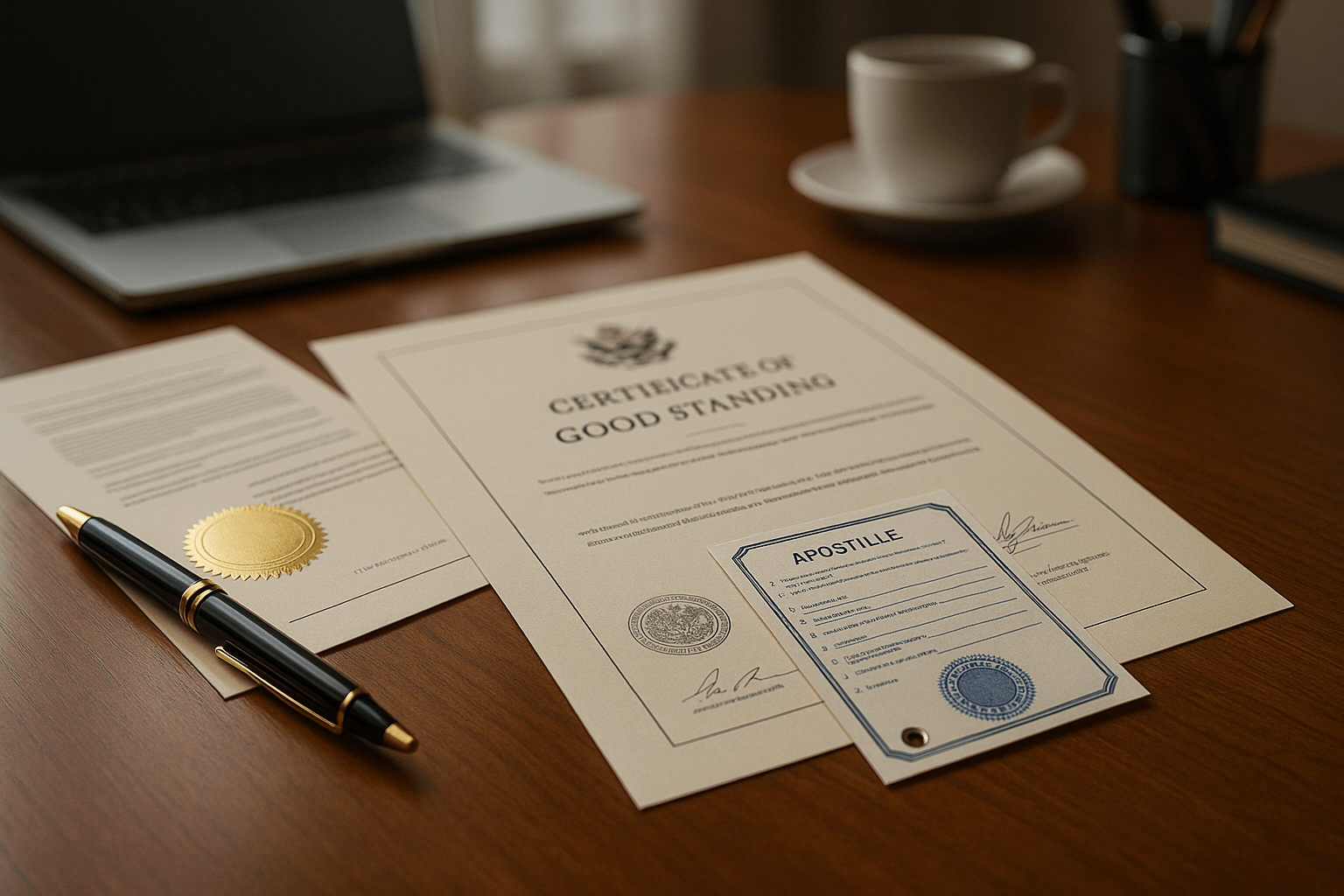
Certificate of Good Standing Apostille: What You Need to Know
If you’re planning to expand your business internationally or submit corporate records overseas, you’ll likely be asked to provide a certificate of good standing. This document proves that your company is properly registered and in full compliance with your home state. But to be accepted abroad, it often needs to be apostilled.
In this guide, we’ll break down how to get your certificate of good standing apostilled, what you’ll need before you apply, and what to expect from your state’s process.
What is a Certificate of Good Standing?
A certificate of good standing is a document your state issues to confirm that your business is officially registered there. It shows that your business has met its filing obligations and is permitted to operate within the state. This certificate is often used to prove that your business is in compliance with state regulations and has not been suspended or dissolved.
When dealing with foreign entities such as clients, banks, or government agencies, you will likely be asked to submit this document as proof of your company’s legitimacy. However, a U.S.-issued certificate by itself is not enough for international use. To be accepted abroad, the document must include an apostille on the certificate of good standing, which serves as formal validation that the document is genuine and properly issued by the state.
This requirement often comes up when your company is expanding into new countries, opening international bank accounts, applying for foreign permits, or participating in cross-border mergers and acquisitions. Countries that typically request this include the United Kingdom, France, Germany, Spain, Mexico, Chile, South Korea, Australia, and the Netherlands. If the country you’re submitting documents to isn’t in the Hague Apostille Convention, you’ll have to follow the full legalization process instead.
Understanding the Certificate of Good Standing Requirements
Before you submit your documents for an apostille, you’ll need to make sure they meet the necessary criteria. Otherwise, your application could be delayed or denied.
What the Document Must Include Before Apostille Submission
To be accepted, the certificate must include:
- The legal name of your company
- Confirmation of its active status
- The state in which it’s registered
- The date of issuance
- The official seal and signature of the issuing authority
Some states also list your business formation date or type of entity, which is helpful but not always required.
When a New Certificate Is Required Instead of an Existing One
A certificate of good standing is generally valid for only a short time, often 30, 60, or 90 days. If yours is older than that, you’ll need a new one before beginning the apostille process. Foreign institutions often reject expired or outdated versions.
Some situations that may require a fresh certificate:
- Submitting documents to a government agency abroad
- Dealing with financial institutions
- Applying for time-sensitive permits
Differences Between Corporate, LLC, and Partnership Good Standing Certificates
How your good standing certificate is issued depends on the kind of business entity you’ve registered:
- Corporations. Typically issued by the Secretary of State, listing the incorporation date and status
- LLCs. Also issued by the state, with similar details to corporate versions
- Partnerships. May require additional documentation or filings, depending on the state
Each structure has its own compliance rules, which the state checks before issuing your certificate. As such, keep all your filings up to date so your request doesn’t get held up.
State-by-State Variations for Apostilling a Good Standing Certificate
The process to apostille a certificate of good standing isn’t the same in every state. Some states offer faster services, while others may require extra steps or supporting documents.
States That Issue the Certificate Through the Secretary of State
Most states handle this directly through the Secretary of State’s office. In many states, you can:
- Order the certificate online
- Request expedited processing
Examples include:
- California
- Texas
- Florida
- Georgia
- Illinois
As long as you obtain a certified version directly from the Secretary of State or other issuing office, no notarization is required in any U.S. state. In these cases, you can send it straight to the apostille office.
States Requiring Additional Corporate Records or Validation
Before a state issues a good standing certificate, your business must be in full compliance with state requirements. This means your annual reports, franchise taxes, and state filings must already be up to date.
However, apostille offices do not require you to submit these filings. They only verify the authenticity of the certificate itself.
If your business is not compliant, the state may decline to issue the certificate — but compliance documents are never part of the apostille submission.
States With Digital vs. Paper Certificates
Many states now issue digitally certified good standing certificates, and most apostille offices accept them as long as they include an official electronic seal or signature. However, some states still prefer or require printed, certified copies.
Here is a more accurate breakdown:
Digital certificates are commonly accepted:
- Delaware
- California
- Texas
- New York
- Arizona
- Colorado
States that more often issue or require physical certified copies:
- Louisiana
- Alabama
- Mississippi
If your certificate is digital but you are unsure whether the apostille division will authenticate it, request a printed certified copy directly from your state agency to avoid processing issues.
Steps to Apostille a Certificate of Good Standing
Once you’ve got the right version of your certificate, here’s how to proceed.
Confirming the Document’s Eligibility
Double-check:
- It’s been issued within the last 90 days
- It includes all the required details
- It’s signed and sealed by the issuing state authority
- The destination country is a Hague-Convention member
Without these, your application could be denied or sent back.
Preparing Corporate Records for Submission
If your state requires supporting paperwork, gather it ahead of time. These may include:
- a completed apostille request form
- a cover letter with destination country information
Some states offer templates or instructions on their website.
Submitting to the Appropriate State Authority
Send your documents to the right office — either the state apostille division or the Secretary of State. Include:
- The original certificate
- Any required application form
- Payment by check or credit card
- A pre-paid return envelope
Some states allow walk-ins or expedited service for an extra fee.
Receiving the Apostilled Certificate Securely
When everything is finalized, your apostilled certificate of good standing will be shipped back to you through mail or a courier. To protect your documents:
- Use tracked shipping
- Store a digital backup
- Don’t separate the apostille from the certificate — doing so may invalidate the document
Processing Options and Expected Timelines
Getting your certificate of good standing apostille can take a few days or several weeks, depending on your state, the service speed you choose, and how busy the office is.
Typical timelines:
- Fast states (1–5 business days): California, Texas, Florida, Colorado, Washington, D.C.
- Moderate states (7–15 business days): Illinois, Georgia, Pennsylvania
- Slower states (3–7 weeks): New York, New Jersey, Maryland
Expedited service, where available, can reduce turnaround to 24–72 hours, but each state sets its own fees.
Apostille fees generally range from $5 to $20 per document, though some states charge more for expedited handling or certified copies. Remember to include shipping costs if submitting by mail.
Delays can happen if you submit a certificate that is not properly certified, forget a payment, skip a required form, or send a digital copy when a physical one is needed. To avoid issues, always follow your state’s apostille instructions carefully.
Common Issues and How to Avoid Application Rejections
Even minor errors can lead to your apostilled certificate of good standing being denied. Here are some of the most common problems.
Certificates Issued Too Long Ago
While apostille offices typically authenticate certificates of good standing regardless of their issue date, the foreign institution receiving the document may require it to be recent — usually no older than 30, 60, or 90 days. To avoid rejection abroad, always confirm how recent the certificate must be and order a fresh copy before starting the apostille process if needed.
Missing Corporate Signatures or Incorrect Entity Information
A good standing certificate must list your company name exactly as registered. If there’s a typo or mismatch in your entity type (like LLC vs. Inc), the apostille might be denied. Also, if your certificate requires a company officer’s signature, make sure it’s signed before submission.
Mistakes When Submitting Digital Copies
While digital certificates are becoming more common, apostille offices only accept versions that include an official digital signature or electronic seal. A simple PDF download or printout without certification will be rejected. When in doubt, request a physical, signed, and sealed certificate from your state agency.
Take the Stress Out of Your Apostille Process
Securing a certificate of good standing apostille is an important step when working with foreign institutions or expanding your business abroad. With state requirements varying widely, paying attention to the details will help you avoid delays and ensure your documents are accepted the first time.
Before you begin, review your state’s process and make sure your certificate is current, correctly issued, and submitted with all required forms and fees. If you’d rather not navigate the process on your own, services like EZ Apostille can handle the preparation and submission for you, ensuring your documents meet international standards without added stress.
FAQ
Do foreign authorities require the certificate of good standing to be issued within a specific timeframe?
Yes. Most international institutions require that the good standing certificate be no more than 30 to 90 days old. Always confirm the date range before sending your documents for apostille.
Is a digitally issued good standing certificate acceptable for an apostille?
It depends on the state. Some accept digital versions with an electronic seal, while others require a printed and signed original. When in doubt, get a physical copy with a raised or ink seal.
Can different versions of a good standing certificate be used for the same apostille request?
No. The document you submit must match exactly what the apostille office approves. Mixing versions — even from the same state — can cause delays or rejections.
Will the apostille process change if my company recently updated its legal name or address?
Yes. If your company has gone through changes, you’ll need to make sure the certificate of good standing reflects the updated information. Otherwise, the document may be considered invalid for an apostille.
Can an apostilled good standing certificate be used for opening a business bank account abroad?
Absolutely. In fact, this is one of the most common uses for an apostille certificate of good standing. International banks want to make sure your business is real and in good standing before they allow you to open an account.
Related Posts

Apostille for a Distributorship Agreement: Requirements, Process, and Costs
How to Get an Apostille for a Birth Certificate in New York