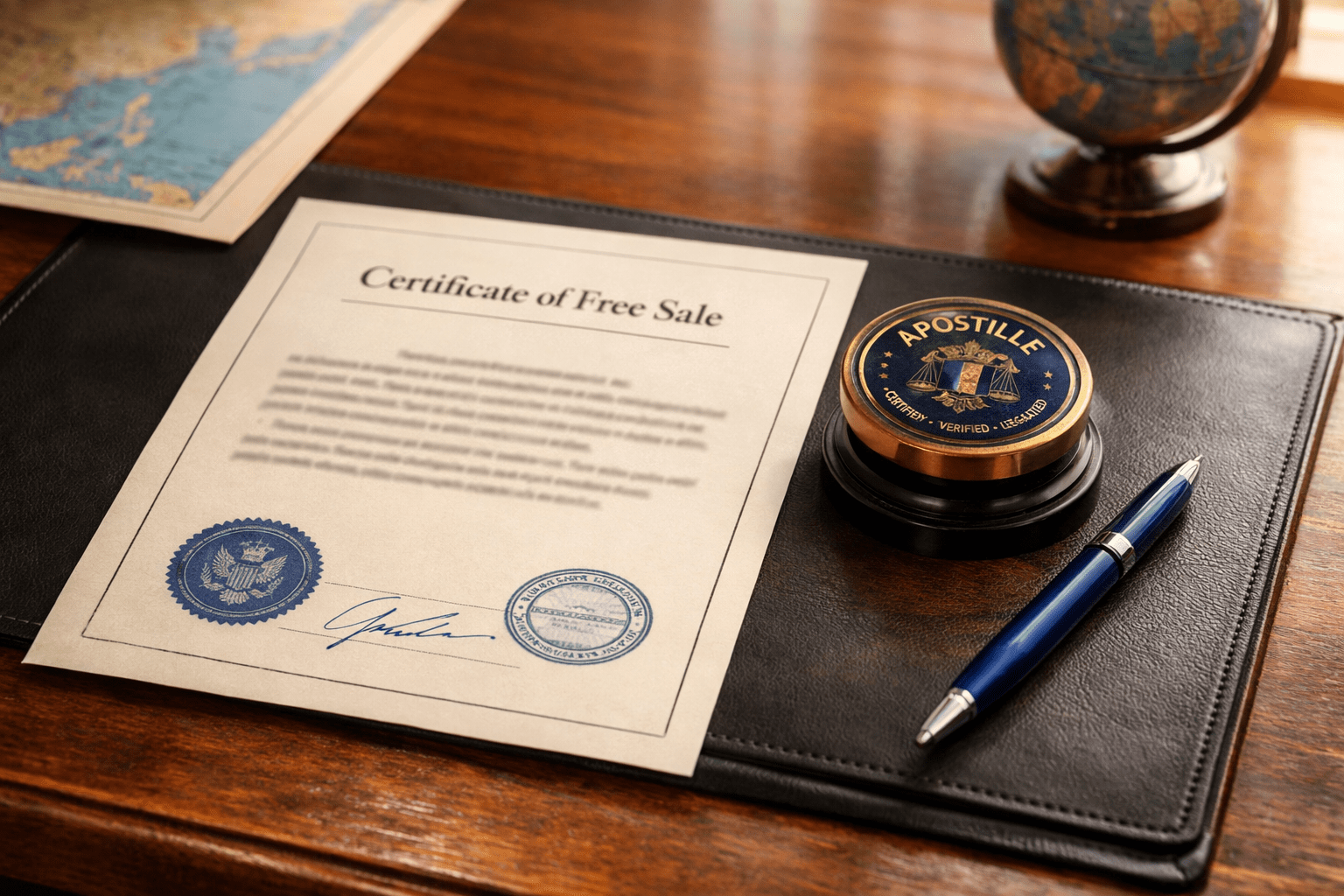
Certificate of Free Sale Apostille
Your products are ready for shipping, but the paperwork is as important as the shipment itself. Often, the single document standing between your business and its new market is the Certificate of Free Sale.
So, what is it, and how do you validate it? If you need a free sale certificate apostille to authenticate the document’s signature and authority for foreign use, you have found the right place. Let’s reveal everything you should know about this document and how to prepare it for the apostille process.
Overview of the Certificate of Free Sale
A free sale certificate is a crucial instrument used by exporters when sending goods overseas. In simple terms, it serves as official proof that the commodities are legally sold in the home country. Here are the details:
What Is a Free Sale Certificate and Why Businesses Need It for Export
Having a certificate of free sale is one of the requirements made by importing governments before they can allow U.S. goods to enter their market. Foreign regulators rely on this certificate to assess a product’s legitimacy, safety, and compliance under the current regulations of the exporting country.
Types of Products and Industries That Rely on This Certificate
A wide range of industries depend on free sale certificates to verify goods that impact public health and the environment. Key sectors include:
- Foods and beverages
- Cosmetics and personal care
- Medical equipment and devices
- Pharmaceuticals
Any exporting companies operating in the U.S. market may need this critical document to fulfill customs or registration requirements in another jurisdiction.
Getting Your Certificate Ready for Apostille
To obtain a free sale certificate apostille smoothly, meticulous preparation is key. Since this certificate is often used in time-sensitive matters, ensuring your paperwork satisfies the strict pre-conditions for apostille processing can save you weeks of back-and-forth or costly setbacks.
Confirming the Correct Issuing Agency
The certificate must originate from a recognized regulatory body, typically the FDA, state departments of health/agriculture, or trade associations. Verifying the source of your certificate is the essential first step because it determines the entire authentication path — whether state-level or federal.
When Extra Signatures or Agency Approvals Are Required
Certain certificates need additional endorsement from a public entity or the issuing agency. For instance, some state offices require a signature from a specific competent official, while digital certificates may undergo extra verification before they qualify for apostille submissions.
Common Document Issues That Prevent Apostille Acceptance
The most common pitfalls that result in apostille rejections stem from:
- Missing original signatures
- Improper notarization or certification
- Submitting to an incorrect apostille processing authority
Ensure your certificate is complete with a legible signature, obtain the necessary notarization or certification, and submit a request to the right office to prevent outright rejection and fast-track approval.
Who Handles the Apostille for a Certificate of Free Sale
Now that you have an idea of what a free sale certificate is and how to prepare it for the apostille, it’s time to identify who is responsible for authenticating it. Rule of thumb: the issuing authority dictates which government agency has the power to attach the apostille.
When the State Secretary of State Processes It
If a state authority, like the Department of Health or the Department of Agriculture, issued your certificate, the apostille must be handled by the Secretary of State’s office in the same jurisdiction. This is often referred to as state-level authentication. Sometimes it requires prior notarization or county certification. Cosmetics, food items, and general consumer goods are typical examples that require state validation for exports.
When the FDA or Other Federal Agencies Require a U.S. Department of State Apostille
Certificates originating from federal agencies, such as the FDA or USDA, must go through the federal route. A state office isn’t authorized to authenticate federal documents. Instead, they must go through the federal apostille process at the U.S. Department of State in Washington, D.C., after the proper federal official’s signature has been certified. Products falling under this category may include certain drugs, biologics, and medical devices.
Why the Destination Country Matters for Your Submission
Some foreign countries have unique requirements about which agency must issue the apostille for your certificate. Others may also request specific endorsement from a designated office or additional verification from their embassy. Understanding these rules helps create an effective submission strategy and increase the likelihood of acceptance in the destination country.
How to Apostille a Certificate of Free Sale: Simple Step-by-Step Guide
The process involves straightforward, organized steps to obtain an apostille for a free sale certificate. By adhering to the instructions below, your documents will meet the standards of both U.S. authorities and the foreign country importing your products.
Step 1: Check the Certificate’s Details and Validity
Begin by conducting a thorough review of the certificate. Confirm that details, including product name, manufacturer information, issuing agency, and dates, are accurate and match other paperwork. More importantly, many countries expect recently issued certificates and may reject older ones, but specific validity windows vary by destination. Confirm your certificate’s validity before moving forward.
Step 2: Complete Any Required Pre-Authentication
Some federal certificates need additional verification before they’re ready for the apostille. Ensure you complete all the required pre-authentication before sending the document to the state or federal office. For instance, the signature on a state-issued certificate may have to be certified by the county.
Step 3: Submit to the Correct Apostille Office
Once you have compiled your apostille package, submit it to the appropriate apostille office. Usually, state-issued certificates go to the Secretary of State in the state of issuance, while federal ones must be directed to the DOS. The procedures often take from a few days to several weeks, so plan accordingly.
Step 4: Review the Apostilled Document Before Using It Abroad
Finally, after receiving your apostilled certificate of free sale, double-check that the apostille is attached properly and all information corresponds to your original certificate. Quality control prevents last-minute mistakes that jeopardize your entire authentication effort before presenting the certificate to foreign customs or regulatory bodies.
Common Reasons Foreign Authorities Reject a Certificate of Free Sale
Receiving an apostille in the mail is a victory, but this isn’t the final hurdle. Even when your apostilled free sale certificate looks fine at first glance, foreign authorities have the sole judgment to decide whether they accept it. Knowing these usual rejection reasons allows you to avoid a stranded shipment effectively.
The Certificate Does Not Match the Product Being Exported
The most frequent issue lies in a discrepancy between the product listed on your certificate and the actual product being shipped. A minor mismatch, such as a product name or packaging description, might trigger rejection. Ensure these details, as well as model numbers, formulations, and intended uses, are identical across your certificate, labels, and customs manifests.
Foreign Authorities Require a Country-Specific Version of the Certificate
Importing nations may have their specific certificate template or require additional attestations, so it’s best to check with the receiving authority first. Presenting a standard U.S. free sale certificate apostille in this case is insufficient. You must follow the receiving country’s rules on format, wording, or regulatory references.
Using a Certificate That Is Too Old or Outside Its Acceptable Validity Range
Some authorities enforce a validity period for certificates, which may require recent issuance depending on destination requirements. Hence, submitting an outdated certificate may result in rejection, even when it has been perfectly apostilled. Note that the date of issue on the underlying certificate differs from the date on the apostille.
Missing or Incorrect Translation Requirements
If the receiving authority requires a certified translation of your certificate, verify whether the translation must occur before or after apostille processing. Requirements differ between jurisdictions. Sending an English version only will lead to outright rejection. An approved professional in your jurisdiction must perform the translation. Incomplete or inconsistent translations also cause problems abroad.
Foreign Authorities Do Not Recognize the Issuing Agency
Foreign authorities may accept certificates issued by selected U.S. agencies that they have officially recognized. For those coming from other sources, there’s a high chance of rejection due to the issuing agency being considered invalid. Ensure that the issuing body is credible internationally for seamless approval.
Practical Tips for Faster, Smoother Apostille Processing
A proactive strategy can make the process way more efficient, especially when your export deadlines are looming. These practical tips derived from real-world experience will help you facilitate approval, ensuring both the goods and paperwork are ready for your upcoming global endeavor.
Timing Your Certificate for Export Deadlines
Order a certificate in time for tight export deadlines, but close enough to make it recent according to the regulatory requirements. Consider the time for certificate issuance, extra verification, certified translation, apostille processing, and a buffer for unexpected delays. Ideally, get started at least 8 weeks before the shipping date.
Ordering Extra Originals for Multiple Markets
Request multiple originals from the issuing agency if you’re exporting to more than one market. You’ll need a separate apostille for each destination, and having extra copies in hand is more efficient than scrambling for duplicates at the last minute.
Preparing Documents for Customs, Registration, or Import Authorities
While important, a certificate of free sale isn’t a standalone paper when exporting goods. You should also pay attention to other supporting documents, such as product lists, commercial invoices, and ingredient breakdowns. Keep the records in sequence to accelerate reviews and clear customs with confidence.
Rely on EZ Apostille Expertise for Export Compliance
Stop leaving your export plans to chance. The right apostille preparation and expert assistance can help you launch your products on the global stage without delays. Ready for fast, reliable processing? Let us manage the paperwork while you focus on your next shipment!
FAQ
These simple answers about free sale certificate apostilles will make navigating apostille requirements easier.
How long is a Certificate of Free Sale valid for apostille purposes?
Some countries prefer recently issued certificates, but acceptable issuance dates vary, even though an apostille can be attached to a document regardless of its issue date.
Can a company apostille a digital Certificate of Free Sale?
Yes, but acceptance depends on the destination country’s rules. Also, check your state requirements if they mandate a print version of the certificate for apostille purposes.
Do different countries require different versions of the Certificate of Free Sale?
Yes, foreign countries may expect a specific format or wording, and you must follow these standards closely to ensure acceptance.
What is the fastest way to apostille a Certificate of Free Sale for urgent exports?
Contacting a professional service provider that offers expedited processing is the most dependable way to handle urgent needs. Our team at EZ Apostille specializes in coordinating time-sensitive document authentication for export.
Can multiple certificates be apostilled together for the same shipment?
Yes, it’s possible to bundle your request and receive multiple apostilles at once if you’re exporting several products. Each certificate of free sale will have its own apostille.
Related Posts
Commercial Invoice Apostille for International Trade: Step-by-Step Guide
Birth Certificate Apostille in Los Angeles, CA: Requirements, Processing Time, and Cost