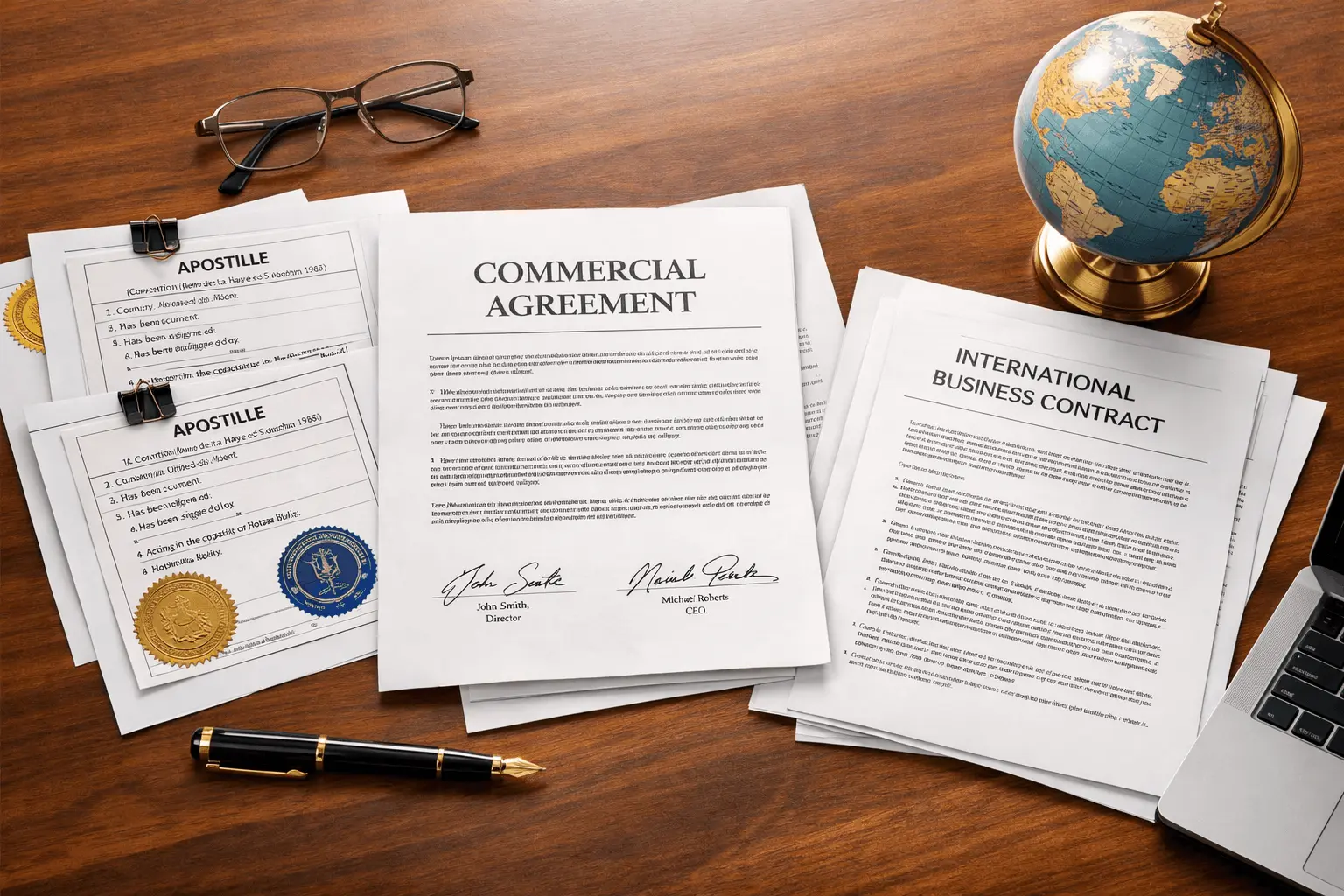
How to Apostille General Agreements for Cross-Border Business
Global business flourishes on trust, which begins with authenticated paperwork. Sealing the deal in a global context requires more than a signature and handshake — your critical contract must undergo the international apostille process for legal enforcement abroad. Let’s uncover how to get your business documents apostilled correctly, paving the way for smooth, solid ventures overseas.
Why General Agreements Require Authentication Abroad
When business crosses international borders, an apostille for business contracts is a strategic shield against compliance issues. Presenting unauthenticated agreements overseas is often considered illegitimate — legally non-binding and unenforceable.
This vulnerability exposes enterprises to reputational damage, loss of proprietary rights, legal impasse, and the inability to uphold terms. Ultimately, securing an apostille certification is a critical safeguard for global operations and partnerships.
Types of General Agreements Commonly Apostilled for Global Use
It’s essential to apostille contracts, but what do they cover? “General agreement” refers to the vital instruments that define your business relationships. When an apostille is attached, these documents are certified for use abroad. Below are the most common types that we help authenticate for our clients:
Commercial and Service Agreements
These foundational contracts govern the sale of goods or the delivery of services between international parties. Whether it’s a procurement agreement for raw materials or an ongoing master service contract with a vendor, foreign authorities often require apostilled copies for official procedures. This protects both parties from legal uncertainty during customs, tax reporting, or disputes.
Partnership, Distribution, and Agency Agreements
Documents establishing formal channels for market entry are usually apostilled to become valid overseas, reducing risks in international business. Think of a partnership agreement that creates a cooperative entity, a distribution contract that grants exclusive rights, and an agency contract that assigns a local representative. An apostille assures foreign regulators of the document’s genuineness and validity.
Shareholder, Joint Venture, and Investment Agreements
For companies seeking foreign investment or entering a joint venture, these pivotal documents confirm ownership, governance, and financing flows across borders. Apostilled documents provide verified proof of shareholder rights or funding commitment that foreign authorities and financial institutions require, whether registering an entity or reporting investments to a central bank.
Licensing, IP, and Technology Transfer Agreements
Intellectual and technological properties are among the most valuable assets in today’s global market. Licensing or transfer agreements involving trademarks, patents, and proprietary technologies must be authenticated before submitting to key foreign licensing offices or tax authorities. An apostille safeguards the company’s interests and ensures its IP rights are defensible during proceedings.
Determining Whether an Apostille Is Required for Your Agreement
Before starting the apostille process, it’s crucial to determine if your agreement actually needs it. An apostille for corporate documents doesn’t apply to every country or situation, so understanding the rules upfront will help you save time and prevent wasted attempts. Here’s a methodical way to identify your route:
Identifying the Destination Country’s Legal Framework
Your first task is to review the laws of the country where your contract will be used. If the destination is a member of the Hague Apostille Convention, you’ll likely obtain an apostille for document acceptance there. Moreover, also check with the specific requesting entity, as some institutions demand extra certification.
Hague Convention Applicability for Business Agreements
For over 120 Hague-member nations, a single apostille is adequate for recognition. It certifies the notary’s signature and seal, making the business agreement admissible in all administrative and court procedures within the given jurisdiction. This framework streamlines global business transactions, as you no longer have to go through the lengthy, multi-step legalization.
When Additional Legalization May Be Required
Countries outside the treaty, such as Cuba, China, and Qatar, require the traditional consular legalization for U.S. contracts to be accepted. It entails verification by both the state and federal offices, along with final approval from the destination’s embassy. Therefore, knowing which method applies is fundamental to pursuing the correct path to document authentication.
Preparing General Agreements for the Apostille Process
Success in apostilling business agreements hinges on careful preparation of the request package. Sending a document that doesn’t meet the eligibility or formatting criteria will result in delayed ventures overseas. Run through this checklist to transform a regular contract into an internationally enforceable one.
Verifying Proper Execution and Signatory Authority
Ensure the agreement is executed perfectly before scheduling a notary. Each authorized representative will sign in their correct legal capacity, with the signature matching their name and title. The notarization later verifies this capacity, so every detail should be accurate without any discrepancies.
Meeting Notarization Requirements for Business Agreements
For a majority of U.S. contracts, notarization is mandatory before requesting an apostille. A commissioned notary must witness the signing of the agreement upon verifying the signatory’s identity and willingness. The notary’s confirmation is what the state-level apostille office will ultimately authenticate.
Determining Whether Certified Copies or Original Agreements Are Required
Some apostille offices accept certified copies of contracts issued by a record keeper, while others strictly demand notarized originals. You should clarify the requirements with the apostille authority and the destination country to avoid resubmissions. In case copies are eligible, they’re almost always issued by a county clerk or certified as a true copy by a U.S. notary public.
Addressing Language, Formatting, and Translation Requirements
An apostille validates signatures and seals, not the content, so it isn’t necessary to translate your agreement into English if it’s drafted in another language for an apostille. However, it may need a certified translation for the end-user country.
If translation is required, it must be carried out before requesting an apostille, and the translated version will be submitted together with the original. Ensure that both are clear, legible, and free of alterations in compliance with formatting rules.
Step-by-Step Process to Apostille General Agreements
Once you’ve prepared your business contract, it’s time to navigate state submission. Having business documents apostilled is a matter of precision, so following our clear roadmap will remove confusion and guarantee a trouble-free journey for the agreement from your desk to its final destination abroad.
Selecting the Correct Competent Authority
The right apostille authority for your agreement is usually the Secretary of State or an equivalent agency in the state where it was notarized. This works for all private contracts, unless they were federally issued or certified. If the agreement is a federal document, it must be directed to the Department of State for authentication.
Submitting Documents for Apostille Processing
After identifying the correct authority, submit your agreement in person, by mail, or via an online portal, depending on the specific state’s submission protocols. This typically involves filling out a request form with your contact details, paying the statutory fees, and handing in the prepared document.
Processing Timelines and Expedited Options
Processing times fluctuate by state, ranging from 5 to 20 business days, depending on workload. Many state offices offer walk-in and expedited services, which may even return approval on the same day — ideal for urgent needs. Planning around these timelines wisely, or choosing an appropriate service when necessary, is key to meeting critical deadlines in international business.
Receiving and Verifying the Apostille Certificate
Upon issuance, you should review the apostille certificate carefully for accuracy. Verify all information is correct and matches the original agreement — names, signers’ details, and the issuing authority’s seal. As everything is in place, the corporate paperwork is now ready to be presented abroad!
Common Mistakes in Apostilling Business Agreements
No matter how well-prepared you are, setbacks might creep in at the most unexpected moment. Being aware of these common pitfalls is the best defense against delays, rejections, and added costs when apostilling business contracts.
Incomplete Notarization or Improper Signatures
An agreement containing a flawed notarization or an unauthorized signature will be rejected instantly. This might include the notary having an expired commission or witnessing a signature where the signer’s name doesn’t match their ID. If the notary’s act is deemed defective, the state office will deny attaching an apostille.
Apostilling Documents Not Accepted by the Destination Country
Sometimes, issues lie in the underlying document itself. Assuming the target country accepts all types of business agreements is a common misstep that many make. It’s best to consult with the requesting authority on your specific agreement in the first place and obtain any required notarization/certification properly.
Overlooking Country-Specific Formalities
Every jurisdiction imposes its unique requirements for document age, formatting, and translation. An expired contract will be rendered useless when the foreign government mandates that it must be recent. Failure to research these nuances can risk non-compliance and stall your project indefinitely.
Delays Caused by Incorrect Authority Selection
Unsurprisingly, selecting the wrong issuing authority ranks among the most frequent reasons for apostille rejection. Submitting a California-notarized contract for authentication in New York will result in an unprocessed package. Similarly, sending your state-level agreement to the DOS is a guaranteed re-route.
Benefits of Apostilling Agreements for Global Operations
Engaging an apostille service like EZ Apostille is a rewarding investment that empowers international operations while minimizing friction. A proper apostille not only authenticates your business contract but also strengthens the company’s position in the global market.
Faster Market Entry and Contract Enforcement
With apostilled documents, businesses can hasten entity registration, bank account opening, and contract enforcement, reducing delays that often occur due to a lack of document authentication. Should any disputes arise, an apostille serves as qualified evidence in local courts, preventing costly delays.
Increased Trust with Foreign Partners and Institutions
Presenting a contract with an apostille attached signals professionalism to foreign partners, financial institutions, and regulatory bodies. It demonstrates your respect for international laws, establishing credibility right from the beginning and fostering meaningful business relationships.
Compliance with International Corporate Governance Standards
Many countries expect businesses with international operations to maintain a portfolio of authenticated documents in compliance with their current regulations. Securing apostilles early allows companies to align with transparency requirements in these jurisdictions, ultimately reducing the risk of violations or regulatory issues.
Get Agreements Ready for Global Use
Apostilling corporate documents sets the blueprint for your international venture. This procedural step protects investments, reinforces partnerships, and supports global growth. With attentive preparation and expert support from EZ Apostille, you can replace uncertainty with trust, recognition, and compliance worldwide.
FAQ
Still have concerns about apostille services for international business? Here are a few answers that may clarify them for you.
Can a single general agreement be apostilled for use in multiple countries?
Yes, but you must ensure that its content and formatting meet the requirements of all receiving countries. Furthermore, you’ll need multiple copies and have them notarized properly, as an apostille will be attached to each copy separately.
Does every amendment or addendum to an agreement require a separate apostille?
Yes, if the amendment or addendum is added after the agreement has been apostilled. To be enforceable abroad alongside the main document, it must undergo the same authentication process as the agreement.
How long is an apostille valid for business agreements?
Indefinitely. Since an apostille doesn’t have an expiration date, it remains valid forever unless the destination country specifies a validity period for the underlying document.
Can digital or electronically signed agreements be apostilled?
Yes, only if your state participates in the e-APP. You’ll also need to check with the receiving authority if they accept e-Apostilles. Otherwise, the digital or electronically signed agreement must be converted into a physical copy before it can be authenticated.
What happens if a foreign authority rejects an apostilled agreement?
In cases of rejection, you may diagnose the problem or contact the foreign authority directly to inquire about the decision. Then, correct the issue to meet the country-specific formalities or translation requirements, for example. Our team can guide you through the necessary rectifying steps quickly to achieve acceptance.
Is it possible to apostille agreements executed outside the United States?
No, you can only obtain an apostille for business agreements executed within the U.S. For those signed or notarized abroad, they must be authenticated by the competent authority of the country where the execution or notarization took place.
Related Posts
FBI Background Check for Bulgarian Residency: What U.S. Applicants Need to Know

Getting Married Abroad: U.S. Documents Couples May Need