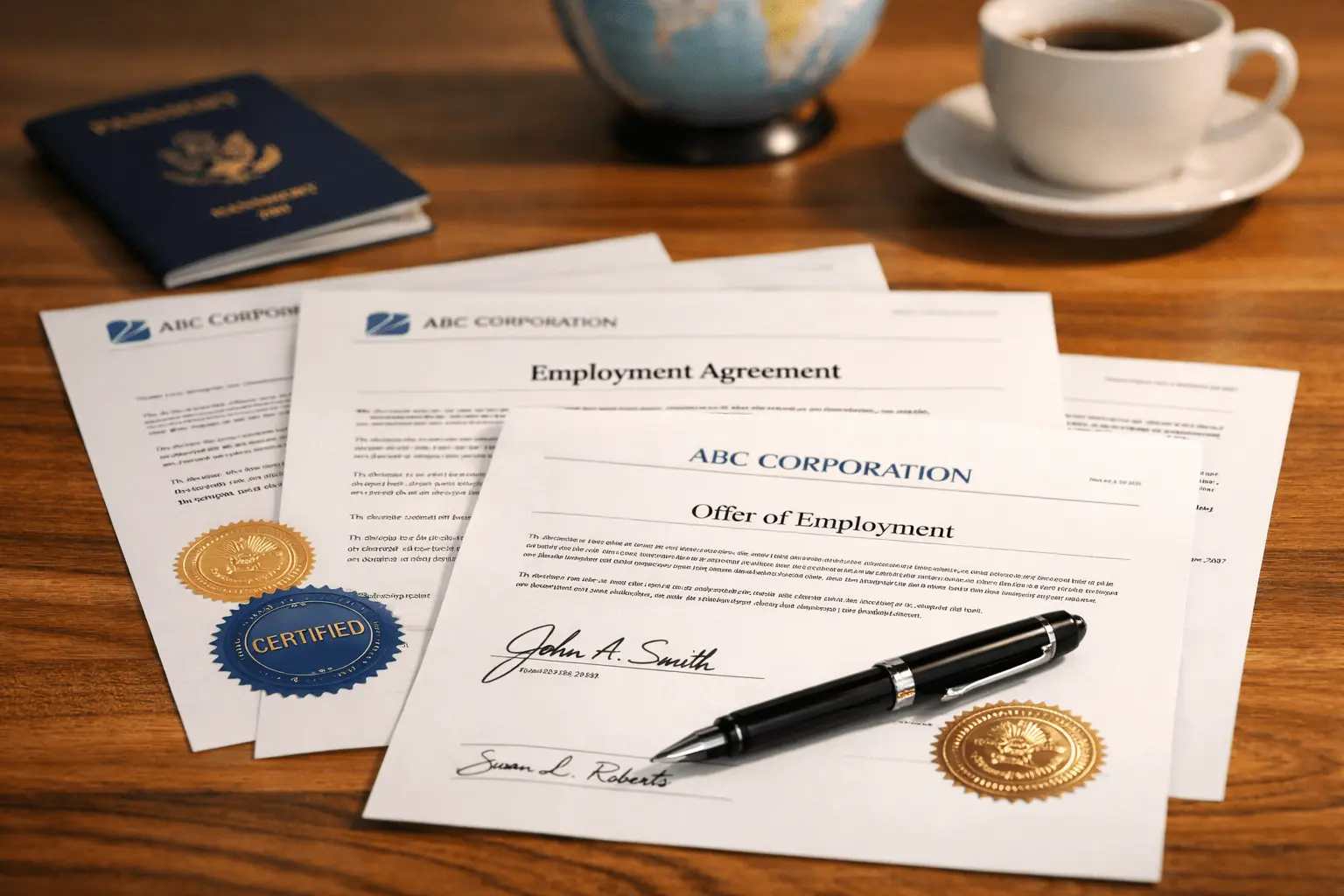
Apostille for your references and job certification documents
Pursuing your dream career overseas often begins with presenting official documents that demonstrate your professional background. Whether a job reference or employment confirmation letter, standard U.S. paperwork isn’t enough to be recognized abroad — these critical papers must carry an apostille seal as proof of authenticity for use in another jurisdiction.
While authenticating work history might seem daunting, it shouldn’t derail your ambitions. In this post, we’ll demystify the pathway to obtaining an apostille for an employment certificate, empowering you as you advance in your new opportunities across borders. Let’s jump right in!
Why Employment References and Job Certificates Need an Apostille
When planning to work abroad, foreign authorities usually require you to show validated employment documents from your home country. A potential employer or immigration officer has no inherent way to verify the signatures. Therefore, an apostille solves this problem by offering a widely accepted chain of authentication.
When Employers Abroad Ask for Apostilled Documents
Before onboarding, many hiring managers overseas request that you submit proof of your work experience. This goes beyond a standard resume or job certification — they expect official documentation that shields them from legal risk when appointing international workers. More than evaluating your skills, companies need to comply with strict labor regulations in their own country.
By sending apostilled paperwork accordingly, you provide verifiable evidence that your work credentials are genuine and formally acceptable. In many cases, this is a standard requirement when working abroad, assuring foreign companies of your professionalism and that the U.S. government has endorsed your background.
How Apostilled Job Documents Help with Visas and Work Permits
Beyond the hiring process, an apostille also plays a crucial role in immigration. Specifically, most embassies and consulates request supporting paperwork when you apply for a visa or work permit.
An unverified reference or certificate may lead to a rejected application or extended processing time, as immigration officers can’t validate the signature. Having your work documents properly apostilled helps ease this global transition by reducing administrative setbacks and strengthening your credibility.
Employment Documents That Can Be Apostilled
You don’t necessarily have to apostille all paperwork related to your career, but certain documents are essential when proving your work history. An employer reference letter, for example, can be authenticated to substantiate your claim of working in a specific role. Here are the most frequently apostilled records:
Employment Reference Letters
These include letters written by a supervisor or manager that outline your position, responsibilities, and achievements. They often come with the writer’s recommendation for the potential job opening. Once authenticated, reference letters carry significant weight with overseas employers, reassuring them that they can rely on the trustworthiness of your references.
Certificates of Employment
Current or former employers may issue these documents to confirm the essential facts of your employment. Certificates of employment typically include:
- Full name and job title
- The start and end dates of employment
- Job duties and salaries
The standardized format of employment certificates makes them a common type of paperwork for apostille purposes.
HR Employment Verification Letters
Employment verification letters are usually generated by a company’s Human Resources department on request. They act as official confirmation of your employment status, stating that the information you’ve provided to foreign authorities is accurate according to the records. For the apostille process, a signature from an authorized HR representative is fundamental.
Experience Letters for Working Abroad
Experience letters aim to highlight your skills, performance, and contributions during your time with a company that are relevant to the new role abroad. They serve as strong evidence of your professional qualifications and align your previous experience with the hiring requirements for the next position overseas. Authenticating these documents supports your career mobility and ensures your U.S. experience is appropriately considered when relocating to another country.
How to Apostille Employment References and Job Certificates
Securing an apostille for work documents involves more steps than simply submitting the paperwork to get approval. The apostille process is governed by precise international standards, allowing documents to become valid abroad. Understanding each step is crucial to avoiding weeks of delays, and this is what you should know:
Check Who Issued the Document
You first need to identify the issuing authority of your employment paperwork. Whether a direct supervisor or a company executive, the issuer must be competent to provide such records. It’s also important to note that authentication offices might reject documents that appear informal or lack information about the issuing party.
Notarize the Employment Document
Notarization is mandatory for all private employment references and job certificates before the official can attach an apostille. A company’s representative must sign your document in the presence of a notary public. Upon verifying the signer’s identity and witnessing the signature, the notary will affix their official seal.
Submit the Document for an Apostille
Once notarized, the document is ready to be submitted to the Secretary of State in the jurisdiction where it was issued. The submission steps include completing an official request form, paying the processing fee, and providing a pre-paid return envelope if you choose to receive the apostille by mail. Some states accept walk-ins, while mail-in requests are the only method in certain places. You should adhere to your specific state’s submission guidelines to secure the certification.
Apostilling Printed Digital Employment Letters
Many references are sent via email nowadays, making it essential to understand how to authenticate a printed copy of a digital letter. If your state does not currently issue e-Apostilles or accept electronically notarized documents, you must create a physical version of the document and have it notarized. This means the original signer has to re-sign the hard copy in front of a notary public to ensure the chain of authentication remains unbroken.
Translation Needs
If English isn’t the official language of your destination country, there’s a high chance you may need a certified translation of your document. While U.S. apostille offices do not require translations, the receiving country may. Any required translation must accurately reflect the content of the original paperwork and comply with the destination authority’s rules. In most cases, the apostille is issued on the original document, and the translation is provided separately when submitting your paperwork abroad.
Where U.S. Apostilled Employment Documents Are Accepted
An apostille for a job reference is accepted in over 120 countries that are signatories to the Hague Convention. This means you can use the apostille in most of Europe, Latin America, and a large part of Asia. In such countries, your employment documents are automatically considered legally valid with an apostille attached — no further verification steps are required.
On the other hand, not every country is a member of this treaty. Most Middle Eastern nations and China ask for additional embassy legalization beyond the U.S. authentication process. In these cases, after obtaining state certification, your documents must be forwarded to the federal agency and then legalized by the foreign consular office. That’s why understanding the target country’s requirements is necessary to determine the right route for your employment paperwork.
Common Problems When Apostilling Job Documents
Oversights can always occur even when the process seems straightforward. To have the best defense against potential issues during apostille certification, be aware of these common pitfalls that may hinder your application.
Missing Letterhead or Signature
Submitting a reference letter or job certification without a company letterhead or authorized signature is one of the most frequent mistakes. Apostille authorities are often stringent about document formality. Your employment document should be printed on official letterhead paper featuring the company’s logo, name, and contacts, along with an original signature that can be verified.
Wrong Person Signed the Reference
A critical mistake is having an irrelevant individual sign your work document. For example, a colleague may provide a reference, but they can’t legitimately confirm your employment. Only authorized HR representatives and company executives are typically considered proper signatories. The receiving institution might reject a reference letter if it lacks official weight, even when it has been properly notarized.
Apostille Issued in the Wrong State
Employment certificates must be apostilled in the state where the notarization occurred. Sending documents to the incorrect Secretary of State will result in rejection and a significant delay to your international plan. Addressing this challenge by confirming the exact jurisdiction based on the notary’s commission before filing an apostille request for seamless acceptance in the U.S. and abroad.
How Long Does It Take and How Much Does It Cost in the USA?
Requesting an apostille for a job reference takes anywhere from 5 to 15 days, depending on the state. Expedited options are available in certain places, which might reduce the wait to just 1 to 3 days. Efficient planning for your international move also entails factoring in mailing time and the prior step of notarization.
Costs typically comprise the state processing fee, courier handling fee, and additional service charges. Generally, you can expect to pay $5 to $ 20 per apostille to the state office. If you rely on professional support, you’ll pay a premium for their expertise, which streamlines the process and speeds up apostille approval.
Should You Use a Professional Apostille Service?
Deciding to manage the apostille yourself or engage an expert boils down to your confidence in resolving bureaucratic hurdles and the value of your time. Partnering with a professional apostille service like EZ Apostille brings reliability to your experience. Here are some of the key benefits:
- Specific state expertise and nationwide coverage: We understand the precise requirements of every state office, ensuring your apostille package is correctly submitted, no matter where the paperwork originated.
- Complex document handling: Employer references and certifications vary in format, and we know how to manage unusual or challenging situations.
- Remote processing for maximum convenience: You don’t need to drive across the state or wait in line; everything can be overseen online.
- Instant notifications and status updates: You’re never in the dark — we maintain clear, proactive communication at every stage of the process.
By leveraging these advantages, you’ll save time, minimize errors, and rest assured that your employment documents are processed without friction.
Your Career Abroad Starts with Proper Documentation
Having your work history properly authenticated is the foundation for your global career. Whether it’s an employer reference letter or an employment certificate, an apostille validates these critical documents for cross-border acceptance. Let EZ Apostille help you prepare them accurately on the first attempt and boost your credibility when pursuing work abroad!
FAQ
Navigating the details of getting an apostille for work documents raises many questions. Here are the most common ones we have received from our clients:
Can I apostille a reference from a former employer?
Yes, as long as the reference is notarized. What matters is that the document must clearly identify the company and the authorized individual who signed it.
Are freelance or contract references accepted?
Yes, but acceptance depends on the receiving institution. Freelance or contract references have to come from legitimate business entities or clients. Personal letters without adequate signatures or formal business ties are generally ineligible.
Can one apostille be used for multiple countries?
Yes, an apostille is valid for all Hague Convention countries, but some institutions may still request separate copies.
Do employment references expire?
No, they don’t have an expiration date. However, some foreign employers or immigration officers may require them to be issued and notarized within a limited timeframe. It’s best to check with the specific requesting institution about document age.
What if my employer no longer exists?
You may still be able to use an employment document signed and notarized before the company dissolved. It’s more complex if you no longer have the original, as you may need to obtain verification or supporting evidence from a former supervisor. Acceptance varies, so consulting an expert about your case is highly recommended.
Can I apostille an emailed or scanned reference?
Yes, but you need to print the digital file and have it notarized first. In the meantime, most states only accept wet signatures, so a PDF with an electronic signature is likely to be rejected. Once you’ve notarized the printed copy of your reference, submit it for the apostille just like an original physical document.
Related Posts
FBI Background Check for Bulgarian Residency: What U.S. Applicants Need to Know

Getting Married Abroad: U.S. Documents Couples May Need