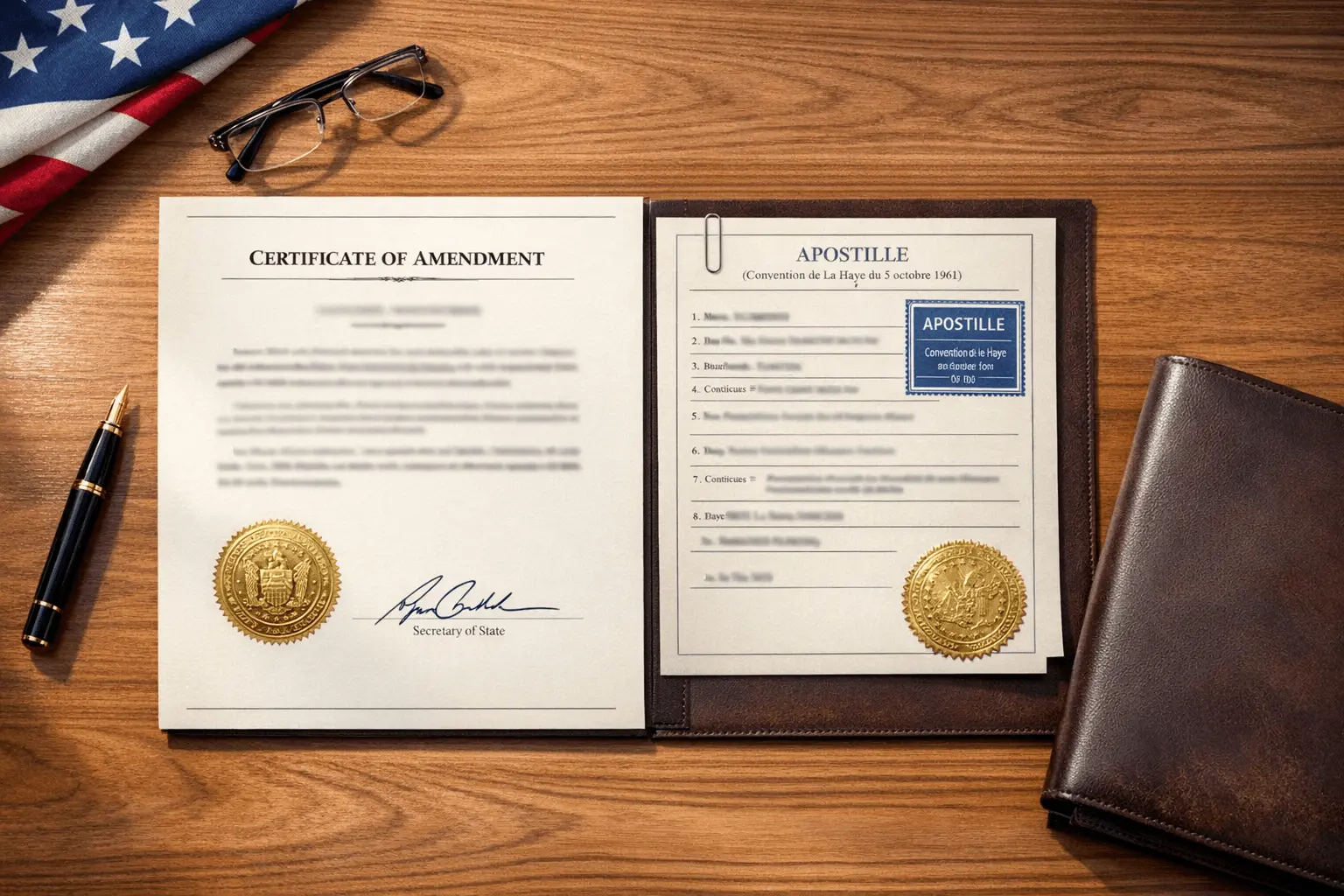
Using a Certificate of Amendment Overseas: Apostille Requirements
A name change, modified structure, or updated governance is an important milestone for your company. But that change must often be authenticated before it can be recognized beyond U.S. borders. That’s what a certificate of amendment apostille does. In this post, we’ll explore how a certificate of amendment records corporate evolution and the requirements to turn it into an internationally accepted document. Let’s map the path to seamless authentication together!
What Is a Certificate of Amendment, and What Changes Does It Record
A certificate of amendment is a state-issued document that records permanent updates to a company’s formation filing, such as the articles of incorporation. Think of it as a note of change, whether a new business name, an adjustment in ownership, or a reclassification of shares. Essentially, by documenting these revisions, your certificate of amendments ensures that corporate information remains accurate and compliant with both domestic and international rules.
When a Certificate of Amendment Is Required for International Use
When companies expand outside the U.S., foreign authorities often require a certificate of amendment as proof of corporate legitimacy. They want assurance that any changes to your company’s name or structure are legally binding. Here are the most common scenarios where you need an apostilled one for global use.
Foreign Government and Regulatory Filings
Many countries require the current legal identity of your company to be provided for registration. If the company name or business purpose has changed since initial formation, foreign authorities demand apostilled amendments that officially record such updates. The apostille reassures compliance officers that your corporate info is genuine and has been properly filed with the U.S. government.
International Banking, Finance, and Compliance Reviews
Banks and financial institutions abroad often request a certificate to verify corporate details when opening a bank account or securing a loan. The document provides the current authorized signatories, ownership, and share capital, ensuring compliance with foreign corporate laws. This is non-negotiable for establishing a good financial standing to operate successfully in another jurisdiction.
Cross-Border Contracts and Corporate Transactions
Disclosing the company’s constitutional documents, along with any authenticated amendments, is essential when entering into international agreements, including joint ventures, acquisitions, and mergers. It assures all parties that the corporate legal identity matches the record and the company has the capacity to perform such contracts or transactions, mitigating risk and facilitating smooth execution.
Subsidiary Registration and Branch Expansion Abroad
Launching an international presence through a subsidiary or branch office typically means creating a new legal identity as part of the parent U.S. company. Local authorities often request a set of corporate paperwork, including any certificates of amendment, to confirm the legal name, ownership, and structure of the parent entity. This step is crucial to the legal establishment of your overseas operations.
What Foreign Authorities Verify in a Certificate of Amendment
More than simply collecting your documents, foreign officials conduct due diligence based on the provided certificate of amendment.
- Confirmation of legal name and structural changes: Check whether the company’s present name matches what you present in your application.
- Validation of ownership, capital adjustments, or governance updates: Review changes related to directors, shares, and corporate purpose.
- Proof of proper filing with a U.S. state authority: Confirm that the amendment is a valid state record in the country of origin.
By verifying these critical elements, requesting authorities ensure they recognize a company that is legitimate and correctly represented before the law.
Determining the Correct Authentication Method for the Destination Country
The right path to authentication depends on the destination country’s membership status in the Hague Convention. For parties to the treaty, a certificate of amendment apostille issued by the relevant U.S. state is sufficient. Non-members require consular or embassy legalization instead. Distinguishing between these two groups is key to seamless acceptance of your corporate documents.
Step-by-Step Process to Apostille a Certificate of Amendment
Your certificate of amendments must be handled carefully to ensure its acceptance abroad. Understanding each link in the procedural chain — verification, submission, review, and delivery — allows you to prepare your document for international recognition without friction.
Verifying the Issuing State and Document Status
First, you’ll need to confirm the exact state that issued the certificate of amendment and whether it’s still valid. This involves checking that the amendment is complete and properly signed by a state official with a raised seal.
Submission to the Appropriate State Authority
The certificate must be submitted to the designated apostille office in the issuing state, typically the Secretary of State. Be aware that each state has its own request forms, fees, and submission methods. Filling out an incorrect form or making an inadequate payment will result in the package being rejected.
Processing, Review, and Issuance
The apostille authority conducts a formal review to see if the document meets all standards and compares it against state records. Upon validation, an apostille will be physically attached, demonstrating the authenticity of the paper for foreign use. Accuracy at this stage is critical to avoid rejection abroad.
Delivery and International Use
After issuance, the apostilled certificate of amendment is returned safely to the applicant. It should be forwarded to an overseas contact, be it a government agency, financial institution, or business partner. Correctly authenticated corporate paperwork streamlines international transactions by securing smooth recognition and compliance across borders.
State-Specific Considerations for Certificates of Amendment
It’s essential to recognize that there’s no single U.S. procedure for obtaining a certificate of amendment with an apostille. Each state operates its own distinct rules. These differences affect both the format of the certificate and the timeline for authentication.
Variations in Certification Formats by State
The certificate format differs by state. Some states issue amendments with raised or embossed seals, while others provide printed stamps or digitally certified electronic PDFs. Most importantly, the critical requirement is that the document submitted for apostille processing is a certified copy issued by the filing office.
Processing Times and State-Level Limitations
The processing schedule varies significantly among states. General processing time ranges from a couple of days to several weeks. With expedited services, you may expect your amendments to be apostilled in 1 to 3 business days. Furthermore, specific limitations might be imposed, such as a cover letter with particular wording or a submission coming directly from the company’s registered address.
Multi-State Companies and Governing State Rules
For businesses qualified to operate in multiple states, correctly identifying the governing state is essential. Apostille requests must be made in the state of incorporation or where the amendments were filed. Missteps here may lead to rejection by foreign authorities, underscoring the importance of meticulous document preparation for international authentication.
Translation Requirements for Overseas Use
Certified translations are sometimes mandatory, especially when the destination’s official language isn’t English. Specifically, the correct order is crucial — have the certificate translated by a linguist first, then authenticate the entire package. Be mindful of language-specific risks, as errors in legal or financial terms can create detrimental inconsistencies in corporate filings across borders.
Common Reasons Certificates of Amendment Are Rejected Overseas
Even when amendments are properly apostilled, foreign governments might still reject them if certain requirements aren’t fulfilled. These frustrating setbacks are almost always caused by preventable mistakes in preparation. The best defense against delays in international business is knowing the common pitfalls below.
Incomplete or Incorrect State Certification
One of the leading reasons for rejection is an improperly certified document. Foreign authorities may deem a certificate invalid if it lacks the official seal, authorized signature, or specific required formatting of the issuing state’s corporations division.
Inconsistencies with Other Corporate Records
Officials often cross-check an apostilled certificate against other corporate filings, such as articles of incorporation or shareholder agreements. A discrepancy in company names or ownership details would raise red flags and result in the refusal of your amendments. Hence, consistency across all corporate documents is crucial for international acceptance.
Apostille Not Accepted by the Destination Authority
While more than 120 countries recognize the apostille under the Hague Convention, others may require extra verification at the embassy or consulate. Sending apostilled amendments to a non-member nation can lead to rejection. It’s highly advised to confirm the right authentication path for the destination first.
Business Risks of Improperly Apostilled Corporate Amendments
Improperly apostilled certificates are more than just paperwork errors — they imply business liability.
- Delays in market entry and regulatory approval: Foreign regulators may refuse registrations or filings, which slows down expansion plans.
- Contractual and transactional consequences: Global partners might hesitate to finalize contracts if corporate papers appear invalid.
- Financial losses and reprocessing costs: Rejected amendments often need costly reprocessing to become acceptable, draining valuable resources.
Accuracy in the apostille process protects companies from these disadvantages and enables global operations to move forward unobstructedly.
Validity, Reuse, and Acceptance Abroad
An apostille itself doesn’t expire, but foreign governments may reject an older document if the corporate status has changed. In most cases, one apostille can be used for multiple filings in the same country, provided it meets all specific requirements of the requesting agency. However, a re-apostille is necessary if the underlying document is replaced or if you need to use it for various applications with distinguished submission standards.
Ready to Move Forward with Your Expansion Plans?
Global expansion shouldn’t stall because of paperwork. At EZ Apostille, we specialize in transforming your domestic certificate of amendment into an international document ready for acceptance wherever your business leaves a footprint. Explore your options and partner with us today!
FAQ
Preparing corporate documents for international use often raises practical questions about certificate of amendment apostilles. Here are the most common ones and their answers.
Can a Certificate of Amendment be apostilled if the company is inactive?
Typically, yes. As long as the certificate was properly filed with the state office, it can be authenticated even when the company is no longer in operation. However, the receiving authority may reject it if one of the requirements is verifying an active entity, which is a separate matter.
Does the apostille confirm the content of the amendment or only its authenticity?
The apostille validates the document’s authenticity at the time of issuance rather than the content. It confirms that the signature, stamp, or seal on the certificate is genuine and issued by the competent authority.
Can electronically issued Certificates of Amendment be apostilled?
This entirely depends on the issuing state. Certified electronic files can be apostilled if they carry an official digital signature or seal in certain states, while others may require physical copies with an ink signature and stamp. Always verify the acceptable format with the relevant authentication office.
Is notarization ever required for a Certificate of Amendment?
In general, notarization isn’t required because the certificate is a formal state-issued document, meaning it’s already certified. However, foreign jurisdictions might request notarization in some rare cases.
What happens if a foreign authority requests additional certification after the apostille?
You may need further authentication at the DOS or consular legalization, and this often happens when the destination country is a non-member of the Hague Convention. A third-party apostille service, like EZ Apostille, can guide you through these additional certification steps for guaranteed document recognition overseas.
Related Posts
FBI Background Check for Bulgarian Residency: What U.S. Applicants Need to Know

Getting Married Abroad: U.S. Documents Couples May Need