


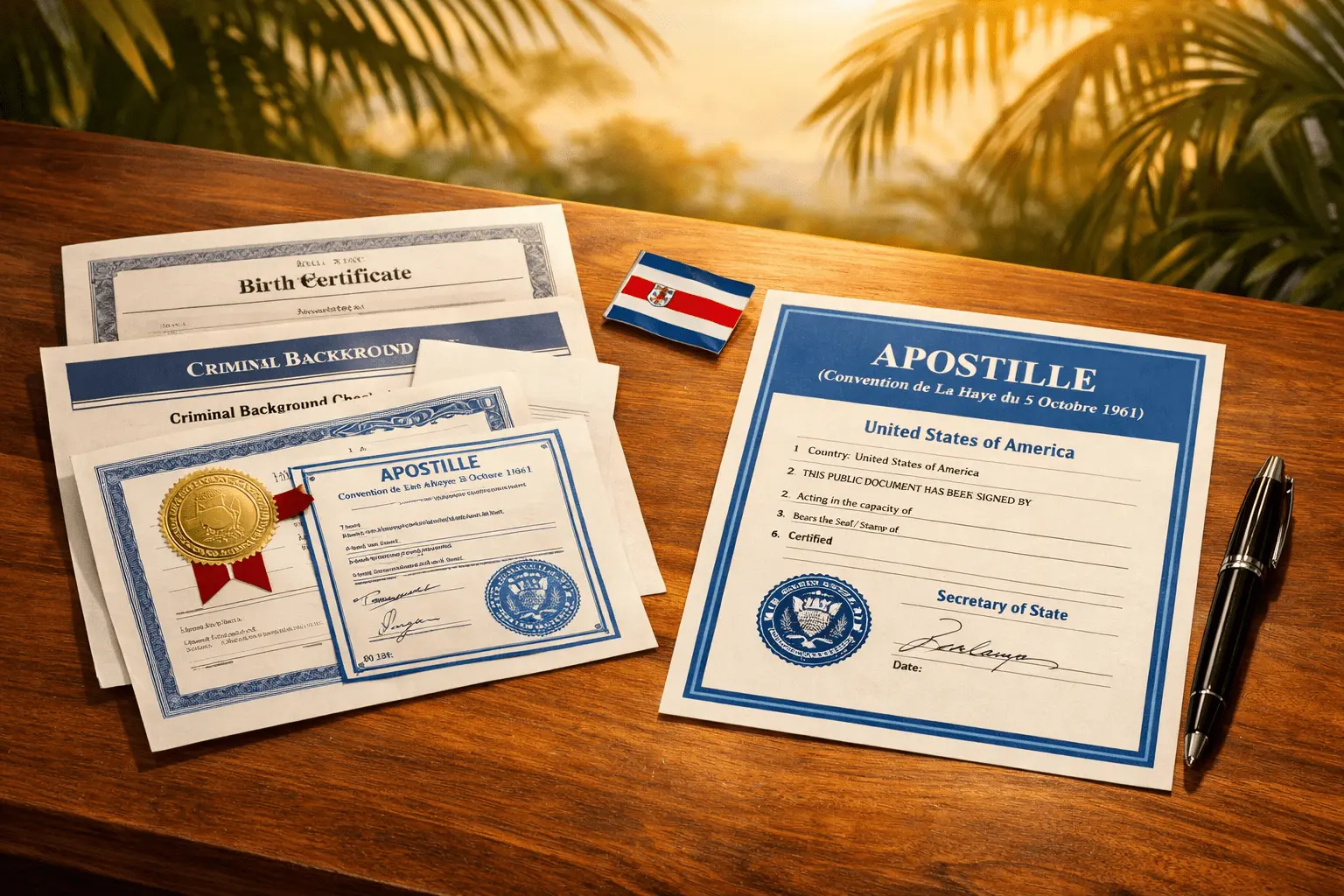
Apostille vs Legalization for Costa Rica: What You Need to Know
Planning to move to Costa Rica from the U.S.? Whether it’s for work or retirement, authenticating your paperwork is often the final hurdle before you can achieve your international goal. Most of the time, people are frequently confused between the apostille and legalization, making it crucial to differentiate these two authentication paths. That’s exactly what we’ll break down today in this post. Let’s demystify apostilles for Costa Rica so you can focus on your adventure abroad, not bureaucratic delays.
Why U.S. Documents for Costa Rica Require an Apostille Instead of Legalization
Here’s good news for you: Costa Rica is a member of the Hague Convention, which means U.S. documents intended for use there don’t need lengthy consular legalization. Instead, a single apostille issued by a competent public authority is sufficient for the paperwork to be recognized. This streamlined process makes it easier for anyone moving to Costa Rica, ensuring documents are accepted quickly without additional embassy steps.
Types of U.S. Documents Submitted to Costa Rican Authorities
Obtaining an apostille for U.S. citizens moving to Costa Rica involves common categories of documents that are routinely requested by Costa Rican immigration officials, employers, or educational institutions. Knowing which group your record falls into is half the battle won when preparing for an apostille submission.
Vital Records
Foundational documents are the most frequently requested ones for visa and residency applications. Examples include:
- Birth certificates
- Marriage certificates
- Divorce decrees
- Death certificates
For instance, a marriage certificate might be required to prove a marital relationship when applying for a spousal visa. The above records must be issued by an appropriate state office before they can be apostilled to be valid in Costa Rica.
FBI Background Checks and Criminal History Records
Proof of a clean criminal history is often required for immigration or highly regulated employment sectors, such as healthcare and education. This almost always means ordering an FBI Identity History Summary Check at the federal level or a state-issued criminal history record from a local sheriff’s department. Securing an apostilled criminal report reassures authorities that you have no disqualifying offenses and are eligible for residency or work permits.
Academic, Professional, and Employment Documents
Educational and professional credentials are necessary for jobs, work history recognition, or university enrollment in Costa Rica. This category includes:
- Diplomas and degrees
- Official transcripts
- State-issued professional licenses
- Letters of employment
A teaching position in Costa Rica might require candidates to submit an apostilled teaching certificate or degree. Apostilles validate these qualifications, ensuring they’re recognized by Costa Rican authorities without any extra verification.
Notarized Affidavits and Powers of Attorney
When presenting private documents before courts or other entities for property transactions, business dealings, or legal proceedings, they often have to be notarized and authenticated. Common examples are:
- Single status affidavits
- Powers of attorney
- Authorization letters
Ensure these are signed in the presence of an active commissioned notary public in your state to qualify for apostille processing.
Preparing U.S. Documents Before Apostille
It’s important to confirm that your U.S. documents meet the state or federal standards before requesting an apostille. Public records, such as birth or marriage certificates, must be submitted as certified copies issued by the state registrar. An FBI report can also be apostilled directly. On the contrary, private documents must be original, signed versions, such as notarized affidavits and powers of attorney.
Notarization must comply with U.S. laws, meaning it must be performed in the state where the document originated. The notary’s signature and seal must be legible, and the notarial wording must include the signer’s name, date, and a statement of the act. Improperly notarized paperwork typically results in rejection upon submission at the apostille office.
Spanish Translation Requirements in Costa Rica
Many Costa Rican authorities require U.S. documents to be translated into Spanish before they can be used for legal purposes. This must be performed by certified translators, especially for sensitive documents like vital records, background checks, and academic credentials. Non-certified translations might be accepted for informal purposes, but they won’t be recognized in courts or immigration filings.
The correct order should be (1) obtain the document, (2) have it translated into Spanish by a certified professional, and (3) submit the document along with the certified translation for apostille processing. In rare cases, the receiving institution might ask for a translation after an apostille is approved, so it’s best to check the specific requirement first before engaging a translation service.
What Happens After a Document Is Apostilled
Once your U.S. paperwork receives an apostille, it becomes legally valid for use in Costa Rica. You’re responsible for delivering the apostilled document to the requesting authority safely. The relevant officials will then review the authenticity of the apostille by checking the unique reference number on the official registry. Upon verifying that all your information matches what is on file, the apostilled record will be accepted without further verification steps.
For those moving to Costa Rica from America, apostilled birth certificates or FBI background checks are often prerequisites for ongoing legal procedures, including property purchases and employment filings. In some cases, certain agencies in Costa Rica might request local certification, such as a verifying signature from a local lawyer, but the apostille always serves as the foundation for any additional certifications in the receiving country.
Apostille Costs and Processing Time
Costs and timelines for apostilling documents for Costa Rica aren’t one-size-fits-all. They depend entirely on the issuing authority of your paperwork. Knowing these details beforehand helps you plan your budget better and avoid last-minute delays, especially if you’re preparing for deadline-driven matters like immigration or residency.
Typical State-Level and Federal Apostille Fees
State-issued records generally cost between $5 and $20 for standard apostille processing, depending on the Secretary of State’s office. Federal documents, including FBI background checks, are processed through the DOS, and typically cost more, starting at $20 per apostille. Note that this is only the government fee. You’ll also need to factor in mailing expenses and professional service charges if you choose to rely on the experts to manage the process.
Average Processing Timeframes
State-level apostilles are usually completed within 5 to 15 business days, excluding mailing time. Expedited options may be available in certain jurisdictions for an additional fee. Federal documents take longer to process, typically more than 5 weeks, depending on demand. Planning at least 2 months before your departure day or document submission deadline is highly recommended.
When Professional Apostille Assistance Is Helpful
Though the apostille process is straightforward to handle on one’s own, many real-life situations can benefit from expert guidance in terms of location, timing, and costs. Professional assistance is particularly valuable in these cases:
- Multiple or mixed U.S. document packages: Coordinating various types of paperwork or documents issued by different states can be complex.
- Time-sensitive residency or immigration filings: Specialists know the shortcuts to accelerate approval, avoiding costly delays from minor errors.
- U.S. citizens residing outside the United States: Handling document authentication is challenging without local support.
Ultimately, the right apostille partner transforms an unsettling task into a streamlined, empowering experience for your new beginning in Costa Rica.
Get Expert help with Apostilles for Costa Rica
Navigating the apostille process for your move or legal plans abroad doesn’t have to be a solo effort. You can cross this item off your to-do list with expert knowledge and personalized support at EZ Apostille. Contact us today for a free, no-obligation quote to get your Costa Rica journey started on solid ground!
FAQ
Worrying that your apostilled paperwork might be rejected overseas is normal, especially if this is your first time doing authentication. Below are answers to the most common concerns for Americans moving to Costa Rica.
Can someone else submit my U.S. documents for apostille on my behalf?
Absolutely. You can authorize a trusted individual, such as a family member or friend, or a professional service like EZ Apostille to act on your behalf during the state submission. This is particularly helpful if you’re currently out of state or living abroad.
Does Costa Rica accept electronic or digital apostilles issued in the U.S.?
Yes. Costa Rica accepts e-Apostilles issued in the U.S. under the Hague Convention. However, it’s best to confirm with the receiving authority first whether they prefer printed copies for official filings.
Can one apostille be reused for multiple Costa Rican applications?
No. Each apostille certification is physically affixed to a document, so you can’t make copies of the same apostilled paper for official use at multiple agencies. If you need to submit the same record for more than one application, you must obtain separate certified copies and apostilles.
What happens if a U.S. document is notarized incorrectly?
Incorrect notarization is one of the most frequent rejection reasons. You should have the document re-notarized properly before sending an apostille request.
Do apostilled U.S. documents ever need to be re-apostilled?
Generally, no. An apostille technically doesn’t expire unless the underlying document becomes outdated. For instance, an old background check must be replaced by a fresh one that has been issued within the last 6 months to be considered valid. This means you’ll need to obtain a new document and, consequently, a new apostille for it.
Comments
Submit a Comment
Related Posts
FBI Background Check for Bulgarian Residency: What U.S. Applicants Need to Know

Getting Married Abroad: U.S. Documents Couples May Need

Hi, I would like to do Apostille for a POA for my lawyers in Jakarta.
Could you do it tomorrow? How much is it ? And how long will it take ?
Hello Jenny,
Yes we can do it same day as long as submissions are received before noon EST. Just submit your request here. Our staff takes about 5 minutes on average to respond to new orders.
Best regards,
Brandon