Apostille for New Zealand: A Complete Guide for U.S. Documents
If you’re planning to move to New Zealand or need to send U.S. documents there for legal, educational, or business use, you’ll likely need an apostille for New Zealand. This special certification proves that your U.S. documents are official and can be trusted by local institutions. Without one, your paperwork could be delayed, rejected, or returned.
In this guide, you’ll learn which documents commonly require apostilles, how to prepare them, and the best way to avoid delays.
Why U.S. Documents Often Require an Apostille for New Zealand
If you’re moving from the U.S. to New Zealand, you may be asked to submit official documents that prove your identity, education, legal status, or business activity. But before New Zealand can use these documents, they have to be verified through an apostille.
Because both the United States and New Zealand are members of the Hague Apostille Convention, apostilles are the agreed method of verifying official documents between the two countries. Without one, even valid documents may be considered incomplete.
Apostilles are often required for visa applications, school enrollment, family reunification, property transactions, and cross-border business. Taking care of this early on can make the process of a U.S. citizen’s move to New Zealand far easier.
U.S. Documents Commonly Apostilled for Use in New Zealand
When sending paperwork abroad, not everything needs to be apostilled. But certain document types are frequently requested by New Zealand authorities.
Personal Vital Records
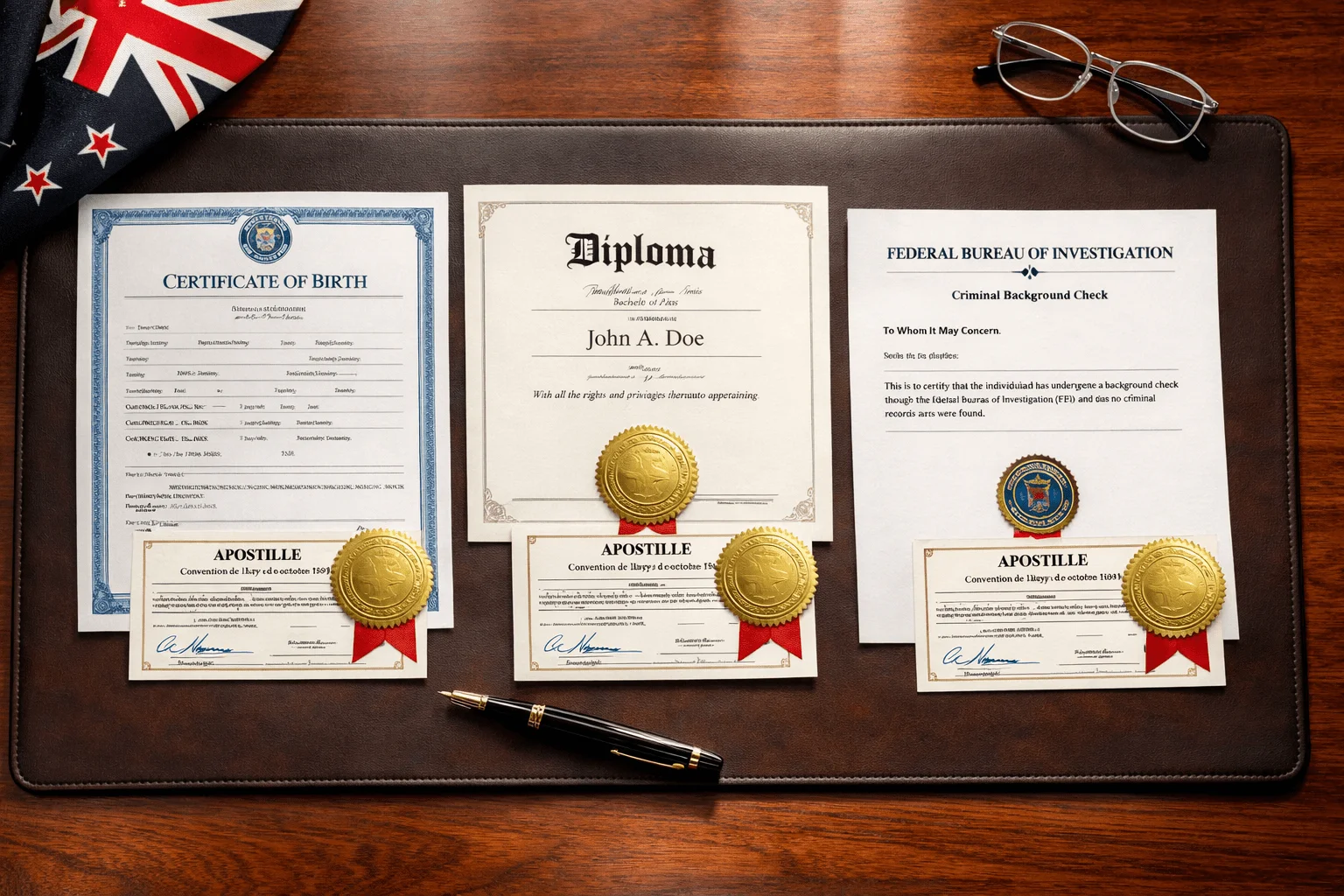
These include death certificates, divorce decrees, marriage certificates, and birth certificates. If you’re immigrating or enrolling children in school, these are often the first documents you’ll need. They have to come as certified copies from the proper state office.
Educational and Professional Documents
If you’re applying to study or work in New Zealand, expect to submit diplomas, transcripts, teacher certifications, or professional licenses. Most of these require notarization before they can be apostilled, and in some cases, they need to be signed by a registrar or school official.
Business and Corporate Documents
Companies expanding to New Zealand will need to apostille items like articles of incorporation, certificates of good standing, commercial invoices, and corporate powers of attorney. They help verify that your business is legitimate and operating in line with U.S. regulations.
Court, Government, and Notarized Documents
This category includes name change orders, adoption papers, FBI background checks, and affidavits. Some are provided by your state, while others have to be obtained from federal agencies. You’ll need to follow the correct process based on where your document originated.
How to Obtain an Apostille for New Zealand
Getting an apostille might seem complicated at first, but the process is fairly simple when you take it step by step. Here’s how to do it right.
Step 1: Verify That Your Document is Acceptable for an Apostille
Start by checking if your document qualifies. It must be an official record signed by a state or federal official or notarized correctly. Photocopies or unofficial versions won’t be accepted unless properly certified.
Step 2: Determine Whether Notarization or a Certified Copy is Needed
For items like vital records, you’ll need certified copies issued straight from the original office. Others, such as bank statements or diplomas, must be notarized. If you’re unsure, confirm the requirement with your apostille authority or the person requesting the document in New Zealand.
Step 3: Submit the Document to the Correct Apostille Office
Where you send your paperwork depends on the type of document. If your document comes from a state office, it should be submitted to that state’s Secretary of State. For federal documents, like FBI background checks, submit them to the U.S. Department of State in Washington, D.C. Each office has its own forms, fees, and processing times.
Step 4: Receive Your Apostilled Document and Prepare It for New Zealand
Once processed, your apostille will be attached to the original document. Do not remove it. The certified document can now be submitted to the proper institution in New Zealand. Use tracked shipping, especially if you’re sending originals abroad.
Practical Tips to Prevent Delays
Even small errors can delay your U.S. document apostille for New Zealand. Whether it’s an outdated certificate, a missing signature, or the wrong submission method, these mistakes can cost you time and money. The good news is that with a few simple precautions, you can avoid most issues and move through the process smoothly.
Understand Your State’s Specific Requirements
Before submitting your documents, it’s important to check the apostille rules in the state where they were issued. States create their own guidelines, and they don’t always line up with one another. Some states allow notarized copies of certain documents, while others require certified originals only. Others may demand extra supporting forms or limit the types of notaries that are accepted.
Submission methods also differ — some states offer online applications or in-person drop-offs, while others require mailing everything in. Always visit the official website of the Secretary of State to get the most accurate and updated instructions before you proceed.
Build In Time for Processing and Delivery
Delays often happen when applicants underestimate how long the full process takes. State-level apostilles typically take 1 to 3 weeks, while federal processing can take several weeks or longer, depending on current backlogs. That doesn’t include the time it takes to mail your documents to the U.S. and then ship them back to New Zealand.
If you’re working with a deadline — such as a visa interview, school start date, or business registration — be sure to factor in extra time for unexpected slowdowns, such as postal delays or processing backlogs. Using tracked or express shipping services is also recommended when sending original documents.
Consider Using a Professional Apostille Service
If you’re abroad or simply don’t have time to manage the paperwork yourself, working with a professional apostille agency can save you stress, time, and unnecessary setbacks. At EZ Apostille, we handle every step of the process for you — from reviewing your documents to submitting them to the correct state or federal office.
Our team stays up to date on each state’s requirements, helps prevent common errors, and ensures your documents are prepared exactly the way U.S. authorities need them. We also provide secure handling, faster processing options, and real-time tracking so you always know where your paperwork stands.
Typical Costs and Processing Times
Apostille costs depend on where and how your document is submitted:
- For state-level apostilles, you can usually expect fees in the $10–$25 range per document.
- Federal apostilles cost $20 through the U.S. Department of State
- Expedited processing, if offered, can add $25 to $75
Processing takes 1 to 3 weeks for state-level requests and 3 to 5 weeks or longer for federal documents. Delays often happen when documents are incomplete, incorrectly notarized, or missing fees.
Other possible costs include:
- Courier or express shipping
- Certified copies of records
- Translation services (if needed into Māori or another language)
To avoid last-minute surprises, confirm all requirements and build extra time into your planning.
What to Keep in Mind Moving Forward
Getting an apostille for New Zealand is a necessary step when using U.S. documents overseas. Whether you’re starting a job, applying for a visa, studying abroad, or expanding a business, apostilled documents are required for your paperwork to be accepted.
By preparing early and understanding what’s needed, you can avoid delays and simplify your transition. Apostilles help ensure your documents are trusted by New Zealand institutions, so getting them right the first time makes all the difference.
FAQ
Can older U.S. documents still be apostilled for New Zealand?
It depends. Some New Zealand authorities accept older documents, but many prefer versions issued within the last 3 to 12 months. Always check with the receiving party.
Is any additional legalization required after obtaining the apostille?
No. Because both countries are part of the Hague Convention, an apostille is the final step. No further consulate or embassy legalization is needed.
What happens if I submit a notarized U.S. document without an apostille?
The document will likely be rejected. A notarization alone doesn’t meet international standards. The apostille confirms the notary’s authority.
Will New Zealand accept U.S. documents that have electronic apostilles (e-Apostilles)?
Some U.S. states issue e-Apostilles, which New Zealand accepts as long as they meet Hague standards.
Can I apostille multiple U.S. documents together, or is one needed per item?
Each document must receive its own apostille. You cannot combine multiple documents under one certification. Keep each document with its matching apostille when submitting.
Related Posts
FBI Background Check for Bulgarian Residency: What U.S. Applicants Need to Know

Getting Married Abroad: U.S. Documents Couples May Need